
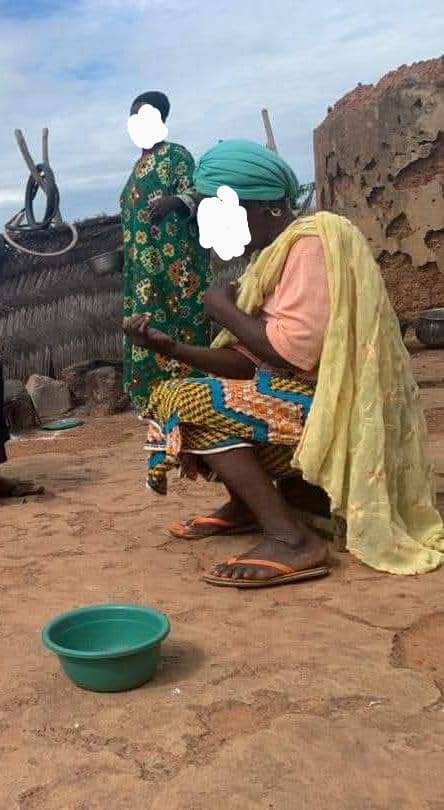
Tucked deep in the savannah belt of the Northern Region of Ghana, the small town of Kpatinga in the Gushegu District is a community where the sun sets over dusty paths, mud-walled homes, and centuries of tightly held traditions. Life here is communal, simple, and largely agrarian. The majority of residents survive on subsistence farming, with few access routes to secondary education or formal employment. In Kpatinga, cultural beliefs still hold more sway than state policies, and this is nowhere more visible than in how women who struggle with infertility are treated.
The Pain Beyond the Body
For Fatima Alhassan (Not her real name), a 42-year-old resident of Kpatinga, the scars she bears are not visible. Married at the age of 20, she spent more than two decades enduring ridicule, spiritual accusations, and even physical isolation, all because she was unable to bear a child. “People say I’m cursed,” she says softly. “They whisper when I walk past. Some even avoid eating my food.”
Fatima’s story is not unique. In Kpatinga, and many parts of Northern Ghana like Karaga, Saboba, Tatale, Yendi and so on, infertility is viewed not as a medical condition but as a spiritual flaw. Women like her are often labeled as Son-ya (witches), believed to have exchanged their fertility for powers, or accused of eating the unborn children of others through supernatural means.
When Stigma Becomes a Sentence
The consequences of such stigma can be devastating. Some women are chased out of their marital homes. Others are banished to so-called “witches camps” in the same village of Kpatinga or nearby areas like Gambaga or Kukuo. The communal shame inflicted on women struggling with infertility affects their mental health, dignity, and sense of belonging.
In a society where motherhood is often considered the ultimate validation of womanhood, infertility becomes a social death sentence. “A woman’s worth here is tied to how many children she can bear, especially sons,” says Zulaiha Nantogmah, a local women’s advocate. “Once you’re labeled as barren, you become an outcast.”
Lack of Education, Abundance of Misconception
A key driver of this stigma is the widespread lack of education. The Gushegu District, like many rural areas in the Northern Region, has low female literacy rates. According to Ghana Statistical Service reports, only a small percentage of women complete secondary education in this part of the country. Without access to sexual and reproductive health information, infertility remains shrouded in myth and misinformation.
Basic facts about conditions like fibroids, hormonal imbalances, or male infertility are absent from community conversations. Instead, infertility is viewed through a supernatural or moral lens. “They say it’s punishment for being disrespectful, or that it’s the result of abortion in the past, even when that’s not true,” Zulaiha explains.
A Voice from the Minaret
But even within these traditions, there are voices pushing for change. One such voice is that of Sheikh Mohammed Abdul-Rahman, a respected Islamic cleric based in Tamale who frequently visits rural communities including Kpatinga.
“In Islam,” Sheikh Abdul-Rahman says, “children are a gift from Allah. But not every servant is given the same gift. This is not a curse, and certainly not a reason to punish women. The Prophet Muhammad (peace be upon him) taught us to be compassionate.”
He adds that the Quran does not support the accusations that women without children are witches. “This belief has no basis in Islam. Education is key. If we can teach our people the truth from both science and scripture, we will break these harmful cycles.”
Breaking the Silence
Organizations like Savana Signatures and Songtaba have begun grassroots efforts to challenge infertility stigma in the Northern Region. Through radio sensitization, community dialogues, and partnerships with religious and traditional leaders, they are opening up space for empathy and understanding.
Fatima, who once considered ending her life, now volunteers as a peer advocate in Kpatinga. She visits other women affected by infertility, encouraging them to speak out and seek medical assistance. “Our silence gave power to the stigma,” she says. “Now, our voices must break it.”
The Road Ahead
Tackling the stigma of infertility in places like Kpatinga requires more than awareness, it needs policy change, increased access to reproductive healthcare, and continued religious engagement. But most importantly, it demands a shift in how communities view womanhood and worth.
As Fatima walks through the same dusty path where she once endured whispers, she holds her head higher than ever before. “I may not have children,” she says, “but I have found my purpose, and no one can take that from me.”
(Name changed to protect identity.)
By: Prince Kwame Tamakloe/Rainbowradioonline.com/Ghana