
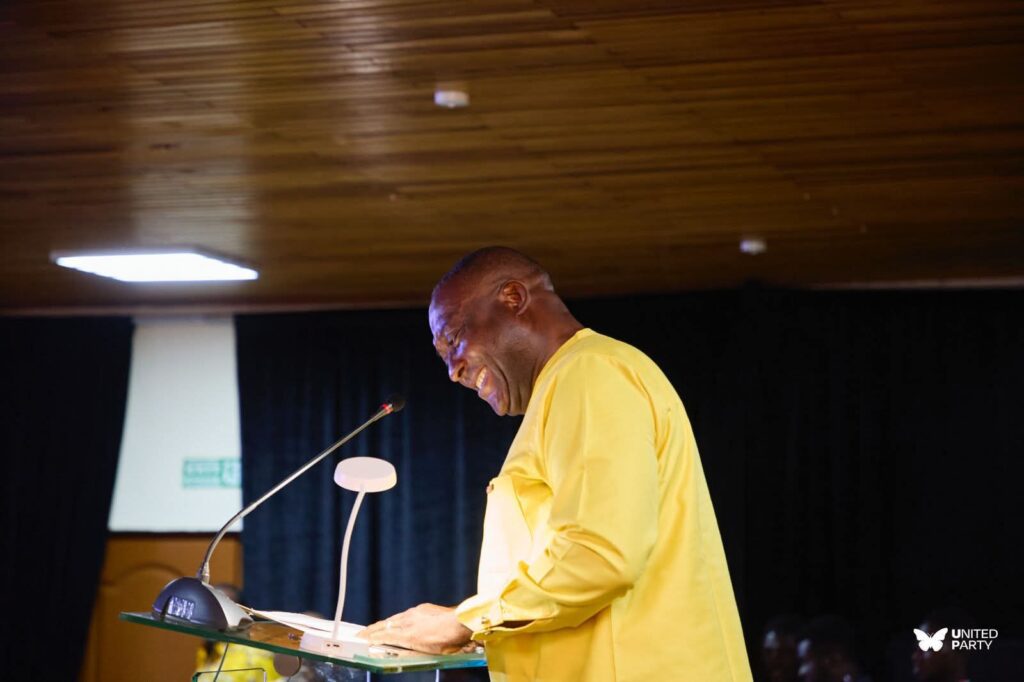
Yaw Buaben Asamoa, the Interim General Secretary of the United Party (UP), has formally proposed the abolition of Ghana’s Council of State as a key part of the party’s constitutional amendment agenda.
This proposal was presented during the party’s official launch on Thursday, October 16, 2025.
The United Party, which was established by former Trade and Industry Minister Alan Kyerematen following his departure from the New Patriotic Party (NPP) and its subsequent emergence from the Movement for Change, contends that the Council of State is a high-cost, underutilized body that wields minimal moderating influence on the broad powers of the President.
To address this, the party seeks to replace the Council with a more effective second legislative chamber by amending Articles 89 and 92 of the Constitution to provide the necessary legal backing.
The objective of this new chamber would be to transition its function from non-binding presidential advisory and consultative roles to an enhanced participatory role, thereby deepening the independence of constitutional bodies, moderating the appointment powers of the Presidency, and strengthening the supervisory and oversight functions of the state.
Mr. Buaben Asamoa proposed that the new chamber’s membership should be broadly representative, drawing from organized civil society, stakeholder groups, and the private sector, including, but not limited to, traditional authorities, faith-based organizations, professional bodies, artisanal associations, farmers and fisherfolk, labour unions, academia, advocacy organizations (such as those representing students, youth, and women), Ghanaians living abroad, and Persons With Disabilities (PWDs).
The party leader noted that this proposal aligns with the evolving role of civil society participation, moving beyond consultation and protest to a broader, more formal inclusion in the processes of policy formation, analysis, monitoring, and evaluation of policy outcomes.
On the functions of the new chamber, the United Party stated:
i. Legislative Input – Review and offer opinions on bills passing through Parliament, upon referral from the Presidency, Speaker, or any member of Parliament or the Public. Referral terms of review criteria would be set out in extenso, to avoid deliberate process manipulation. (Article 90 and 106(7)(b)(8)(9), 290(2))
ii. Concurrent Approval of Agreements – Debate, input, review, and approve concurrently international loans and financial agreements, investment, and resource agreements. (Article 181 to be amended).
iii. Legislative Input/Budgetary Approval – Approval of the Administrative and Operational Budgets of the Central Government, Judiciary, Parliament, and ICBs in a ‘Joint Committee’ with Parliament in consultation with the Minister responsible for Finance. Relevant budget provisions include Articles 179(3)(4)(5) and (6), as well as 145 and 149, in respect of the Judiciary, 54 in respect of the Electoral Commission, 124(5) for Parliament, 171 in respect of the National Media Commission, 187(14) for the office of the Auditor General, 227 for CHRAJ, and 239 for the NCCE.
iv. Oversight – Receive and review for action periodic performance reports from the ICBs, the Judiciary, the Public Services Commission, and Public Corporations within the meaning of Articles 190(1)(b) and 192.
v. Appointments – In consultation with the Public Services Commission, make appointments for the following:
- The Chair, two Deputy Chairs, and four other members of the Electoral Commission (Article 43)
- The Commissioner for CHRAJ and two Deputies (Article 70(1)(a))
- The Chair, two Deputy Chairs, and four other members of the NCCE (Article 232)
- The Auditor-General (Article 70(1)(b))
- The District Assemblies Common Fund Administrator (Article 70(1)(c))
- The Chair and other members of the Public Services Commission (Article 70(1)(d)(i))
- The Chair of the National Development Planning Commission (Article 86(2))
- The Chief Justice with the approval of Parliament (Article 144(1))
- Other Justices of the Supreme Court upon the recommendation of the Judicial Council and the approval of Parliament (Article 144(2))
- Justices of the Court of Appeal, High Court, and Chairmen of Regional Tribunals upon recommendation of the Judicial Council (Article 144(3))
- After appointment and approval, Justices of the Superior Courts and Chairmen of Regional Tribunals shall receive warrants of office under the hand of the President and sealed by the Presidential seal
- Acting appointments upon the advice of the Chief Justice and recommendation of the Judicial Council (Article 144(9)(10)(11))
- Retain Article 183(4)(a) with the appropriate designation for the ‘Second Chamber’.
- Retain Articles 185(3) and 186(1)(a) with the appropriate designation for the ‘Second Chamber’.
- The Inspector General of Police (Article 202(1)) and the Director General of the Prisons Service (Article 207(1)).
- Add new provisions to cover the appointment of the Heads of the Immigration and Fire Service.
- Retain Article 212(1) on the appointments of the Heads of the Armed Forces with the appropriate designation for the ‘Second Chamber’.
ACCOUNTABILITY
a) Development of Procedures and processes (in subsidiary legislation): for nominations, interviews, and assessments. The entire work of the Second Chamber shall be guided by Orders and Guidelines.
b) Public sittings, except in sensitive matters.
c) Tenure: by nomination from distinct organized civil society shareholder groups on a rotational basis for a renewable two-year term at the discretion of the relevant stakeholder group. The determination of expenses and allowances would be by the Empowered Fair Wages and Salaries Commission.
By: Rainbowradioonline.com/Ghana