
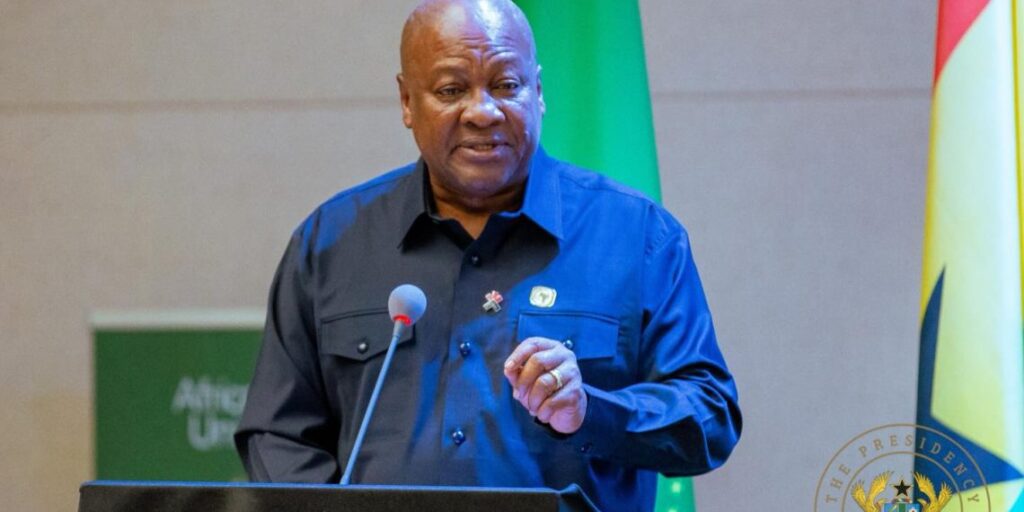
President John Dramani Mahama has highlighted the escalating role of chieftaincy and land disputes in driving national instability, advocating for a more robust partnership with traditional authorities to mitigate these tensions.
He expressed these concerns during a formal engagement with the Eastern Regional House of Chiefs, where the dialogue centred on national security, regional development, and the evolving responsibilities of traditional leaders.
During the meeting, the President observed that disputes rooted in chieftaincy and land boundaries continue to pose a significant threat to peace across various regions. Addressing the delegation, he remarked, “One area of concern is security and conflict, and we realise that a major contributor to conflicts across the country is the chieftaincy institution and issues of land boundaries.”
While acknowledging the gravity of these conflicts, President Mahama clarified that the government’s capacity for direct intervention is strictly governed by legal frameworks.
He explained, “The 1992 Constitution barred government from interfering in chieftaincy matters and said that issues of chieftaincy disputes should be handled by the chiefs themselves.” He further noted that “Government only intervenes when law and order breaks down, but we cannot interfere in the customs and usages of the chieftaincy institution.”
To resolve these recurring issues, the President emphasised the necessity of a collaborative approach between the state and traditional bodies. “We believe that it is something we need to work on with the National House of Chiefs and the Regional Houses of Chiefs,” he stated.
Transitioning to economic matters, President Mahama asserted that Ghana is nearing pivotal milestones, specifically citing the conclusion of its programme with the International Monetary Fund. He informed the House, “We are coming out of the IMF programme. It is coming to an end, with the final review expected next month.”
He maintained that the government is committed to long-term stability, adding, “But beyond the programme, we intend to keep the fiscal discipline that has resulted in the stabilisation of the macroeconomic environment.”
The President also reaffirmed his administration’s dedication to enhancing healthcare infrastructure, particularly within the newly created regions.
He confirmed that plans to construct several regional hospitals are well underway for the current year. “The other new regions that are going to receive regional hospitals… we are starting with three of the regional hospitals this year, and next year we will cut sod for the next three,” he promised.
Regarding the Eastern Regional Hospital, which has faced significant delays, he assured the chiefs that progress is being revitalised, stating, “The Eastern Regional Hospital stalled a bit. I have asked that the contractor go back to the site and we pay him so that we can complete it.”
On the subject of education, the President pledged to accelerate the establishment of new institutions to broaden access to tertiary learning. He referenced a recent diplomatic visit to South Korea as a catalyst for these plans, noting, “Recently I was in Korea, and we discussed the issue of the University of Engineering, Science and Agriculture in Bonsu.”
He stressed the urgency of the project, stating, “That is an institution we are activating as quickly as possible so that we can create more room for our young people who are seeking tertiary educational opportunities.”
By: Rainbowradioonline.com/Ghana