
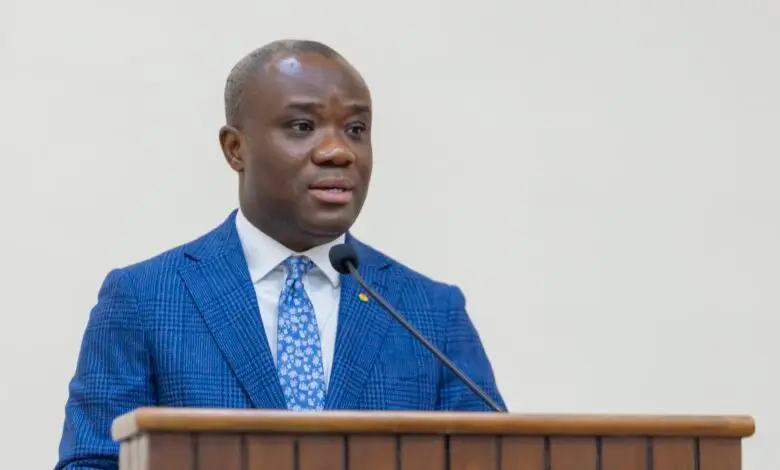
Government spokesperson and Member of Parliament for Abura Asebu Kwamankese, Felix Kwakye Ofosu, has asserted that the proliferation of disinformation poses a critical threat to Ghana’s democracy, national security, and public health.
Addressing guests at a ceremony hosted at the British High Commissioner’s residence to mark World Press Freedom Day on Wednesday, 6 May 2026, he argued that the nation is currently grappling with an “information integrity” crisis exacerbated by fabricated news, manipulated media, and politically motivated falsehoods.
He observed that the digital landscape has fundamentally altered the speed at which inaccuracy spreads, noting that “We now live in an age where a single falsehood can travel around the world in seconds while the truth is still putting on its shoes.”
In his assessment, orchestrated disinformation campaigns, deepfakes, and clickbait are not merely nuisances but dangerous instruments capable of inciting political and ethnic friction. He further underscored the gravity of the situation by stating, “This is not just a media problem. It is a national security problem. It is a public health problem, and it is a democratic problem.”
The spokesperson warned that these deceptive practices possess the potential to erode public confidence, weaken state institutions, and jeopardise democratic stability. He maintained that
“When citizens cannot tell what is true and what is false, trust erodes,” adding that “And when institutions become weak, democracy becomes fragile.” Despite these risks, he cautioned against the use of censorship as a remedy, arguing that “Censorship breeds suspicion and drives information underground.”
Instead of restrictive measures, he advocated for the delivery of “better information and faster” responses. He drew a sharp distinction between state censorship and necessary legal action against the criminal exploitation of digital platforms.
“As a government, we remain acutely aware of the need to act swiftly to stem the tide of misinformation,” he affirmed, noting that the government communication office under his leadership has prioritised the proactive and timely release of accurate data.
He reiterated the administration’s commitment to upholding press freedom and the rights of the media.
He insisted that “Journalism is not the enemy of governments. Good journalism is actually an ally,” explaining that “When a reporter investigates a contract gone wrong, they are not attacking the state.
They are protecting the taxpayer.”
He further provided assurances that no member of the press would be “harassed, detained or threatened for doing lawful work.”
Turning his attention to the industry’s responsibilities, he urged journalists and media organisations to maintain the highest standards of ethics and accuracy.
He warned that “Publishing unverified allegations, amplifying disinformation for engagement, that is not dramatic, that is harm.”
Consequently, he called upon the Ghana Journalists Association and the National Media Commission to strengthen self-regulation and rigorously enforce professional standards, advising that
“Public trust is your greatest capital. Do not spend it for a headline.”
In his concluding remarks to state institutions, he emphasised that “The Ghanaian public deserves straight talk.”
He reminded the audience that “Democracy is not a gift that lasts forever. It is a practice that must be renewed every day, and journalism is one of the daily practices that keeps it alive.”
By: Rainbowradioonline.com/Ghana