

A nationwide poll conducted by the Institute of Economic Affairs (IEA) reveals that a majority of Ghanaians continue to back President John Mahama eighteen months into his administration, driven largely by positive shifts in key economic indicators.
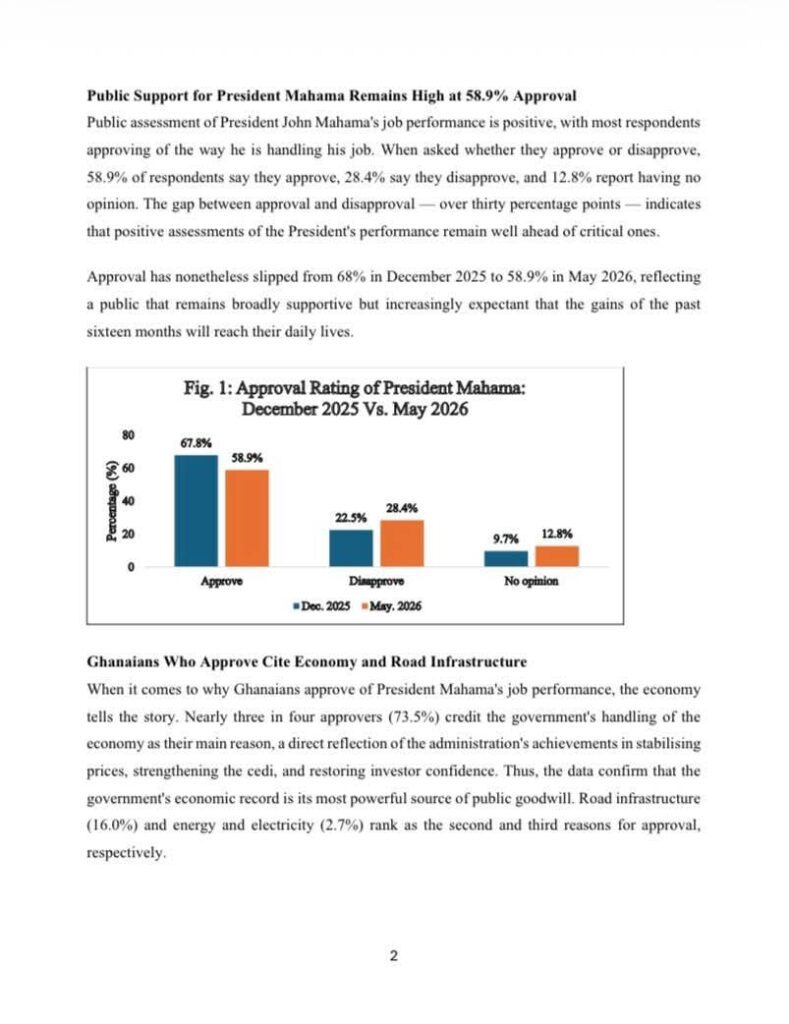
The survey, which covered over 1,000 respondents across all sixteen regions of Ghana in May 2026, found that President Mahama commands a 58.9% job approval rating.
According to the IEA, this strong public backing is anchored heavily to the administration’s macroeconomic achievements since taking office in January 2025, which include a dramatic drop in inflation from 23.5% to roughly 3.4%, a 26% appreciation of the cedi, and significant cuts to the central bank’s policy rate.
These fiscal gains recently triggered a rare triple sovereign credit rating upgrade from international agencies Fitch, Moody’s, and S&P.
However, the findings also signal emerging challenges for the executive. While the gap between approval and disapproval remains wide at over thirty percentage points, the President’s approval rating has dipped from the 68% recorded in December 2025.
The IEA noted that this shift reflects “a public that remains broadly supportive but increasingly expectant that the gains of the past sixteen months will reach their daily lives”.
The data highlights a unique dichotomy in public perception regarding the state of the economy.
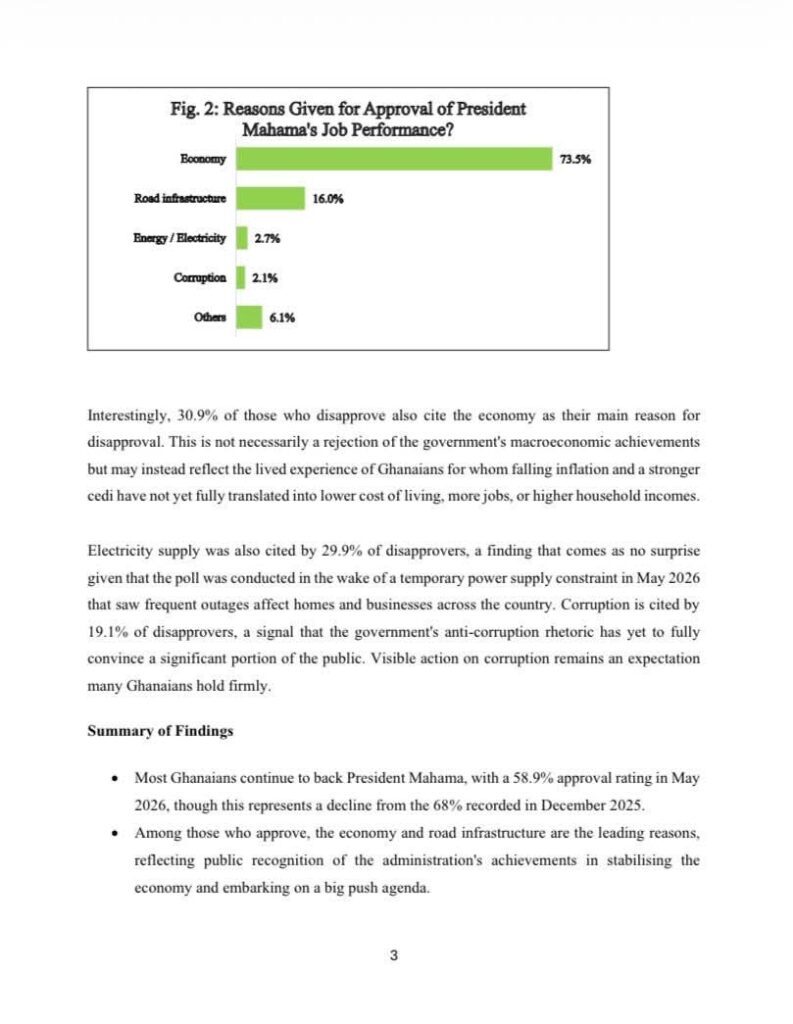
Among the respondents who approve of the President’s performance, nearly three in four credit the government’s handling of the economy as their primary reason.
Conversely, the economy was also cited by 30.9% of those who disapprove of his stewardship. The report explains that this dual sentiment “is not necessarily a rejection of the government’s macroeconomic achievements but may instead reflect the lived experience of Ghanaians for whom falling inflation and a stronger cedi have not yet fully translated into lower cost of living, more jobs, or higher household incomes”.
Beyond economic indicators, infrastructure and utility performance heavily influenced respondent sentiment.
Road infrastructure stood out as the second-highest driver for approval at 16.0%. On the flip side, power reliability and governance remain friction points.
Nearly 30% of disgruntled respondents cited electricity supply as their main grievance, following a wave of temporary power constraints and frequent outages that hit homes and businesses during the month of the poll.
Additionally, 19.1% of disapprovers pointed to corruption, signaling that “the government’s anti-corruption rhetoric has yet to fully convince a significant portion of the public”.



By: Rainbowradioonline.com/Ghana