
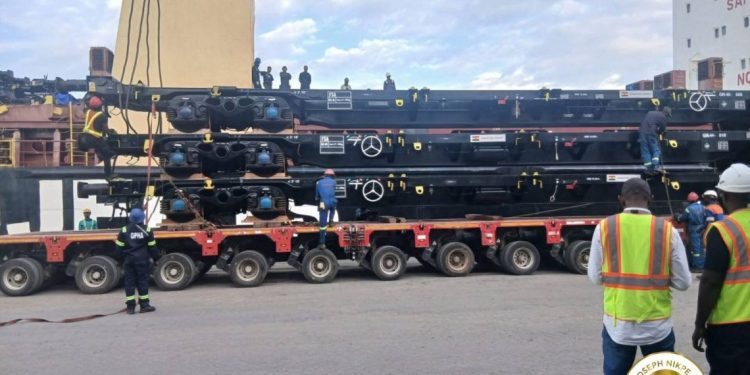
The members from the Minority on the Transport Committee of Parliament has strongly criticised the Government of Ghana’s recent rail procurement, labelling the newly acquired locomotives “museum toys” that threaten to drain taxpayer funds.
The dispute follows an announcement last month by the Ministry of Transport, led by Hon. Joseph Bukari Nikpe, celebrating the arrival of two locomotives and 20 cargo wagons.
Government officials championed the fleet as a major success capable of boosting freight capacity, stimulating economic growth, and removing heavy trucks from the national road network.
However, an “independent investigation” said yo have been conducted by the opposition committee reportedly revealed that the rolling stock consists of refurbished, secondhand British Rail Class 56 diesel-electric units manufactured between 1976 and 1983.
With fewer than 15 of the 135 originally built units remaining operational worldwide, the committee warned that the “40-year-old technology” faces severe structural and financial challenges.
In a signed statement, committee leadership—including Co-Chairs Hon. Sulemana Alhassan Tampuli (MP) and Akwasi Poku, alongside spokespersons Awal Mohammed, Nana Adu Agyei Pharez, and George Krobea Asante—cautioned that the factories that built the models are long closed, leaving global spare parts stocks virtually dry.
“Buying 40-year-old, refurbished British trains cannot be celebrated as a victory when the government is hiding the true costs, spare parts are vanishing globally, and local workers lack the training to maintain them,” the committee stated. “Ghanaian railway workers have no experience maintaining this specific class of trains. Without immediate technology transfer and specialist training, the trains risk becoming unfixable junk.”
The committee also highlighted critical infrastructure deficiencies at the Mpakadan station, where the trains are expected to transfer cargo to vessels on Volta Lake. The facility currently lacks heavy-lifting machinery, such as mobile harbour cranes and container handlers. Furthermore, the opposition group noted that the government has failed to produce market feasibility studies or signed haulage contracts with mining and shipping firms to guarantee commercial viability.
Financially, the MPs argued that the GHS 70 million allocation to the rail sector in the 2026 national budget is wholly inadequate to expand tracks or sustain daily operations.
They added that this funding level contradicts 2024 manifesto pledges to complete the Western Railway Line for bauxite and manganese transport, whilst simultaneously failing to address overdue back-wages owed to local rail workers.
Demanding full transparency, the committee urged the administration to release the transactional details of the purchase to ensure public accountability.
“A working railway requires honesty, comprehensive maintenance structures, and operational cargo stations,” the statement concluded. “Ghana deserves a reliable, commercially viable rail network that builds the national economy, rather than a collection of expensive ‘museum toys’ that will drain taxpayer money.”
By: Rainbowradioonline.com/Ghana