
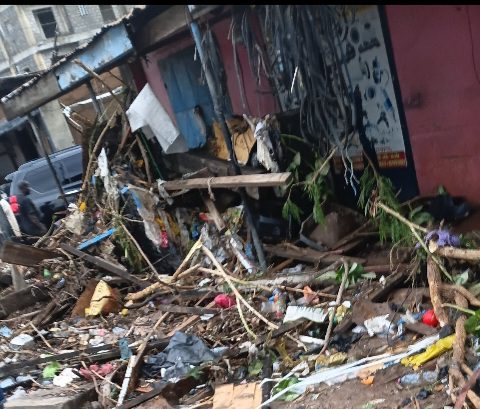
Ghana’s perennial and devastating floods are no longer mere natural disasters but a damning indictment of failed governance, environmental lawlessness, and a lack of political will, a policy think-tank has warned.
The SMART Generation Governance Hub (SMARTGENZ) is demanding an immediate overhaul of the country’s disaster response, calling for a comprehensive legal framework and the establishment of a specialized court to prosecute environmental offenders.
Addressing journalists in the capital, the executive director of SMARTGENZ, Rev DK Odei-Appiah, said the country could not continue to suffer catastrophic losses year after year without confronting the root causes of the crisis.
He identified a destructive trio of drivers behind the ongoing crisis: rampant illegal mining, known locally as galamsey; a total failure to enforce spatial planning laws; and a lack of “strong and courageous” political leadership.
“Recurring flood disasters should no longer be viewed merely as natural occurrences,” Rev Odei-Appiah said. “They have become governance, environmental, public health, and legal challenges that require deliberate, concerted effort and sustained intervention.”
The think-tank linked the destruction of the country’s ecology directly to the worsening severity of recent floods. Illegal mining operations have stripped vast swathes of vegetation that naturally absorb rainfall, leading to rapid, unmanageable runoff.
This environmental degradation is compounded by a severe waste management crisis. According to data from the Environmental Protection Agency (EPA), Ghana generates approximately eight million metric tonnes of waste annually—up to 15,000 tonnes a day—with the Greater Accra Region alone accounting for nearly a quarter of the total.
Alarmingly, only 10% of this waste is properly collected and disposed of. The remainder frequently chokes drains or is swept away by floodwaters, though experts note that up to 70% of the daily waste is organic and could be recycled productively if managed correctly.
SMARTGENZ also targeted local authorities for allowing unchecked urbanization and the blatant abuse of land-use schemes.
Activists point to the regular construction of permanent structures in unapproved zones, including waterways, wetlands, and reclaimed lagoons.
“We have witnessed, on countless occasions, the blatant abuse of our land-use schemes,” Rev Odei-Appiah said. “Several structures have been cited in unapproved areas. This raises serious questions: Were approvals granted for such developments? Was proper engineering assessments conducted? If so, who conducted them?”
The hub argues that solving the crisis hinges entirely on executive action. Because the constitution places national resources and tax revenues under the stewardship of the president, the organization believes flood mitigation must become a direct presidential priority to secure the necessary budgetary allocations.
To break the cycle of seasonal destruction, SMARTGENZ is advocating for a robust, coordinated legal framework that explicitly defines the responsibilities of state institutions, developers, and citizens.
Central to their proposal is the creation of a dedicated Specialized Spatial Planning and Disaster Management Court to fast-track the prosecution of planning violations and environmental degradation.
Rev Odei-Appiah warned that any new legislation would fail without the political fortitude to withstand pressure from influential figures, including traditional leaders, the clergy, and the political class who often intervene on behalf of developers.
“A nation cannot continue to suffer devastating floods year after year without taking decisive and practical measures to address the root causes,” he said. “The time has come for Ghana to adopt a comprehensive national flood management strategy backed by strong legislation, effective enforcement, and responsible citizenship.”
By: Rainbowradioonline.com/Ghana