
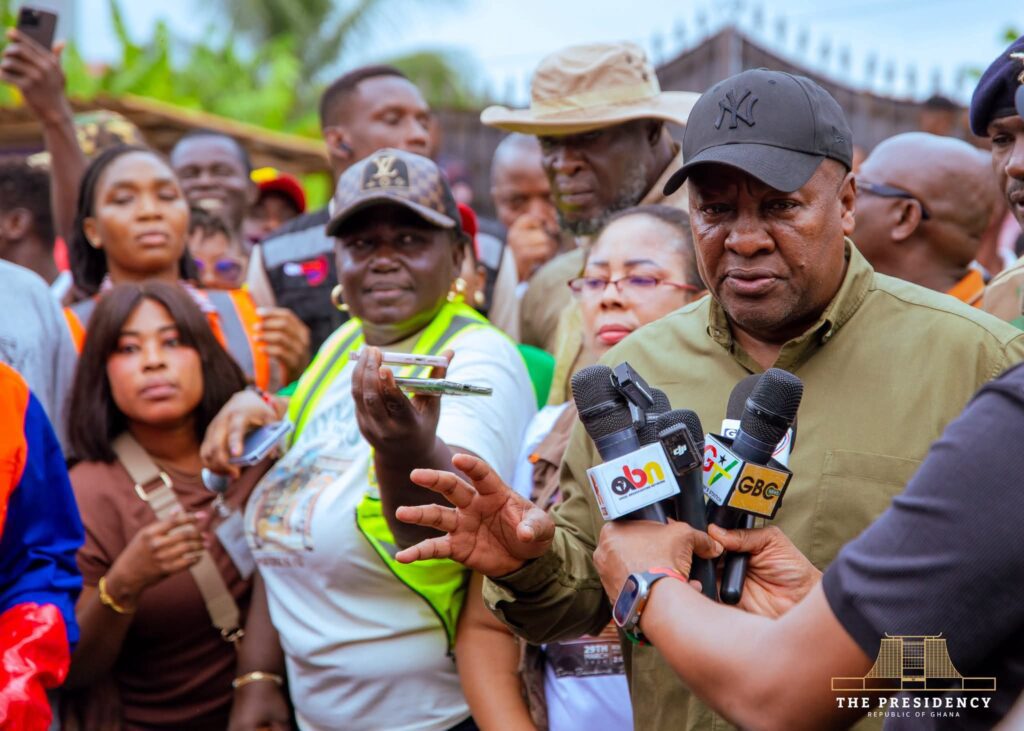
President John Dramani Mahama has pressed citizens to halt the practice of utilizing drainage systems for refuse disposal.
During his active participation in the National General Cleaning Exercise today, the President visited several sites throughout the Accra Metropolis, backing community initiatives designed to elevate civic hygiene and community health standards.
The nationwide campaign underscores the administration’s dedication to fostering a more pristine, healthy, and ecologically sound nation by fostering shared civic duty.
Throughout his tour, he cautioned that the reckless dumping of trash exacerbates flood hazards and undercuts initiatives meant to safeguard residential areas.
Observing conditions firsthand at the Alajo Drains, President Mahama noted that the disaster on June 29 should act as an urgent reminder for the public to alter their conduct and assume greater personal ownership over ecological upkeep.
He pointed out that the Alajo channel overflowed precisely because it was choked by a mixture of mud, plastics, and domestic garbage, which obstructed the natural movement of water.
“We have to clear the drains. We just worked on this Alajo drain. It’s part of the outdoor stream. And there are two problems in it. There’s silt, and then there’s also plastics and household waste,” he said.
The President remarked that the specific debris discovered inside the waterways illustrates a profound lack of accountability in trash management, with individuals abandoning items that require proper disposal channels.
“You find in a drain like this, there are Indian blocks. People discard an Indian block and throw it in the drain. Old furniture, dining tables, everything you can find in that drain,” he said.
“The drains are not garbage instruments. If you want to dispose of something, you know how to dispose of it,” he said.
He called upon local inhabitants to utilize established waste receptacles, such as the large collection bins positioned throughout the municipality, rather than throwing their rubbish directly into the gutters.
“We have skip trucks that leave containers all over the city. Just go and throw your garbage into the skip, and the truck will come and pick it and take it where it has to take it,” he said.
President Mahama maintained that reforming national sanitation practices demands a revival of historic communal principles centered around collective neighborhood upkeep, suggesting that the detached nature of city life has eroded those original standards.
“We are taught to keep a clean environment. But when we all leave our hometowns and we come, because of the anonymity of urbanization, we think that nobody watches us. So we dump those values, and we live in filth. We must change that attitude,” he said.
He expressed appreciation to the military and police forces, local chiefs, and community volunteers participating in the cleanup, framing the post-flood recovery as a moment for Ghana to display its true strength.
“The floods have been devastating, but we must show that we are a resilient nation and we can bounce back even better,” he said.
Furthermore, the President assured that state-led infrastructure upgrades would persist long after the conclusion of the two-day cleaning campaign, promising that extra machinery would be deployed to guarantee that excavated mud and refuse are completely cleared from the banks.
He emphasised that failing to transport the dredged material away from the channels would neutralize the entire operation.
“Otherwise, if we don’t do that, what we would have done would be in vain, because when the rains come, it will just wash all those silt and garbage back into the drain,” he said.
By: Rainbowradioonline.com/Ghana