
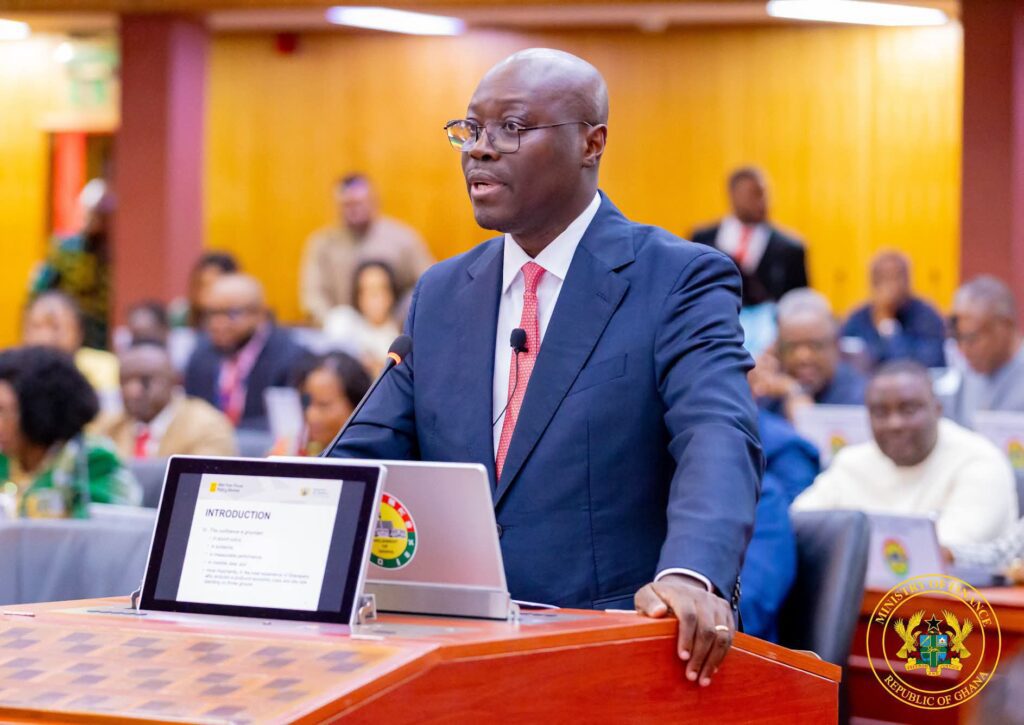
Finance Minister Dr Cassiel Ato Forson has pushed back strongly against critics claiming the government has locked up the state purse and refused to fund critical public sectors.
Presenting the 2026 Mid-Year Budget Review to Parliament on Thursday, 23 July 2026, Dr Forson presented a detailed breakdown of state expenditure, insisting that public funds are being deployed responsibly to stabilize the economy and cushion citizens.
Addressing Parliament, the Finance Minister rejected allegations that the administration had halted spending, maintaining that government operations continue to be guided by fiscal discipline.
“Nothing could be farther from the truth,” Dr Forson stated. “Far from standing still, we have been steadily and responsibly deploying resources, guided by the simple but firm principle that we spend only what we have, and we spend it wisely, with the future of our nation firmly in view.”
According to the expenditure figures laid before the House, public sector workers absorbed the largest single chunk of revenue, with GH¢48.8 billion paid out as compensation for employees.
This figure includes GH¢4 billion remitted as contributions toward SSNIT and the Tier 2 Pension Scheme.
To maintain national power stability and prevent load-shedding, the government allocated GH¢7.1 billion to the energy sector. Infrastructure development also recorded heavy capital deployment, with GH¢11.5 billion spent on overall capital expenditure and an additional GH¢6.5 billion directed to the Big Push Infrastructure Programme to improve national roads.
A further GH¢1.7 billion went directly to the Road Maintenance Trust Fund.
Debt servicing and domestic financial sector support consumed substantial resources.
The government spent GH¢21.5 billion on interest payments, alongside $700 million allocated for Eurobond debt service and interest obligations.
To restore investor confidence following domestic debt restructurings, GH¢10 billion was paid out to domestic bondholders, while GH¢5.3 billion went toward clearing legacy government arrears.
Education and health services received major cash injections across several flagship initiatives.
The Free Secondary Education Programme received GH¢1.8 billion, complemented by GH¢4.2 billion disbursed to GETFund and GH¢537 million to execute the No Fees Stress Policy for tertiary students. Basic education support included GH¢877 million for the Ghana School Feeding Programme, GH¢76 million in Capitation Grants, and GH¢46 million to cover Basic Education Certificate Examination (BECE) registration fees.
Teacher and nursing trainees received GH¢104 million and GH¢144 million in allowances, respectively.
In healthcare, the National Health Insurance Scheme (NHIS) received GH¢4.5 billion to support service delivery, while GH¢1.1 billion was channeled into the specialized MahamaCares initiative.
Social intervention and local governance expenditures saw GH¢485 million disbursed to Livelihood Empowerment Against Poverty (LEAP) beneficiaries, GH¢4.4 billion paid into the District Assemblies Common Fund (DACF), and GH¢93 million disbursed as allowances for Assembly Members.
Dr Forson emphasized that the spending disclosures demonstrate government’s commitment to transparency while ensuring key sectors—including agriculture, security, and social safety nets—remain adequately resourced without jeopardizing long-term fiscal stability.
By: Rainbowradioonline.com/Ghana