
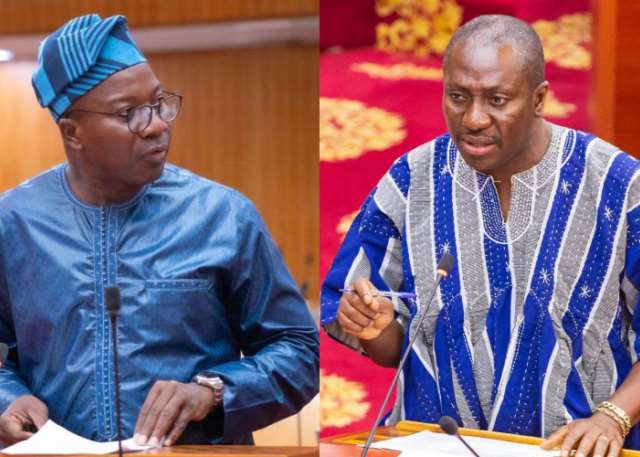
The Majority Leader, Mahama Ayariga, has defended the 2026 Mid-Year Budget Review, insisting the government’s economic performance must be judged on cold facts rather than partisan rhetoric.
Responding to criticisms from the Minority Caucus, Ayariga maintained that the Majority holds a duty to present an objective assessment of national progress and will resist efforts to misrepresent key achievements.
He accused the opposition of cherry-picking figures presented by the Finance Minister, emphasizing that positive shifts in key indicators stem from deliberate policy decisions rather than political spin.
Ayariga dismissed assertions that government achievements were exaggerated, maintaining that administration measures have stabilized the economy and paved the way for sustainable growth.
Addressing public expenditure concerns, Ayariga acknowledged payment delays to contractors across several sectors.
However, he argued that prudent expenditure management does not signal economic decline, stressing that fiscal discipline remains vital to safeguarding macroeconomic stability.
He urged that fiscal and debt management strategies be judged within the context of broader economic reforms rather than isolated statistics.
While acknowledging lingering challenges, Ayariga concluded that the review demonstrates steady progress toward economic recovery and called on Parliament to base its judgment on evidence.
In a swift rebuttal, Minority Leader Alexander Afenyo-Markin criticized the review, contending that it paints an overly rosy picture at odds with the daily struggles of ordinary Ghanaians.
Concluding the Minority’s response in Parliament, Afenyo-Markin vowed that the opposition would not permit the government to use the House to “decorate its record” or repeat campaign claims without rigorous scrutiny.
He argued that an analysis of the Finance Minister’s own data reveals that government celebrations are premature and that structural economic foundations remain fragile.
According to him, the government selectively highlights favorable economic ratios while ignoring surging absolute figures, falsely credits commodity price spikes to structural reforms, and frames slowing inflation as an actual drop in prices.
Afenyo-Markin insisted that the true test lies in whether the government has alleviated citizen burdens, expanded productive opportunities, executed the development budget, and placed the economy on a sustainable trajectory.
“On each of these tests, the mid-year review falls short,” he asserted.
The Minority Leader pointed out that national debt continues to climb despite improvements in the debt-to-GDP ratio, adding that fiscal targets were achieved through drastic underspending rather than structural efficiency.
He expressed further worry that economic growth remains heavily reliant on gold exports while oil revenues lag, leaving households crushed by the high cost of living.
Afenyo-Markin noted that ministers for Education, Agriculture, Works and Housing, and Roads and Highways could all confirm payment delays to contractors.
He added that withholding payments and starving planned expenditure must not be masqueraded as sound economic management, calling on Parliament to demand policies that translate into tangible relief for Ghanaians.
By: Rainbowradioonline.com/Ghana