
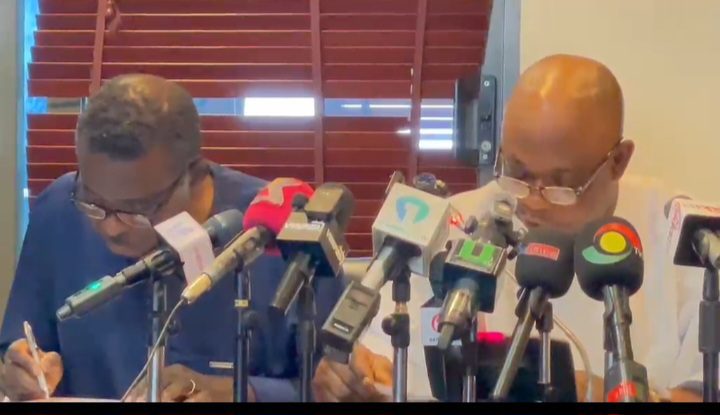
Years of institutional neglect and chronic underfunding under the previous administration have crippled Ghana’s fight against international narcotics syndicates, Parliament’s Majority Caucus has alleged.
Addressing parliamentary correspondents, Majority Leader and Chairman of the Defence and Interior Committee, James Agalga, accused the Akufo-Addo government of abandoning the Narcotics Control Commission (NACOC) at a time when illicit drug networks were becoming increasingly sophisticated.
Mr Agalga argued that the public must be made aware of the state of affairs before 2025 to properly evaluate the remedial actions currently being implemented.
“The public must be informed of the extent of institutional neglect that preceded 2025 to fully value the transformation that is now taking place and hold this government to the standard it has set itself. The state of the situation prior to 2025 — an institution left to fail,” he stated.
Describing the anti-narcotics agency as severely starved of operational funding and personnel, he added: “This was not a commandment which was not carried out. This was a need that was not met and resources were not available to do so.”
A central point of contention in the security debate is a 2018 policy change that excluded NACOC from conducting routine, mandatory physical container examinations at Tema Port. Mr Agalga branded the decision a critical failure that compromised maritime security.
“This country made a decision in 2018 whose impact we are still facing. NACOB was no longer to be subject to mandatory joint inspection at the Tema port,” he remarked.
However, former Defence Minister Dominic Nitiwul has pushed back against these claims, insisting that NACOC operatives were never completely withdrawn from the port. He explained that the directive was purely an administrative measure aimed at cutting red tape and expediting port clearing processes by reducing the number of inspecting bodies.
Former government official Kofi Brako-Powers has similarly challenged the Majority’s narrative, asserting that no empirical evidence currently links the 2018 port directive directly to the recent rise in drug busts.
The political clash follows heightened international pressure after French authorities seized almost 3.9 tonnes of cocaine hidden inside a shipping container from Ghana at the Port of Dunkirk.
In response to the interception, President John Dramani Mahama instructed national security chiefs to immediately draft a comprehensive strategy to fortify the nation’s borders against transnational drug cartels. As an immediate measure, NACOC has been reinstated into the joint physical container inspection framework alongside other border agencies.
Meanwhile, 48 Members of Parliament have petitioned the Speaker for an extraordinary parliamentary sitting scheduled for 29 September to scrutinise the country’s recent high-profile drug seizures. Though the Speaker’s official recall notice did not explicitly outline the order of business, the Majority’s parliamentary stance is expected to take centre stage in the upcoming debates.
By: Rainbowradioonline.com/Ghana