
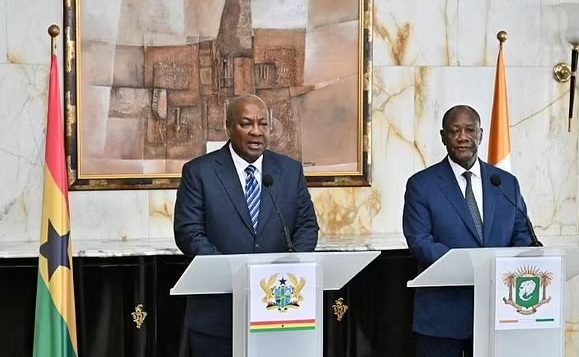
In a major step towards strengthening bilateral relations and securing peaceful coexistence along their shared frontier, Ghana and Côte d’Ivoire have officially commissioned 37 newly constructed international boundary pillars.
The event marks the successful conclusion of Phase 1 of the Joint Ghana-Côte d’Ivoire Land Boundary Reaffirmation Exercise. Supervised by the Ghana Boundary Commission (GBC), the first phase covered a total distance of 150 kilometres.
The newly erected structures comprise one Terminus Pillar, 12 Main Pillars, 20 Intermediate Pillars, and four Border Crossing Pillars. The project was fully funded by the German Agency for International Cooperation (GIZ) alongside the African Union Border Programme, with the 48 Engineer Regiment of the Ghana Armed Forces acting as the main contractor.
Two separate ceremonies were organized to mark the milestone.
The first took place at New Town in the Jomoro Municipality of the Western Region, where the Terminus Pillar was unveiled. This specific pillar signifies the end of the land boundary and the starting point of the maritime boundary between the two West African nations.
A second ceremony was held at Diby, an Ivorian border town adjacent to Yaakase in the Enchi enclave, to commission International Boundary Pillar 48 (IBP48), which functions as both a Main Pillar and a Border Crossing Pillar.
Addressing attendees at the venues, the Commissioner General of the Ghana Boundary Commission, Major General Anthony Ntem, highlighted that the newly constructed pillars reinforce the African Union’s vision of a Borderless Africa. He emphasized that well-demarcated and respected borders remain vital for regional harmony and deeper integration.
“A Borderless Africa does not mean an Africa without clearly defined boundaries. Rather, it is an Africa in which clearly defined and mutually respected boundaries facilitate the free movement of people, goods and services, encourage legitimate trade and interaction, and create the certainty necessary for deeper regional integration.
“It is an Africa where boundaries connect rather than divide, and where clarity over territorial jurisdiction provides a foundation for cooperation from communities living along the boundary to the highest levels of government,” Major General Ntem stated.
He further noted that trust and legal certainty amongst sovereign states are essential pillars for continental unity.
“The strength of a united and integrated Africa depends on certainty, trust and cooperation among sovereign states, which clearly defined and mutually respected boundaries, established through delimitation, demarcation and reaffirmation, provide.”
The Commissioner General urged local communities and relevant stakeholders to treat the newly installed markers as enduring symbols of security, trust, and peaceful cohabitation.
On his part, the Executive Secretary of Côte d’Ivoire’s National Boundary Commission, Dr Diakalidia Konate, explained that the reaffirmation drive seeks to enhance the visibility of the international boundary line.
Dr Konate expressed gratitude to the members of the Joint Land Boundary Technical and Sub-Technical Committees for their dedication throughout Phase 1, urging them to demonstrate the same zeal as preparations commence for the next stage.
Phase 2 of the boundary reaffirmation exercise is scheduled to kick off later this year.
By: Rainbowradioonline.com/Ghana