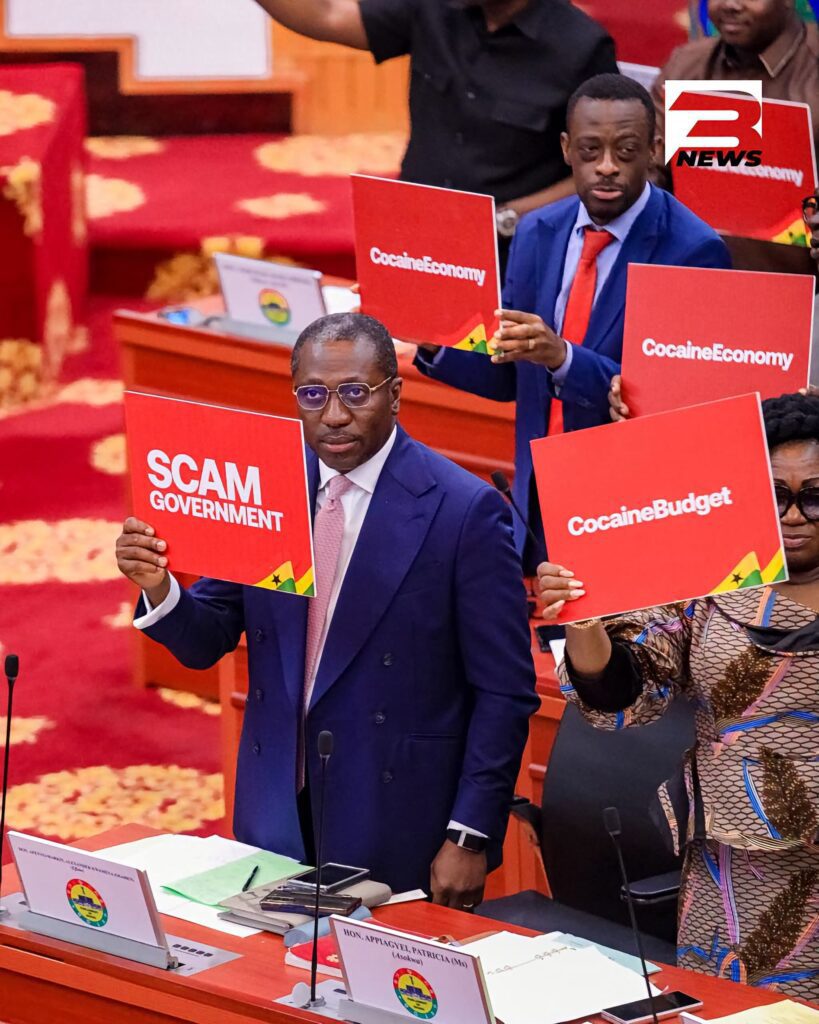
The Minority Leader in Parliament, Alexander Afenyo-Markin, has dismissed the government’s 2027 Budget Statement and Economic Policy as a reflection of a “paper economy” that fails to address the daily struggles of ordinary Ghanaians.
Speaking at a press conference on Thursday following Finance Minister Dr. Cassiel Ato Forson’s presentation to Parliament, Mr. Afenyo-Markin contended that the administration’s macroeconomic indicators do not match the harsh realities on the ground, particularly concerning high food prices and widespread unemployment.
“Stability on paper, hardship in our pockets,” he said.
Mr. Afenyo-Markin accused the Finance Minister of timing the budget presentation at a moment when citizens were seeking relief from ongoing economic pressures, only to invite them to further lamentation through appeals for patience. He pointed out the irony of the Minister now preaching patience, noting that someone who was impatient during his own tenure as Minority Leader now realizes the economy is merely running on paper. Having already been in office for two years, he argued, the government has had sufficient time to improve living conditions.
“The NDC cannot rebrand unemployment. They cannot slogan away the cost of living.”
According to the Effutu legislator, the true state of the nation is visible in major trading centres rather than in government statistics. He referenced markets in Accra, Makola, Kumasi, Aboabo, Techiman, Tamale, Koforidua, and Winneba, insisting that the cost of goods and basic foodstuffs remains well beyond the reach of the average household. He attributed the surging cost of locally produced staples to the administration’s neglect of the agricultural sector.
“Our farmers are suffering; they are not getting any support from the government.”
Turning to job creation, Mr. Afenyo-Markin maintained that household welfare and employment must be the ultimate benchmarks for economic success, rather than abstract figures. He criticized the budget for failing to clearly outline how the proposed New Economy Programme will generate employment or how it aligns with the government’s flagship 24-hour economy policy. He further raised concerns over the lack of transparency regarding how much of the programme’s proposed US$10 billion funding will be accessible in 2027, which specific projects will benefit, and why a development plan spanning 2027 to 2030 extends beyond the administration’s current mandate.
“It is not data that Ghanaians are going to consume. Ghanaians want jobs, jobs, jobs.”
While acknowledging the government’s reported capacity to honour its obligations under the Domestic Debt Exchange Programme, the Minority Leader questioned why similar urgency and funding were lacking for public-sector remuneration and recruitment.
“But the question is that where is the money to pay JUSAG, the money to pay teachers, the money to pay nurses, and the money to recruit?”
Mr. Afenyo-Markin also took the Finance Minister to task for omitting updates on the promised women’s bank, despite commitments made in previous budget cycles. Additionally, he warned that rising electricity tariffs and inadequate incentives for machinery imports will stifle private-sector expansion, which he described as vital to national development.
“Without the private sector, the economy cannot grow.”
The Minority Caucus indicated that it will thoroughly scrutinize the policy document and deliver a comprehensive response following Parliament’s upcoming budget workshop.

By: Rainbowradioonline.com/Ghana