
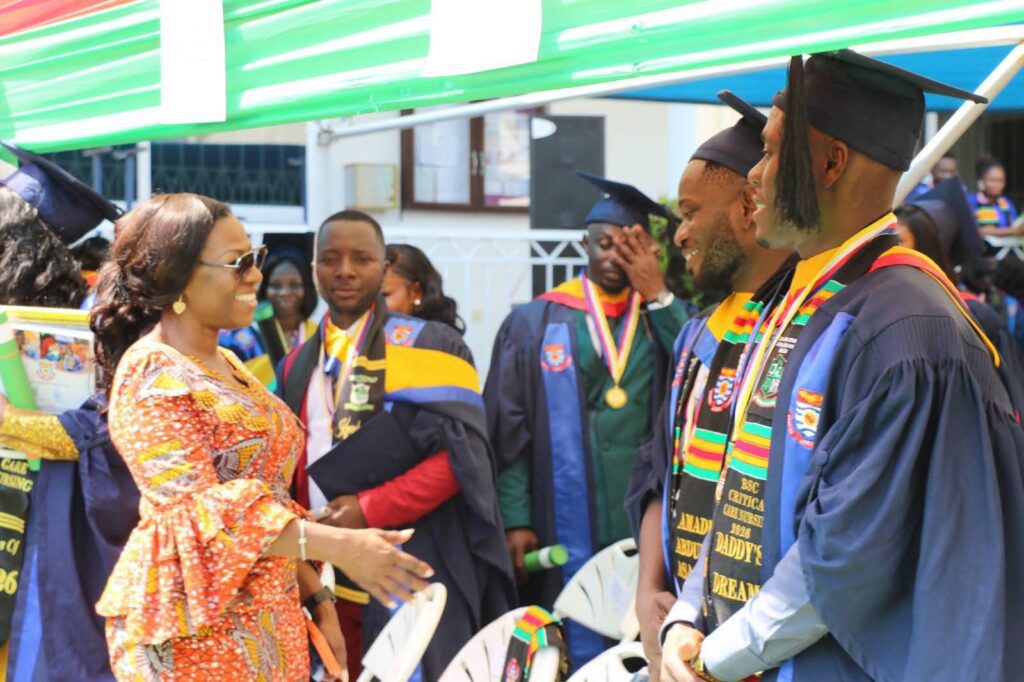
The Deputy Minister of Health, Prof. Dr Grace Ayensu-Danquah, has cautioned against examination malpractice in health training institutions, stressing that the calibre of professionals produced by nursing schools directly impacts patient safety and the survival of individuals receiving medical care.
She noted that nursing and medical professionals must be adequately trained, assessed and certified to ensure they possess the requisite knowledge and skills to deliver safe and effective healthcare, particularly as Ghana’s disease burden increasingly shifts towards non-communicable diseases.
The Deputy Minister made these remarks during a working visit to selected health training institutions at the Korle Bu Teaching Hospital in Accra.
The institutions visited included the School of Public Health, School of Hygiene, Nursing and Midwifery Training College, and the School of Peri-Operative and Critical Care Nursing, where she engaged school authorities and staff on their operations and challenges.
Prof. Ayensu-Danquah emphasised that examination malpractice in health training was particularly alarming because nurses and doctors are entrusted with the lives of patients, often at their most vulnerable moments.
“Let us really graduate them or move them when they are really qualified. After they have done the examination, let us ensure that they have really passed and that they know the basics so that when they get out and are taking care of us, they are doing the right thing,” she said.
She urged school authorities to uphold strict academic and professional standards in the training and assessment of students.
The Deputy Minister also called on healthcare professionals to demonstrate empathy and compassion towards patients, whilst acknowledging the pressures associated with inadequate staffing and heavy workloads.
Prof. Ayensu-Danquah stated that the visit had afforded the Ministry an opportunity to appreciate the challenges confronting the institutions, notably infrastructure deficits, staffing shortages, inadequate teaching personnel and logistical constraints.
On logistics, she disclosed that the Ministry was working to provide pickup trucks to health training institutions to support their operational activities, with plans to address their requests for buses subsequently.
She added that the Ministry was assessing the staffing needs of the institutions to identify areas where personnel could be redistributed or additional staff recruited, whilst strengthening the capacity of existing staff through further training.
Prof. Ayensu-Danquah further revealed that the Ministry had opened applications for PhD programmes for staff of nursing training institutions as part of broader efforts to build the academic and professional capacity of tutors.
She explained that the establishment of specialised nursing schools also formed part of measures to address the backlog of unemployed nurses while equipping them with advanced skills to meet emerging healthcare demands.
She assured the institutions that the concerns raised during the engagements would be tabled for further deliberation and appropriate intervention.
By: Rainbowradioonline.com/Ghana