
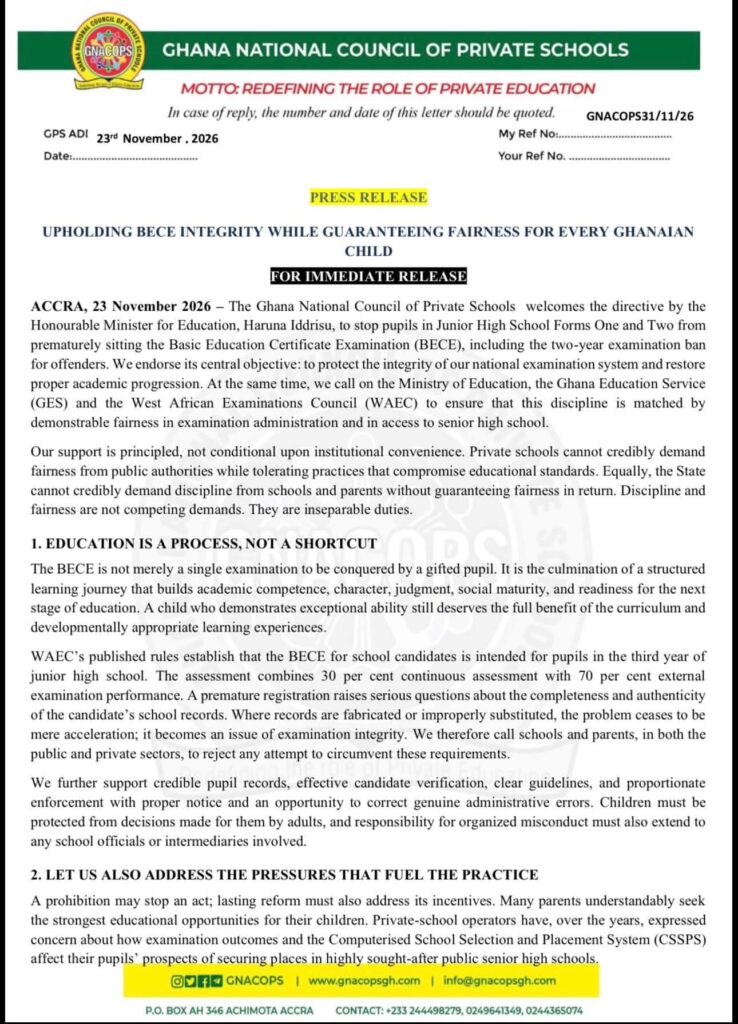
The Ghana National Council of Private Schools (GNACOPS) has thrown its weight behind a directive by the Minister for Education, Haruna Iddrisu, barring Junior High School (JHS) Forms One and Two pupils from sitting the Basic Education Certificate Examination (BECE).
In a press release signed by its Executive Director, Obenfo Nana Kwasi Gyetuah, the council endorsed the policy, including the two-year examination ban imposed on offenders. GNACOPS noted that while the measure is necessary to safeguard the credibility of Ghana’s examination system and restore proper academic progression, the Ministry of Education, the Ghana Education Service (GES), and the West African Examinations Council (WAEC) must match this strict enforcement with demonstrable fairness in grading and Senior High School (SHS) placement.
“Our support is principled, not conditional upon institutional convenience. Private schools cannot credibly demand fairness from public authorities while tolerating practices that compromise educational standards. Equally, the State cannot credibly demand discipline from schools and parents without guaranteeing fairness in return. Discipline and fairness are not competing demands. They are inseparable duties,” the statement read.
According to the council, the BECE is the culmination of a structured learning journey rather than a mere hurdle for gifted pupils, adding that premature registration raises serious questions about the authenticity of school records. While calling on both public and private schools to reject attempts to circumvent WAEC rules, GNACOPS urged authorities to ensure proportionate enforcement that protects children from adult misconduct while holding complicit school officials and intermediaries accountable.
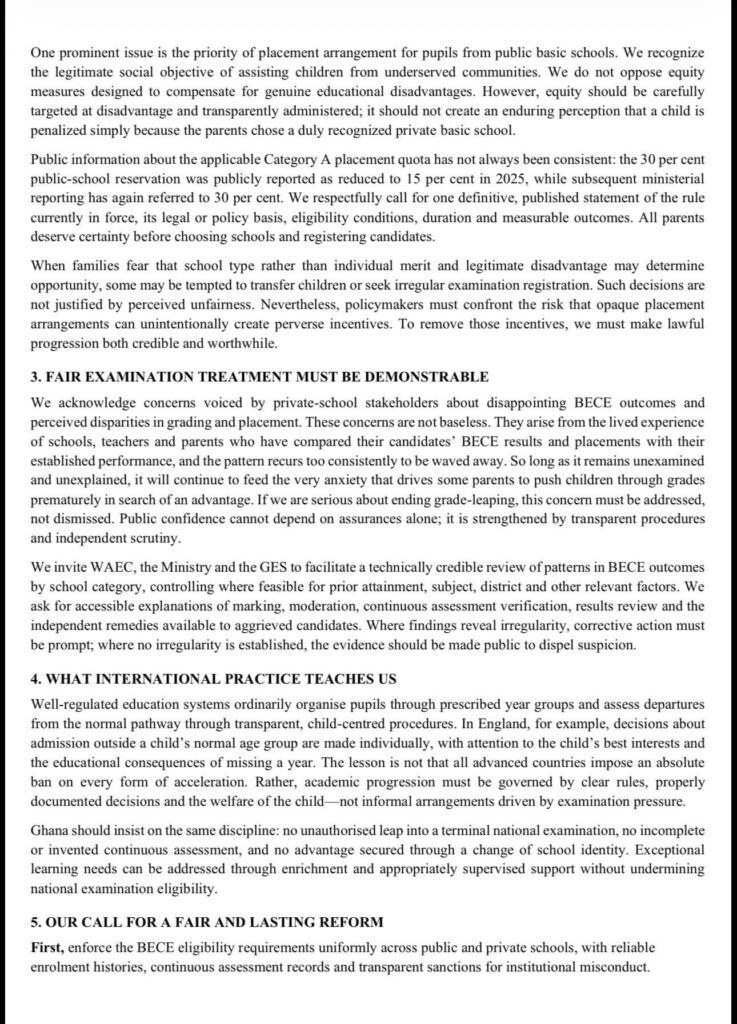
Addressing the root causes of grade-leaping, the council pointed out that anxieties over the Computerised School Selection and Placement System (CSSPS) often push parents toward irregular registration.
Specifically, GNACOPS highlighted conflicting public information regarding the Category A priority placement quota for public basic schools, noting that a 30 per cent reservation was reported as reduced to 15 per cent in 2025, only for subsequent ministerial reports to cite 30 per cent again.
“We respectfully call for one definitive, published statement of the rule currently in force, its legal or policy basis, eligibility conditions, duration and measurable outcomes. All parents deserve certainty before choosing schools and registering candidates,” the council stated.
GNACOPS further acknowledged long-standing concerns among private-school stakeholders over perceived disparities in BECE outcomes and placements compared to candidates’ established academic performance.
To rebuild public confidence, the council invited the Education Ministry, GES, and WAEC to conduct a technically credible review of BECE patterns across school categories, alongside accessible explanations of marking, moderation, and continuous assessment verification.
Drawing lessons from regulated systems such as England, where academic acceleration is governed by transparent, child-centred procedures rather than examination pressure, GNACOPS outlined a six-point reform agenda.
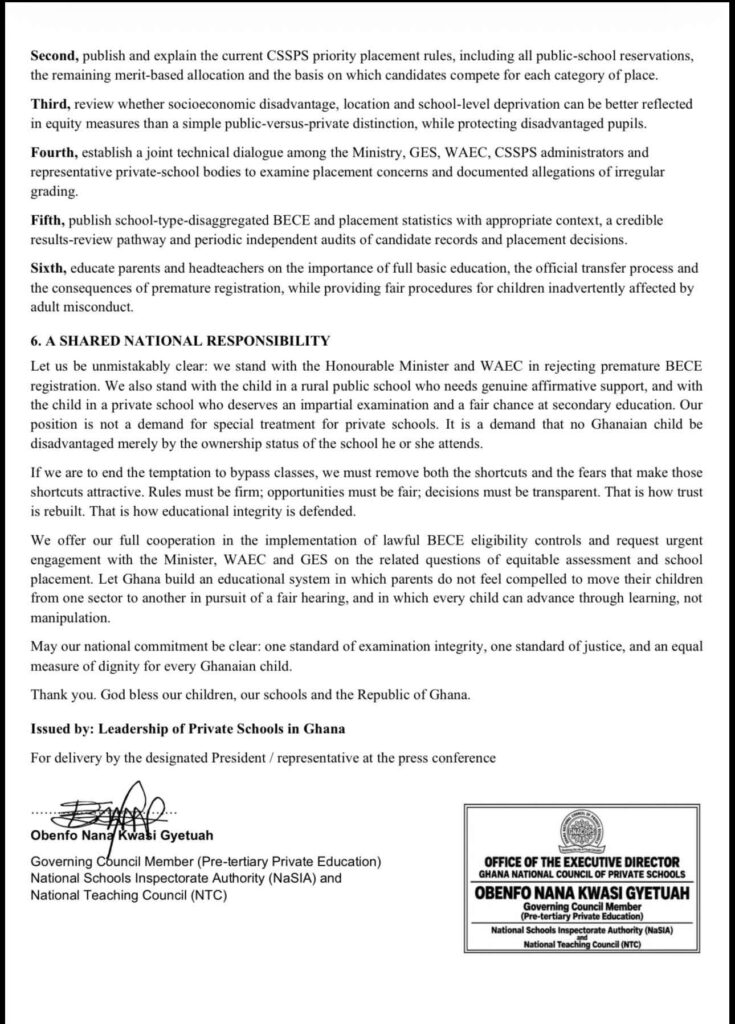
The council urged authorities to enforce eligibility rules uniformly, publish clear CSSPS allocation rules, base equity measures on actual socioeconomic deprivation rather than a simple public-versus-private divide, and establish a joint technical dialogue with private-school bodies. It also called for periodic independent audits of candidate records and nationwide sensitisation on official school transfer processes.
“Our position is not a demand for special treatment for private schools. It is a demand that no Ghanaian child be disadvantaged merely by the ownership status of the school he or she attends,” the council emphasised, pledging its full cooperation to help build an educational system where every child advances through genuine learning rather than manipulation.



By: Rainbowradioonline.com/Ghana