

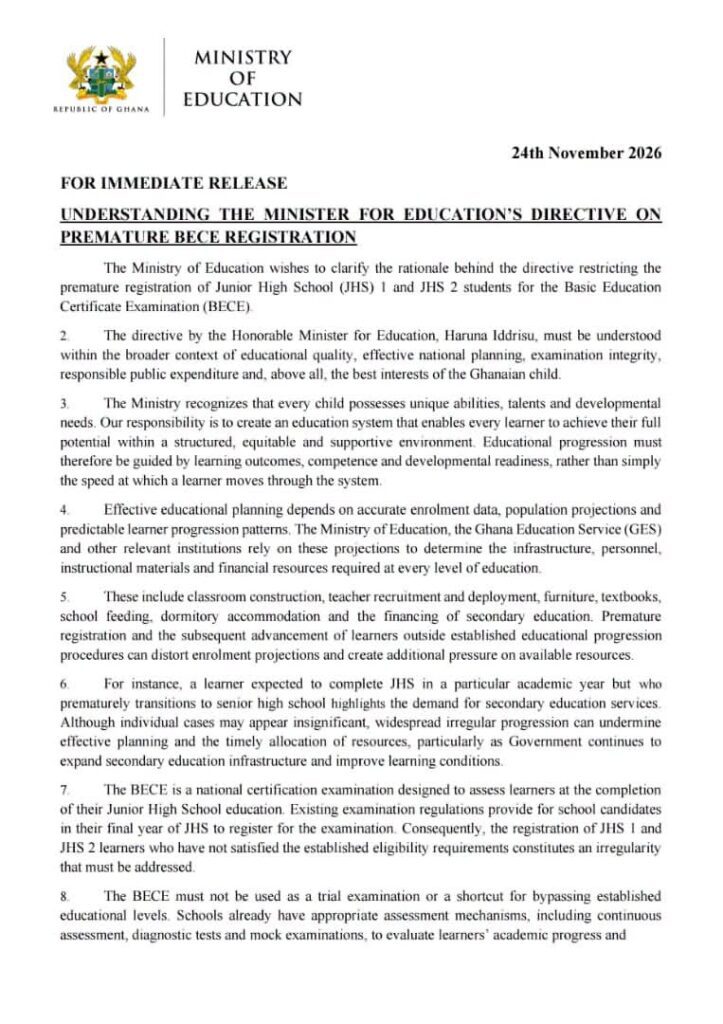
The Ministry of Education has defended Education Minister Haruna Iddrisu’s directive banning premature registration for the Basic Education Certificate Examination (BECE), arguing the measure safeguards examination credibility, national planning, and public funds.
In a statement issued on Tuesday, November 24, 2026, and signed by Press Secretary Hashmin Mohammed, the ministry said registering Junior High School (JHS) 1 and JHS 2 pupils violates existing examination rules that limit school candidacy to final-year JHS learners.
According to the statement, data from the West African Examinations Council (WAEC) shows roughly 5,000 candidates are registered prematurely for the BECE each year. Learners sanctioned for early registration face a two-year examination suspension.
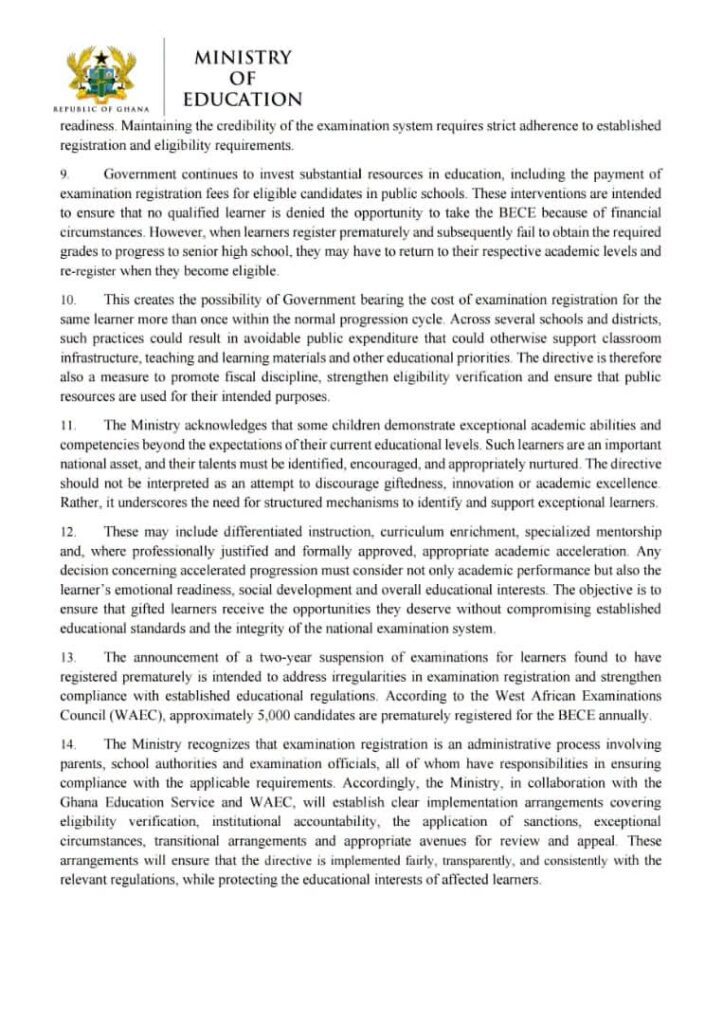
The ministry stressed that the directive is not intended to penalise bright pupils, insisting exceptional learners remain a national priority.
“The directive should not be interpreted as an attempt to discourage giftedness, innovation or academic excellence,” the statement read. “Rather, it underscores the need for structured mechanisms to identify and support exceptional learners.”
It added that gifted students should be supported through structured options rather than early exam entry.
“These may include differentiated instruction, curriculum enrichment, specialized mentorship and, where professionally justified and formally approved, appropriate academic acceleration,” the statement noted. “Any decision concerning accelerated progression must consider not only academic performance but also the learner’s emotional readiness, social development and overall educational interests.”
The ministry warned that irregular progression distorts enrolment data used by the ministry, the Ghana Education Service (GES), and partner agencies to plan infrastructure, staffing, textbooks, school feeding, dormitory space, and senior high school financing.
“Premature registration and the subsequent advancement of learners outside established educational progression procedures can distort enrolment projections and create additional pressure on available resources,” the release stated. “The BECE must not be used as a trial examination or a shortcut for bypassing established educational levels.”
Officials also flagged financial waste, noting that taxpayers fund BECE registration fees for eligible public school candidates. Pupils who sit the exam early and fail to secure senior high school placement may have to repeat levels and be registered again later at public expense.
“This creates the possibility of Government bearing the cost of examination registration for the same learner more than once within the normal progression cycle,” the ministry said. “Across several schools and districts, such practices could result in avoidable public expenditure that could otherwise support classroom infrastructure, teaching and learning materials and other educational priorities.”
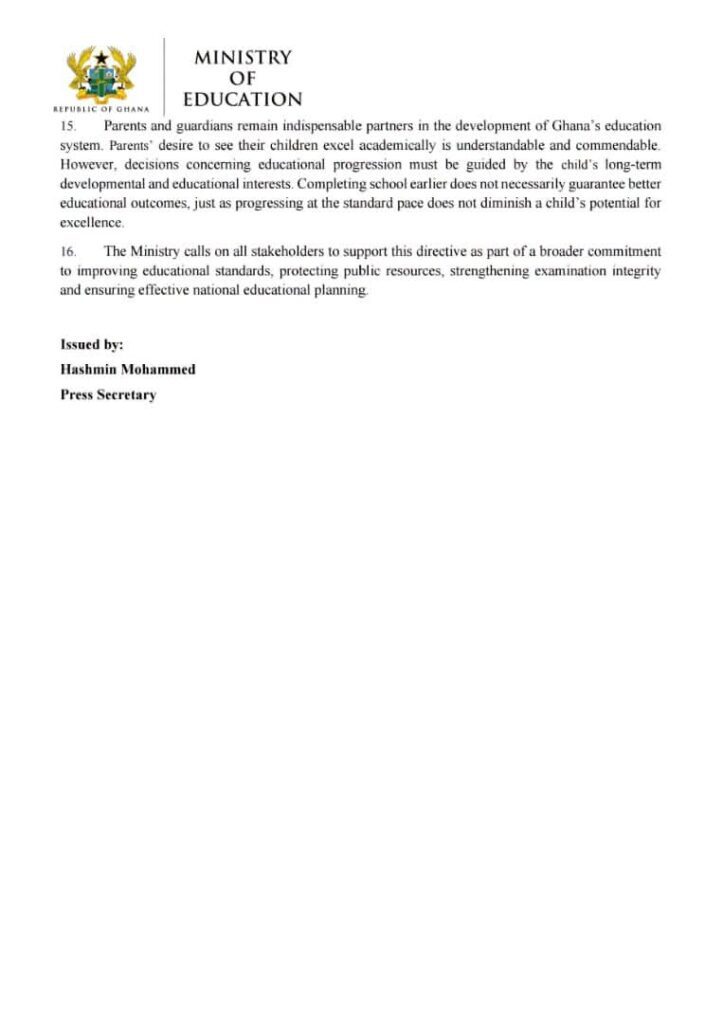
The ministry pledged to work with the GES and WAEC to roll out clear rules on eligibility checks, institutional accountability, sanctions, exemptions, transitional measures, and appeals. It also urged parents and guardians to prioritise long-term child development over rushing pupils through school.
“Completing school earlier does not necessarily guarantee better educational outcomes, just as progressing at the standard pace does not diminish a child’s potential for excellence,” the statement concluded.

By: Rainbowradioonline.com/Ghana