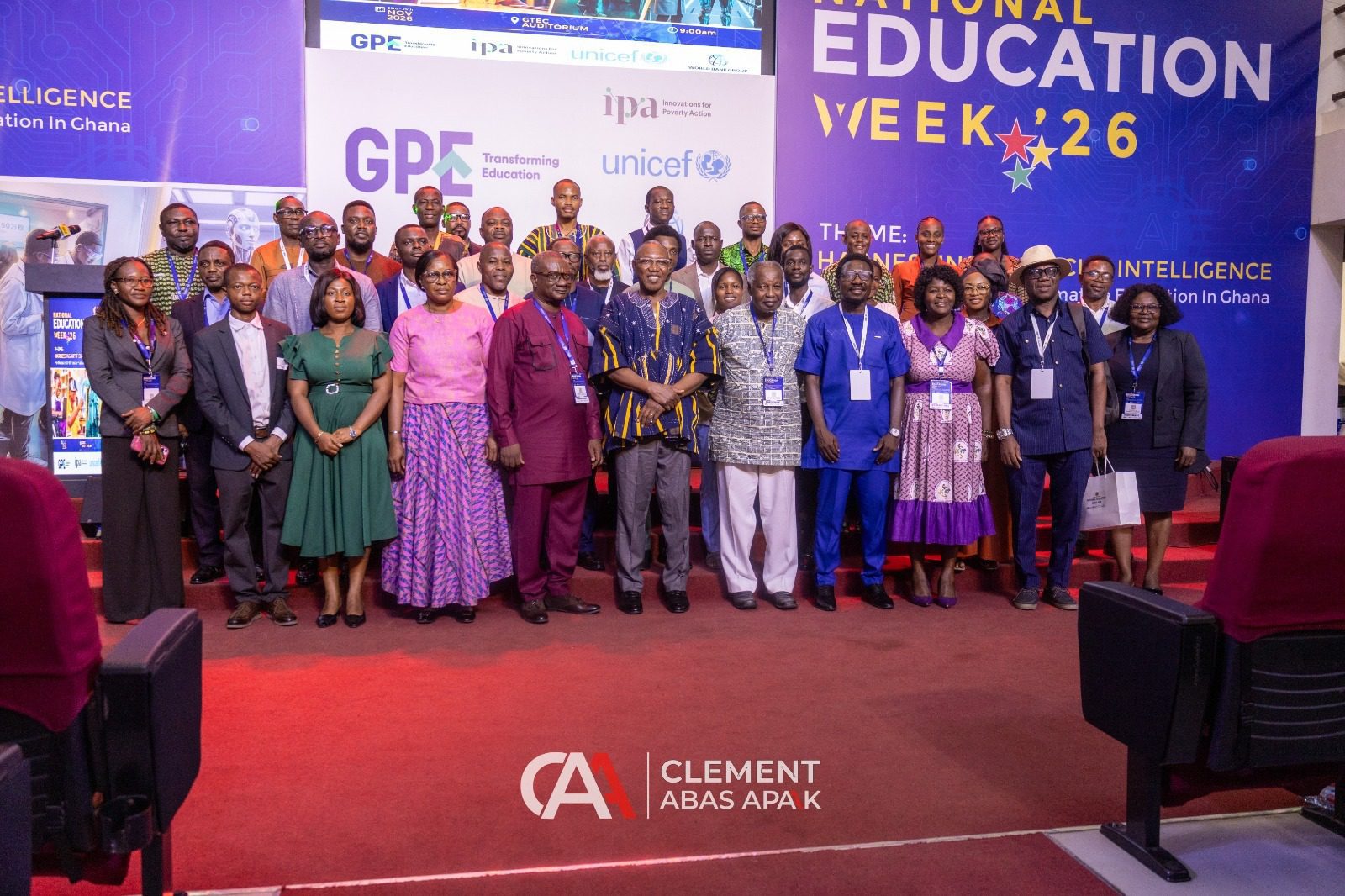
Deputy Minister for Education, Dr. Clement Abas Apaak, has cautioned that the adoption of artificial intelligence in Ghana’s schools must complement foundational learning rather than replace the vital role of teachers in the classroom.
Speaking at the closing ceremony of the 2026 National Education Week and Evidence Summit at the Ghana Tertiary Education Commission in Accra on Tuesday, November 24, 2026, Dr. Apaak stressed that emerging technologies should only be judged by how well they improve teaching and learning outcomes.
The week-long event, held under the theme “Harnessing Artificial Intelligence for Inclusive and Transformative Education in Ghana,” brought together policymakers, academics, development partners, teachers, and students to examine the future of digital education.
Dr. Apaak noted that recent national assessment findings show more work is required to ensure every Ghanaian child can read with understanding, communicate effectively, and apply basic mathematical concepts.
“AI cannot substitute for strong foundational learning; rather, it should complement and strengthen efforts to improve education quality,” the Builsa South legislator said. “We must embrace innovation without losing the essential human, intellectual and social dimensions of education.”
He urged learners to cultivate critical thinking skills to question and verify information generated by AI tools, while calling on teachers to exercise sound professional judgement to ensure digital content remains accurate and aligned with the national curriculum.
Addressing infrastructure, connectivity, data protection, and ethical concerns, Dr. Apaak stated that integrating AI into the education sector goes beyond acquiring hardware or software. He described it as a broader governance and institutional readiness issue requiring strong policy frameworks to safeguard learners.
To achieve meaningful results, the Deputy Minister called for coordinated action among key sector agencies, including the Ghana Education Service, the National Council for Curriculum and Assessment, the National Teaching Council, the Ghana Tertiary Education Commission, and the Centre for National Distance Learning and Open Schooling.
He challenged stakeholders to move beyond conference discussions and measure the success of the summit by tangible policy shifts and classroom improvements.
“Technology is a means to an end, and every investment must contribute to better teaching, improved learning and expanded opportunities for our children and young people,” Dr. Apaak added, thanking civil society organisations, researchers, and development partners for their continued commitment to transforming Ghana’s education sector.
By: Rainbowradioonline.com/Ghana