Billpayers have been urged to give an accurate meter reading as gas and electricity price rises take effect.
A household in England, Wales and Scotland using a typical amount of gas and electricity will now pay £1,717 a year, a 10% rise to the annual bill of £149.
Experts have encouraged people to submit a meter reading as the change comes in so they can avoid being charged on estimated usage at the higher rate.
It comes as winter approaches without extra cost-of-living payments for those on low incomes, and as winter fuel payments are withdrawn for about 10 million pensioners.
Price cap changes
Energy prices for about 27 million homes in England, Wales and Scotland are governed by a price cap, calculated by the energy regulator Ofgem. It is set every three months and affects the price paid for each unit of gas and electricity.
Under the cap, prices have fallen twice this year – in April and July – but now, at the start of October, they have increased by about £12 a month for a typical user.
The final bill will depend on the amount of energy used, but to estimate the effect on annual costs, billpayers can add 10% to their current bill.
By reading their meters and submitting those to their supplier, price comparison website Uswitch says billpayers can avoid being charged in the short-term for energy they have not used, or having a bill based on an estimated reading at a higher rate. Those with operational smart meters have the reading taken automatically.
Standing charges have risen by one penny a day for gas and also for electricity, but the regulator is considering reforming the system.
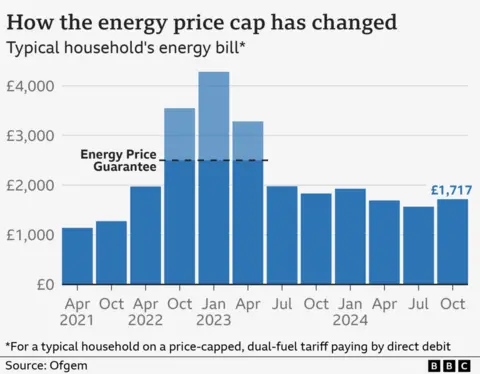
The price cap is illustrated by Ofgem in terms of an annual bill for a household using a typical amount of gas and electricity. It affects those on default, variable tariffs, not those who have fixed a price for a set period.
That annual bill is lower than last winter, but charities say many people will struggle to cover the cost.
Some households have built up debt to their suppliers. Ofgem said nearly £3.7bn is owed collectively.
Steve Vaid, chief executive of the Money Advice Trust, the charity that runs National Debtline, said: “This only highlights what we have been saying for some time – without urgent support for households facing unaffordable arrears, energy debt will only rise further.”

James McMahon, from Blackburn, is slightly behind on his gas bill, which he said he was “not proud about” but unavoidable.
“[The price rise] is a big disappointment. You feel it inside,” he said.
“You can be big and proud and say I can manage, and make that bit of extra money. But when you take everything else we are being put through, it is just that bit too much.”
Some households will have less support because the final cost-of-living payment was made to eight million people on means-tested benefits in February.
For pensioners, the previously universal winter fuel payment, worth up to £300, will now be paid only to those on low incomes who receive certain benefits.