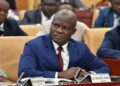
Benjamin Nsiah, the Executive Director for the Centre for Environmental Management and Sustainable Energy (CEMSE), has added his voice to growing calls for the government to scrap the GH₵1 fuel levy.
The energy analyst argued that the original justification for the levy is no longer valid and urged the government to repeal the Energy Sector Levy Amendment Act of 2025.
His concerns come amid a sharp rise in fuel prices, driven by ongoing hostilities involving the United States, Israel, and Iran, alongside the closure of the Strait of Hormuz. Mr Nsiah projected that if the conflict persists, crude oil could climb to between $110 and $120 per barrel.
Locally, this could push petrol prices as high as GH₵15 to GH₵17 per litre. As of the second pricing window of March 2026, diesel was already retailing at GH₵15.60 per litre, while petrol had exceeded GH₵12.40 per litre.
The analyst explained that while the government originally projected crude oil prices to hover around $70 per barrel, that figure has nearly doubled, making the removal of the levy essential.
Speaking in an interview on Frontline on Rainbow Radio 87.5FM, he cautioned that maintaining the levy under these circumstances would be viewed as a lack of sincerity toward the public.
He noted that such a move would breed mistrust, warning that “in the future, when you bring on another levy with the justification that you want to address a challenge, Ghanaians will remind you that when you promised to scrap the 1-cedi levy when it was necessary, you failed to do so.”
Mr Nsiah further highlighted that the government has already settled a significant portion of its legacy debt to Independent Power Producers and has established a four-year payment plan for the remaining balance.
He argued that the fiscal rationale for the levy has evaporated, stating, “That means you don’t need much revenue to settle some of these debts because you will need about $300 million, equivalent to GH₵3.3 billion, to pay the remaining debt.”
He pointed out that the government has already paid $1.47 billion toward energy sector debt, which includes the full repayment of the GH₵597 million World Bank partial risk guarantee and the settlement of outstanding gas invoices. With crude currently trading at approximately $111 per barrel—well above the $70 projection—he estimated that government revenue could exceed targets by roughly 30%.
“Government will possibly generate $30 more per barrel, and when you multiply that by about 5 million or 6 million barrels, the windfall we generate could be able to pay for the debt in the power sector. That is a justification for the levy to be scrapped”, he added.
He advised the government to weigh these financial options and take immediate action to provide relief to consumers.
By: Rainbowradioonline.com/Ghana