
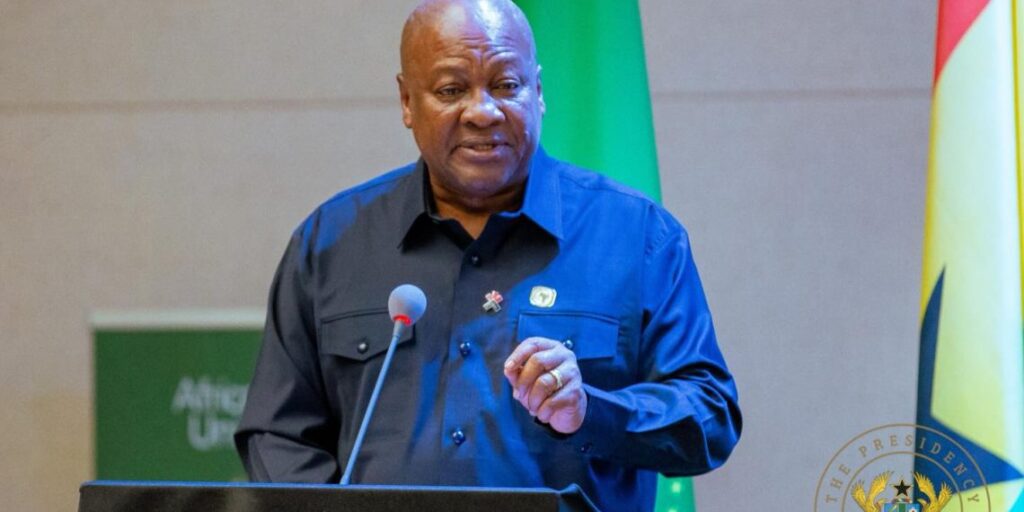
President John Dramani Mahama has called for a more inclusive global framework for reparatory justice, arguing that acknowledging historical wrongs must lead to sustained international action.
Addressing the opening session of the Next Steps Conference on Reparatory Justice in Accra on Thursday, June 18, 2026, Mahama emphasized that the UN’s recent resolution on slavery and its legacy is merely the starting point of a much larger journey, rather than its final destination.
“The adoption of the resolution journey,” he said, adding “It was intended to provide the foundation for a more meaningful process of engagement, reflection, and action.”
The President maintained that the success of these reparative efforts hinges on broadening international and institutional involvement, warning against restricting the conversation to a closed circle of participants.
“The pursuit of historical justice is not strengthened by narrowing the circle of participation. It is strengthened by expanding it,” he said.
Mahama urged all stakeholders to approach the deep-seated legacy of the transatlantic slave trade with open-mindedness, humility, and a commitment to dialogue. He noted that divergent political and historical viewpoints should serve as a reason for cooperation, not a barrier to it.
“It is strengthened when those who may approach these issues from different historical, political, or legal perspectives nevertheless choose dialogue over silence and engagement over distance,” he said.
Accepting the reality of past injustices, Mahama argued, naturally binds the global community to a shared duty of action. He reminded the audience that the ripple effects of slavery still necessitate a unified global response.
“We are here because recognition creates responsibility, and because the enduring consequences of this history continue to demand thoughtful, coordinated, and sustained international engagement,” he said.
To anchor his point, the President highlighted Ghana’s own landscape—pointing to the physical reminders of the trade, such as historical slave routes, coastal castles, and dungeons, which stand as enduring evidence of this global tragedy..
These landmarks, he observed, serve as a bridge between Africa and regions like the Americas, where the forced migration of millions permanently altered local identities. Today, descendants of those victims are returning to Ghana’s shores as scholars, statesmen, and global citizens.
Significantly, Mahama shone a spotlight on the unique and frequently ignored trauma endured by enslaved women and girls. He argued that their specific suffering has long been sidelined in mainstream history and must be brought to the forefront of modern reparations debates.
“Their suffering was often concealed from the official record, leaving them victims not only of the extinction, but also of historical erasure,” he said
By: Rainbowradiooline.com/Ghana