
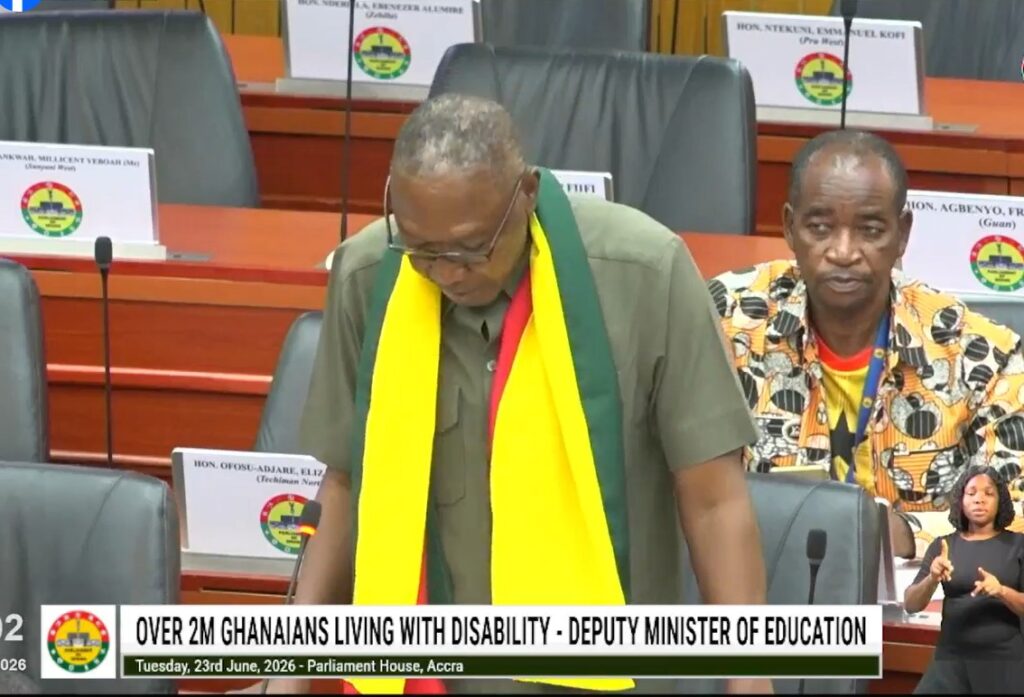
Deputy Education Minister issued a call to action for the immediate enforcement of the country’s disability laws, warning that millions of citizens continue to suffer from systematic exclusion despite decades of policy promises
.
Speaking on the floor of the House on Tuesday to mark the National Day of Persons with Disabilities, Hon. Dr. Clement Abas Apaak, Chairman of the Parliamentary Caucus on Disability, stated that legislative intentions must urgently translate into tangible changes in the daily lives of affected individuals.
Reflecting on this year’s theme, “From Act to Action: Finalizing Reforms and Enforcing Disability Rights Now,” Dr. Apaak argued that rights remain entirely meaningless without robust implementation and public accountability.
He revealed that data from the 2021 Population and Housing Census indicates more than two million Ghanaians live with some form of disability, representing a vast, underutilised reservoir of talent, intellect, and economic potential.
“Behind these statistics are individuals with aspirations, talents, skills, and immense potential,” Dr. Apaak stated during his address to the House. “Their inclusion is not only a matter of social justice; it is essential to Ghana’s development and prosperity.”
While acknowledging historical milestones, such as the passage of the Persons with Disabilities Act of 2006 (Act 715) and the ratification of the United Nations Convention on the Rights of Persons with Disabilities, the lawmaker noted that severe systemic gaps persist.
Public infrastructure, transportation networks, schools, and healthcare facilities across the nation remain largely inaccessible, effectively shutting out a significant portion of the population from economic and social life.
The Member of Parliament stressed that true progressive reform requires a fundamental shift in societal mindset, rejecting the notion that support for vulnerable communities is a form of welfare.
“Disability inclusion must never be viewed as an act of charity or benevolence,” Dr. Apaak emphasized. “It is fundamentally a matter of human rights, equality, and justice.”
To address these deficits, the Parliamentary Caucus on Disability has actively engaged with global bodies to adopt international benchmarks.
Representatives recently returned from key high-level summits, including the United Nations Conference of States Parties in New York and the Commonwealth Parliamentarians with Disabilities Forum in South Africa, aiming to integrate global best practices into the domestic framework.
Dr. Apaak concluded his presentation with a direct appeal to ministries, municipal assemblies, the private sector, and civil society to collaborate on removing physical and institutional barriers.
He insisted that policy formulation must actively include the voices of those it intends to protect, demanding a shift from token recognition to absolute implementation.
By: Rainbowradioonline.com/Ghana