
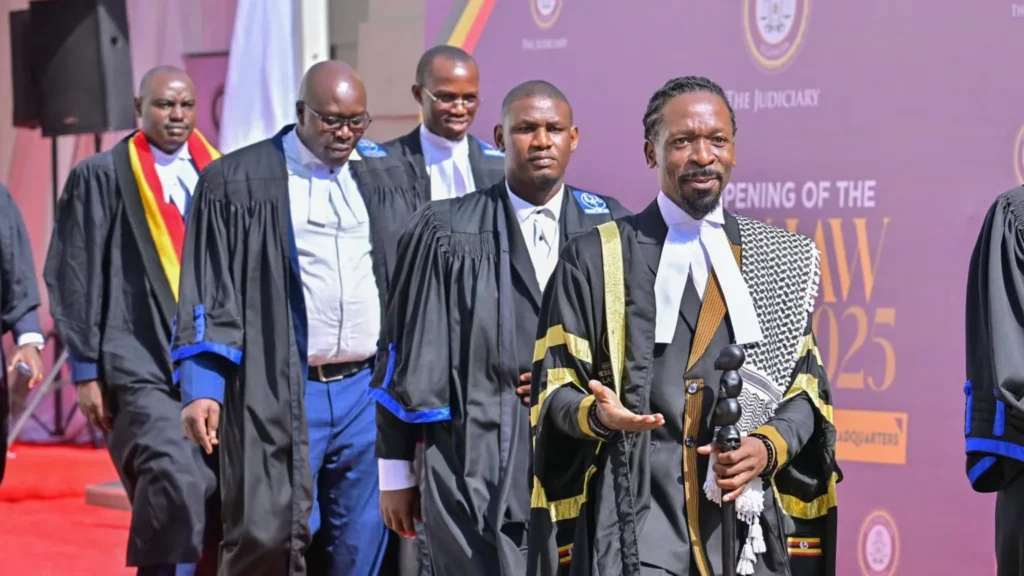
Uganda’s judiciary has pushed back against a directive by the country’s lawyers’ association instructing its members to stop addressing judges as “My Lord” or “My Lady” and to abandon the longstanding practice of bowing before them.
In the directive, the Uganda Law Society (ULS) said such “feudal and colonial honorifics” elevate judicial officers above citizens, “who are in reality their employers”.
But judiciary spokesperson James Ereemye told the BBC that the ULS had no authority to tell judges “what to do or say” and would continue to “demand the known decorum” from lawyers.
Like many former British colonies, Uganda inherited its legal system and many courtroom traditions from the UK.
The ULS, the professional body which represents advocates, said the “archaic” colonial structure had contributed to the “failure” of Uganda’s judicial system.
The society said colonial courtroom practices “force Ugandans into postures of humiliation as the powerful enjoy comfort and deference”.
“The practice of bowing or any other form of physical subservience before judicial officers is henceforth prohibited for all members of the Uganda Law Society,” it said in a statement signed by its president Isaac Ssemakadde.
In the directive, the Uganda Law Society (ULS) said such “feudal and colonial honorifics” elevate judicial officers above citizens, “who are in reality their employers”.
But judiciary spokesperson James Ereemye told the BBC that the ULS had no authority to tell judges “what to do or say” and would continue to “demand the known decorum” from lawyers.
Like many former British colonies, Uganda inherited its legal system and many courtroom traditions from the UK.
The ULS, the professional body which represents advocates, said the “archaic” colonial structure had contributed to the “failure” of Uganda’s judicial system.
The society said colonial courtroom practices “force Ugandans into postures of humiliation as the powerful enjoy comfort and deference”.
“The practice of bowing or any other form of physical subservience before judicial officers is henceforth prohibited for all members of the Uganda Law Society,” it said in a statement signed by its president Isaac Ssemakadde.
It added that as part of reforms aimed at “decolonising justice and restoring dignity to the people”, lawyers should stop addressing judges and magistrates with titles such as “My Lord”, “Your Lordship”, “My Lady” and “Your Worship”.
Instead, lawyers should use plain forms of address such as “Mr Justice”, “Madam Justice”, “Mr Judge”, “Madam Judge”, “Mr Magistrate” or simply refer to judicial officers by their surnames where appropriate.
“All advocates and litigants appearing before any court or tribunal shall stand upright and speak as free citizens,” the ULS added.
Responding to the directive, Ereemye, the judiciary spokesperson, said the courts were an independent arm of government and could not be instructed by any outside body.
He dismissed the ULS as “just a section of young people who have failed to know the principles of agenda setting in management and administration”.
“If you have a point, you use the appropriate forum for discussion and when you make a good case, it forms part of the policy or the policy,” added Ereemye.
Across Africa, lawyers and other legal practitioners have long debated whether colonial-era courtroom traditions, including wigs and robes, should be abandoned as part of broader efforts to reform judicial systems.
In 2011, Kenya’s then-Chief Justice Willy Mutunga criticised the judges’ dress code and chose to take his oath of office in a suit.
Similar debates have emerged in Zimbabwe, Malawi and Ghana, where critics argue that some colonial-era court practices and attire are no longer appropriate for modern Africa.
Source: BBC