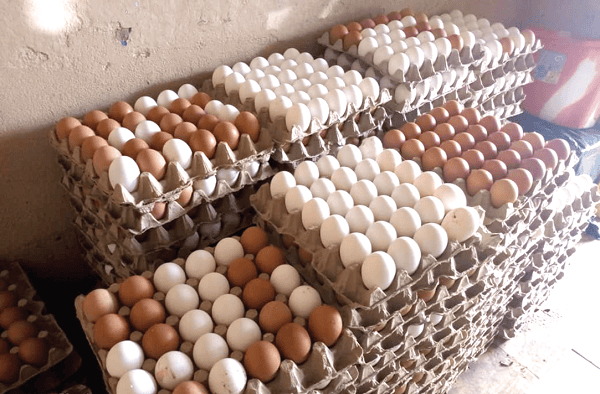
The Ghanaian government has been urged to implement an “egg-a-day” directive under the National School Feeding Programme to scale up local procurement, absorb domestic production, and eliminate the country’s heavy reliance on foreign markets.
The National Chairman of the Poultry Farmers Association of Ghana, Mr. George Dassah, emphasized that the country’s vast student population could easily sustain the poultry industry if local supply is fully integrated into the school feeding agenda.
“Although the School Feeding Programme patronises eggs for the schools, the quantity of eggs purchased is not encouraging, and that is why we have proposed that a directive ought to be issued so that every beneficiary under the Programme will consume an egg a day. If that is done, there would be no need to export eggs to Burkina Faso and other neighbouring countries. This will help us expand, create more jobs, and employ more people,” he explained.
Speaking on Nyankonton Mu Nsem on Rainbow Radio 87.5FM, he recalled that during the launch of the Nkoko Nkitinkiti initiative, President John Dramani Mahama pledged that beneficiary schools would purchase local eggs and chicken—a commitment subsequently captured in the national budget by Finance Minister Dr. Cassiel Ato Forson.
“That was something we commended; however, you will agree with me that in most cases, when such announcements are made, they become just a talk shop. So we took steps and engaged with authorities so we could develop modalities on how the schools could off-take the eggs. We met with the Education Minister, and it was agreed that CHASS would be the implementation body. We have set up a committee; the committee has finished its work and submitted its report, so we expect that the recommendations will be implemented,” he noted.
This call comes even as Mr. Dassah expressed profound gratitude following Burkina Faso’s decision to lift its ban on egg imports from Ghana.
He noted that while the move will enable farmers to regain vital export markets, generate much-needed income, and sustain their operations, long-term stability lies in domestic consumption.
Mr. Dassah explained that the foreign trade prohibition had severely impacted association members, forcing many to halt operations due to a lack of buyers, resulting in significant capital losses.
“Already, we had an egg glut, but it was not severe until the ban on egg exports took effect. It negatively impacted farmers. Poultry farmers faced a serious financial crisis. The eggs were not moving. We will therefore express our gratitude to the authorities who managed to have the ban on exports lifted. This will go a long way in providing us with the market to sell our eggs. We will get more resources to purchase feed for our birds,” he stated.
He further reassured the public that the resumption of exports would not trigger any astronomical price hikes for eggs on the local market.
The diplomatic breakthrough followed high-level engagements in Burkina Faso led by the Minister for Trade, Agribusiness and Industry, Elizabeth Ofosu-Adjare, and the Minister for Food and Agriculture, Eric Opoku.
Burkina Faso had previously imposed the restrictions as a precautionary measure over quality concerns involving egg imports from certain countries, particularly those originating from Dormaa.
The lifting of the trade barrier paves the way for the immediate resumption of exports and strengthens bilateral trade between the two neighbouring nations, even as local farmers push for stronger internal market protections.
By: Rainbowradioonline.com/Ghana