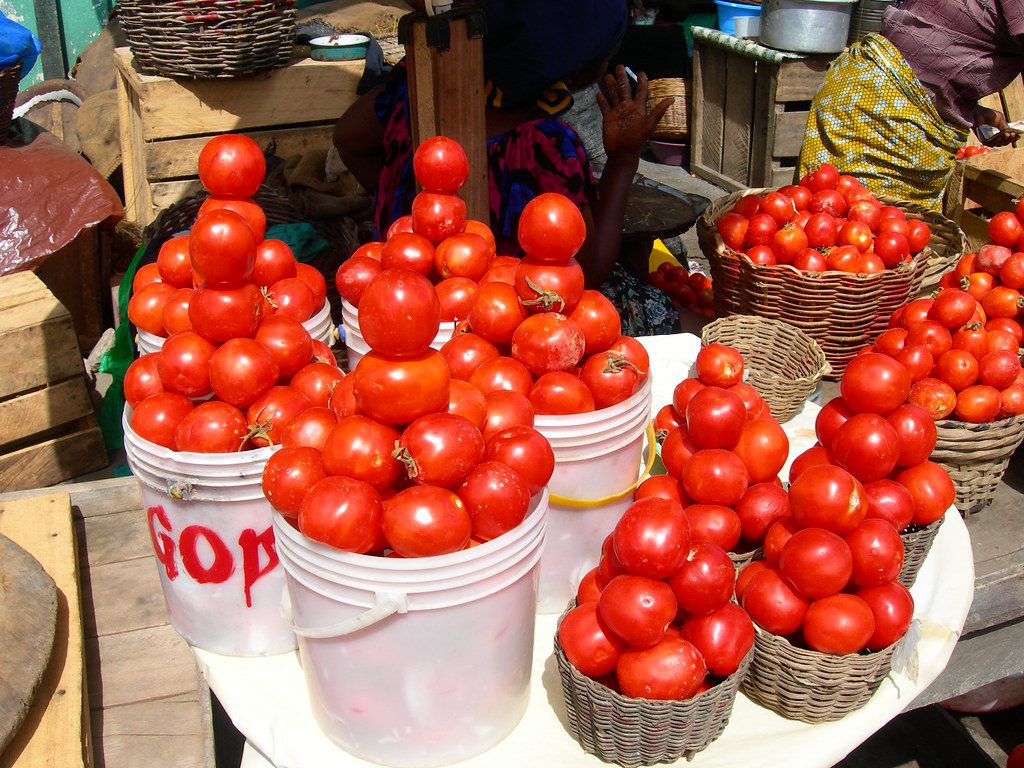
Ghana’s tomato imports alone exceed US$230 million annually, while a disease-driven collapse of ginger has left the country 99 per cent import-dependent, Council for Scientific and Industrial Research (CSIR) researchers have said, urging a research-led recovery.
Scientists at CSIR said the country’s increasing dependence on imports highlights weak seed systems, limited irrigation, poor soil health, disease pressure, and insufficient investment in horticultural research.
They were speaking at the second session of the 2026 Ministry of Environment, Science, Technology and Innovation (MEST) Visibility Webinar Series, held virtually on the theme “CSIR’s Interventions on Tomato and Ginger”.
Dr Michael Kwabena Osei, Principal Research Scientist and vegetable breeder at the CSIR Crop Research Institute, reported that national demand for fresh and processed tomatoes now exceeded 1.4 million metric tonnes annually, but local production met only about 15 to 18 per cent of that requirement.
He explained that Ghana produced about 120,000 to 180,000 metric tonnes of tomato a year from an estimated 25,000 to 30,000 hectares, leaving an annual supply deficit of about 1.1 million metric tonnes.
Fresh tomato imports, mainly from Burkina Faso, were estimated at 100,000 to 120,000 metric tonnes annually, costing about US$18 million, while processed tomato imports, largely from China and Europe, were equivalent to 400,000 to 450,000 metric tonnes of raw tomato and cost about US$150 million.
Dr Osei stated that combined tomato imports exceeded US$230 million a year yet still filled only about 40 per cent of the country’s tomato shortfall.
More than 60 per cent of fresh tomato imports enter Ghana during the dry season, between November and April, when local supply falls sharply, he said.
Despite having more than 400,000 hectares of arable land suitable for tomato cultivation, Ghana’s average yield remains between seven and 10 tonnes per hectare, compared with potential yields of 20 to 80 tonnes under improved varieties and good agronomic management.
Dr Osei said the constraint was not land but technology, citing quality seed, plant protection, dry-season water, healthy soils and sound agronomy as the missing links.
“A country that imports its seed will always import its food,” he said.
He noted that about 89 per cent of tomato farmers were small-scale growers cultivating between five and 20 acres, while many relied on seed extracted from ripe fruit or recycled hybrids that lost vigour and productivity.
More than 85 per cent of tomato seed planted in Ghana was expensive commercial hybrid seed, he said, calling for a stronger domestic seed system to reduce dependence on imports.
Dr Osei also pointed to irrigation gaps, saying only about 9,000 hectares of the 15,000 hectares covered by 22 public irrigation schemes were currently in use.
He said public irrigation schemes and affordable dry-season water were central to reducing imports, especially as crops could fail when temperatures rose above 32 degrees Celsius.
The tomato sector was also being held back by weak extension support, acidic soils, bacterial wilt, nematodes, low organic matter and a struggling processing industry, he added.
Dr Osei said the state-owned Pwalugu Tomato Factory, established in 1961 with a capacity of 500 tonnes a day, had been non-functional for years, while private processors relied largely on imported concentrate instead of local fruit.
He stated that the CSIR had already released two open-pollinated tomato varieties, CRI-Kwabena Kwabena and CRI-Copia, which have shelf lives of approximately 18 and 21 days, respectively, and that it holds the largest tomato germplasm in Ghana.
The researchers proposed a range of interventions spanning short-, medium- and long-term strategies.
These include the rapid evaluation of existing crop varieties, the production of certified seeds, training programmes for farmers, the establishment of solar powered boreholes, improvements in soil quality, the creation of mechanisation hubs, and the implementation of protected cultivation techniques
Dr Osei said Ghana also needed a Tomato Board by 2028 and a dedicated Horticultural Research Institute by 2030 to coordinate research, seed development, processing, financing and market integration.
He summarised the proposed recovery framework as “policy to protect, research to solve, and market to make profit.”
On ginger, Dr Osei noted that national demand had risen from about 18,000 tonnes in 2020 to between 30,000 and 32,000 tonnes in 2025, but production collapsed after a bacterial wilt outbreak in 2022.
The disease, caused by Ralstonia solanacearum and locally referred to as the “ginger killer”, reduced national production from about 102 tonnes to roughly 10 tonnes, leaving Ghana more than 99 percent dependent on imported ginger.
Ghana now spent about US$500,000 annually importing ginger, mainly from China, Nigeria and Burkina Faso, he added.
The supply shock had driven prices sharply upward, with a sack of ginger rising from about GH¢250 in 2022 to GH¢4,000 in 2025 and about GH¢6,000 or more at the time of the webinar.
Dr Osei noted that the disease was soil-borne, spread through infected planting material, poor drainage, heavy rains, monocropping and contaminated farm tools, and could not be chemically treated once a crop was infected.
He stated that CSIR’s recovery plan for ginger rested on four pillars: development of resistant varieties, production of disease-free planting material through tissue culture, disease surveillance and integrated pest management, and farmer deployment through extension networks.
Ms Matilda Frimpong, a ginger research scientist at CSIR-CRI, advised that growers should obtain certified rhizomes from certified companies or research institutions because the wilt pathogen was microscopic, soil-borne and could not be identified by sight.
She noted that the most sustainable long-term control measure was breeding for resistance, beyond crop rotation and other cultural practices.
Dr Richard Yaw Agyare, vegetable breeder at the CSIR Savannah Agricultural Research Institute, indicated that northern Ghana, particularly the Upper East Region, once played a leading role in national tomato production but many irrigation sites now produced little tomato.
He said national tomato output had stagnated at about 360,000 tonnes annually for nearly a decade, with productivity around 7.8 tonnes per hectare, far below Morocco’s 94 tonnes and Burkina Faso’s 17 tonnes per hectare.
Dr Agyare attributed the northern production decline to pests and diseases, declining soil fertility, weak agronomy, recycled hybrid seed, heat stress, poor market incentives and competition from imported Burkina Faso tomatoes.
He said heat stress from February onwards shortened the dry-season production window, while the absence of rainy-season varieties suited to hot, humid conditions limited year-round production.
The SARI, he stated, was breeding tomato varieties for both rainfed and dry-season ecologies, with promising lines undergoing validation and multi-location trials.
He added that adding climate-smart varieties could increase yields, improve fruit quality, raise farmer incomes, support nutrition, revive processing industries and reduce Ghana’s tomato import bill.
Rev. Dr Cephas Adjei Mensah, the Director of Research, Statistics and Information Management at MEST, said that the government was encouraged by CSIR’s interventions and would follow up on proposals for stronger institutional support.
He welcomed the call for a dedicated horticultural research institute, saying it could be framed as a centre of excellence to serve Ghana, West Africa and the wider continent.
The webinar was moderated by Prof. Maxwell D. Asante, Director of CSIR-CRI, and formed part of MEST’s visibility series to showcase research interventions supporting national development.
Source: GNA