
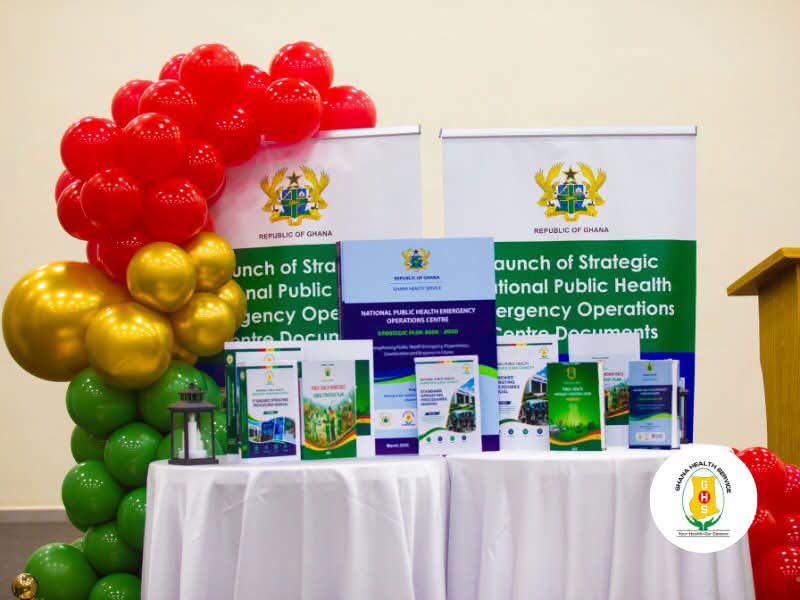
The Ghana Health Service (GHS) has launched a strategic policy suite and national roadmap to establish, govern, and operationalize Public Health Emergency Operations Centres (PHEOCs) across the country.
The initiative aims to strengthen Ghana’s capacity to prepare for, coordinate, and respond to public health threats.
The unveiling took place at the Prof. Agyeman Badu Akosa Conference Centre at the new GHS Headquarters in Pantang, bringing together key players from health, security, and development sectors.
Delivering the welcome address on behalf of the Director of the Public Health Division, Deputy Director for Disease Control Dr. Kwame Amponsa-Achiano stated that modern health crises require an all-inclusive, multi-sectoral approach.
He noted that emergencies ranging from infectious disease outbreaks to chemical hazards impact national security, trade, and the broader economy, demanding unified leadership, clear accountability, and timely information sharing.
Officially launching the documents, the Director-General of the GHS commended the PHEOC team for over eight years of dedicated work.
Reflecting on past crises, including the 2014 West African Ebola outbreak and the COVID-19 pandemic, he stressed that effective emergency response relies on institutions acting as one coordinated system.
To maintain inter-agency readiness, he proposed establishing an annual “National Public Health Emergency Operations Centre Day” to test protocols and review joint responses.
Head of the National PHEOC, Dr. Lawrence Lartey, presented a technical overview of the five core documents forming the integrated framework.
These include the National PHEOC Strategic Plan (2026–2030), the National PHEOC Handbook (2026), Volume 1 of the Standard Operating Procedures (SOPs), the National Public Health Workforce Surge Strategic Plan (2026), and its accompanying Volume 2 SOPs.
Dr. Lartey explained that these policies align with international benchmarks under the International Health Regulations (IHR 2005) and outline seven strategic priorities, including governance, predictive AI technology, workforce expansion, and sustainable financing.
International partners present at the event reaffirmed their support for Ghana’s health security agenda.
Country Director of KOICA Ghana, Dong Wan Woo, pledged continued collaboration to build resilient systems.
Outgoing Country Director for the US CDC, Dr. Danielle T. Barradas, noted that real-world encounters with outbreaks like Marburg virus, Mpox, Lassa fever, and polio helped shape the practical framework, urging stakeholders to prioritize live simulation exercises and continuous training.
Representing the African Field Epidemiology Network (AFENET) Ghana, Mr. Joshua Asamoah Frimpong emphasized that written policy must translate into rapid action, remarking that the true test of the framework will be its execution during real-time crises.
Technical partner representatives from Resolve to Save Lives and Palladium also praised the GHS for proactive leadership in establishing clear operational guidelines.
Highlighting community engagement, Manye Naa Badu Adiagba, Queenmother of Abelemkpe and Caretaker of Dzorwulu, urged formal collaboration between health authorities and traditional leaders.
She proposed establishing a five-member health committee in every palace to ensure early reporting of unusual illnesses and effective local communication during emergencies.
The event concluded with a farewell tribute to Dr. Danielle T. Barradas, with the GHS acknowledging her contribution to expanding national disease surveillance, laboratory capacity, and border health infrastructure during her tenure in Ghana.
By: Rainbowradioonline.com/Ghana