
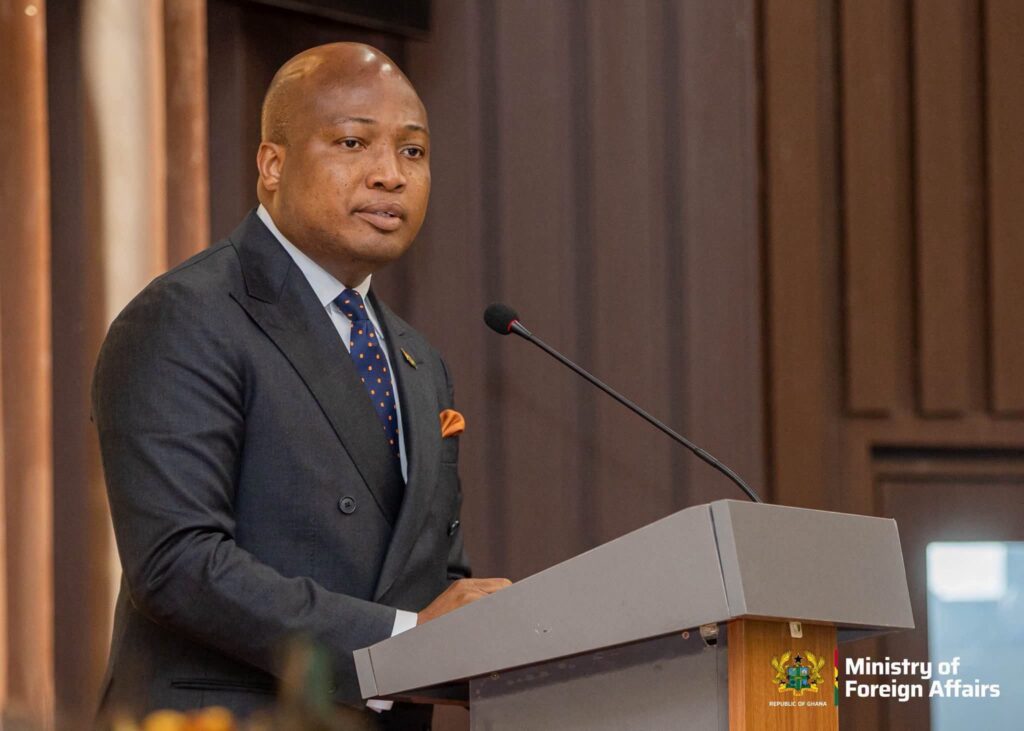
The Minister for Foreign Affairs, Samuel Okumdjeto Ablakwa, has offered further clarification on Ghana’s intentions regarding the BRICS bloc, specifying that the country plans to apply strictly as a Partner Country rather than seeking full membership.
Speaking during an interview on Key Points, a Saturday morning current affairs programme on TV3 on 10th October 2026, the Minister explained that the decision aligns with Ghana’s constitutional mandate to prioritise national interest.
According to Mr Ablakwa, Ghana already enjoys excellent bilateral relations with existing BRICS nations and would essentially be joining natural allies in what has become one of the world’s most formidable economic groupings.
He emphasized that at the core of the strategy is the country’s economic and strategic advancement as framed under the directive principles of state policy.
“At the heart of the decision is the desire to seek the national interest first, as enshrined in Article 40 of the 1992 Constitution of Ghana,” he stated.
Highlighting the global weight of the coalition, the Foreign Minister noted that BRICS brings together eleven major emerging economies: Brazil, China, Egypt, Ethiopia, India, Indonesia, Iran, Russia, Saudi Arabia, South Africa, and the United Arab Emirates.
He maintained that gaining partner status would offer Ghana a vital platform to participate in high-level consultations and cooperation on matters of global political, economic, and regional governance.
Addressing concerns surrounding potential geopolitical friction with traditional Western allies, Mr Ablakwa dispelled fears that the move would compromise West-backed diplomatic ties.
He reiterated that the decision is a clear reaffirmation of Ghana’s historical policy of non-alignment, citing past diplomatic precedents set during the First Republic.
“The decision affirms Ghana’s policy of non-alignment, which enabled President Kwame Nkrumah, at the height of the Cold War, to navigate the terrain to secure the support of the United States to build the Akosombo Dam, while at the same time getting the then Soviet Union to launch Africa’s pioneering atomic energy programme, the Ghana Nuclear Reactor Project,” he stressed.
The Minister further revealed that the government held prior diplomatic engagements with European Union member states to clarify the motivation behind the move, ensuring open communication.
He noted that Ghana clearly communicated its rationale, reaffirming that diversifying strategic partnerships for economic development does not signal a departure or disengagement from long-standing relationships with Western nations.
Should the application succeed, Ghana will join ten other nations—including Belarus, Bolivia, Kazakhstan, Cuba, Malaysia, Nigeria, Thailand, Uganda, Uzbekistan, and Vietnam—that were admitted as BRICS Partner Countries in 2025.
The BRIC group—comprising Brazil, Russia, India, and China—was formalised in 2006 during the UN General Assembly in New York, followed by its inaugural summit in Yekaterinburg in 2009.
South Africa joined in 2010, turning the bloc into BRICS, and attended its first summit in Sanya in 2011.
The alliance expanded further as Egypt, Ethiopia, Iran, Saudi Arabia, and the UAE became full members in January 2024, with Indonesia joining in January 2025.
In 2025, BRICS added a “Partner Country” status, admitting Belarus, Bolivia, Kazakhstan, Cuba, Malaysia, Nigeria, Thailand, Uganda, Uzbekistan, and Vietnam.
By: Rainbowradioonline.com/Ghana