
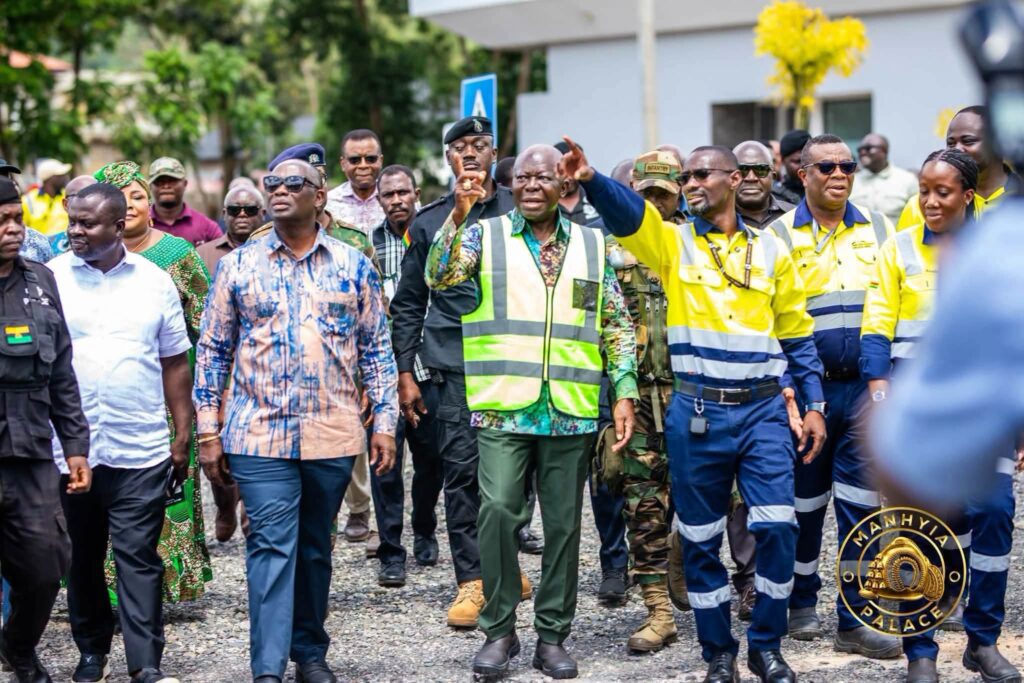
The King of the Asante Kingdom, Otumfuo Osei Tutu II, has spearheaded a major environmental restoration exercise along the Jimi River near Obuasi, planting symbolic trees to launch a decisive initiative aimed at reclaiming degraded lands and restoring water bodies wrecked by illegal mining activities.
Following an initial briefing at the AngloGold Ashanti headquarters in Obuasi, the Asantehene inspected ongoing reclamation works at Lot 1 of the Jimi Land Reclamation and River Watercourse Rehabilitation Project.
The 153-hectare site serves as a pilot under the Green Ashanti Initiative, before his tour extended to inspect the critical Jimi Dam downstream.
Crucial to the survival of the Adansi enclave, the site has suffered severe environmental degradation caused by illegal miners, popularly known as galamsey.
Unregulated mining has stripped vast vegetation cover, left dangerous open pits scattered across the landscape, and heavily polluted local soils.
At Tasliman, miners went as far as altering the natural watercourse with massive sand heaps, resulting in severe siltation and elevated water turbidity.
This severe contamination directly imperils the Jimi Dam, which processes portable drinking water for over 200,000 residents across Obuasi and surrounding Adansi communities. Elevated turbidity levels have dramatically escalated water treatment expenses while shrinking the dam’s storage capacity, forcing authorities to ration water supply to nearby towns.
Explaining the operational strain, the Director of Engineering at AngloGold Ashanti, Ing. Eric Broni, warned that the environmental damage poses an immediate threat to the region’s water supply.
“There is a possibility that this year, water abstraction will decrease. When the water level drops, abstraction decreases, but our cost increases. Last year we spent about $584,000 to treat water despite treating less. It is becoming a worry because we have to ration water to other communities,” he said.
To reverse the damage, the Jimi restoration scheme—conceived under the patronage and vision of the Manhyia Palace and directed by Oheneba Nana Kwaku Duah under the Ashanti Green Initiative—is executing a structured six-stage rehabilitation framework.
The comprehensive process involves backfilling abandoned pits, re-grading waste heaps, constructing slope terraces, containing heavy metal pollutants, establishing drainage controls, restoring topsoil, and cultivating kenaf crops.
Environmental experts selected kenaf—a rapidly growing fibre crop utilized for manufacturing sacks, ropes, and eco-composites—instead of traditional food crops to eliminate human health risks from residual soil toxins, while simultaneously generating alternative income streams for local farmers.
Under the supervision of the Environmental Protection Agency (EPA), the Jimi River and its surrounding buffer zones are undergoing thorough cleansing and re-vegetation, supported by technical and operational assistance from AngloGold Ashanti.
Reacting to the development, the Minister for Lands and Natural Resources, Emmanuel Armah-Kofi Buah, revealed that illegal mining has ravaged nearly 8,000 hectares across 188 forest reserves nationwide, with barely 150 hectares successfully reclaimed to date.
“Government can only succeed with partnership. 80% of water comes from forest reserves, and this goes to the core of human survival. Government is committed to this partnership. The Asantehene’s commitment is a model for all chiefs,” he said.
In his remarks, the Minister for Local Government, Chieftaincy and Religious Affairs, Mahama Ayariga, commended the initiative as a landmark multi-stakeholder campaign.
“What you are doing is the launching of a national crusade for traditional leaders to partner with civil society, mining companies and government to lead the way to restore degraded lands,” he said.
Project organisers maintain that the tree-planting exercise at Jimi represents far more than a symbolic gesture, establishing a scalable, practical blueprint to rehabilitate Ghana’s damaged ecosystems, safeguard vital water infrastructure, and secure sustainable livelihoods for affected mining communities.
By: Rainbowradioonline.com/Ghana