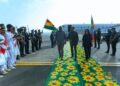
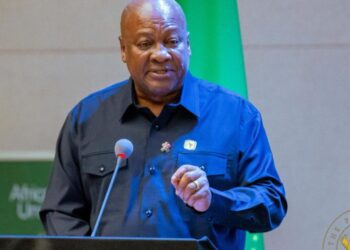
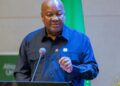
President John Dramani Mahama, has called on African nations to break away from their reliance on foreign aid for security initiatives, insisting that sustainable peace can only be achieved through genuine regional integration, economic trade, and inclusive governance.
Delivering an address at the Tana Forum, Mahama cautioned that relying heavily on foreign aid undermines the continent’s autonomy and its ability to resolve domestic challenges effectively.
“My brothers and sisters, that is not an African solution to African problems. That is external dependency disguised in an African beret. We must fund our own peace outcomes,” he said.
Beyond traditional security measures, Mahama stressed the strategic role of economic collaboration in averting conflict. He challenged the continent to look past the conventional commercial view of the African Continental Free Trade Area (AfCFTA), describing it as a central pillar for long-term stability.
“We often view the African Continental Free Trade Area purely as a commercial project. That is a mistake. The African Continental Free Trade Area is perhaps our architecture for conflict prevention,” President Mahama said.
“When you integrate markets, you raise the opportunity cost of war. You make your neighbor more valuable to you as a trading partner and a supplier than as a geopolitical adversary.”
He further observed that robust commercial cross-border links help weaken shadow economies—such as mineral smuggling and illegal extortion points—that frequently finance armed groups. Highlighting the Pan-African Payment and Settlement System (PAPSS), which allows cross-border trade using local currencies, he commended Ethiopia for embracing the platform and encouraged other African governments to follow suit.
“Trade cannot replace political settlement but poverty and border friction will always guarantee war,” he noted.
Detailing Ghana’s proactive regional strategy, Mahama cited the Sahel-Gulf of Guinea Accord—a initiative introduced by Ghana to supersede the Accra Initiative—as proof of practical commitment to regional security cooperation across bilateral, mini-lateral, and multilateral levels.
He reiterated that grassroots engagement forms the core of national defense.
“In our northern communities we learn that the first line of defense is not the soldier but the citizen who trusts the state enough to speak.”
Turning to diplomatic engagements, Mahama addressed Ghana’s position regarding members of the Alliance of Sahel States, emphasizing the importance of keeping communication channels open despite political differences.
“When our neighbor in the Alliance of Sahel States chose a different path we did not close the door to them. We appointed a special envoy to keep that conversation open because geography has made us neighbors and no border post can stop a threat that we refuse to discuss amongst ourselves.”
On social inclusion, Mahama urged leaders to move past symbolic representation and address economic disenfranchisement among women and young people.
“For too long, we have treated the inclusion of women and youth as a cosmetic exercise. A matter of token representation to satisfy a foreign checklist. Representation without economic power is meaningless,” he said.
“When African women farm the land but cannot own it, peace cannot take root. When youth unemployment is so rampant that joining an armed syndicate or an extremist group becomes the only viable path to a livelihood, our security strategies can be said to have failed.”
He urged African nations to shift their perspective on social empowerment entirely.
“We must stop viewing youth and women empowerment as charity. It is a hardline national security imperative.”
Concluding his speech, Mahama urged a fundamental shift in how state authority is perceived, emphasizing that true sovereignty must directly impact the lives of citizens on the ground.
“Sovereignty is not a legal fiction defended in presidential palaces. Sovereignty is what the nomadic herder in the Liptako-Gourma corridor feels when he looks for protection. It is what the cross-border trader at Lake Chad faces. It is what a mother in Goma feels when she tucks her children in at night,” he said.
“If the state is absent from their lives or if it shows up only as an extortionist checkpoint, someone else will fill that vacuum, whether a warlord, a terrorist recruiter or an external mercenary group. Sovereignty must be built from the ground up.”
By: Rainbowradioonline.com/Ghana