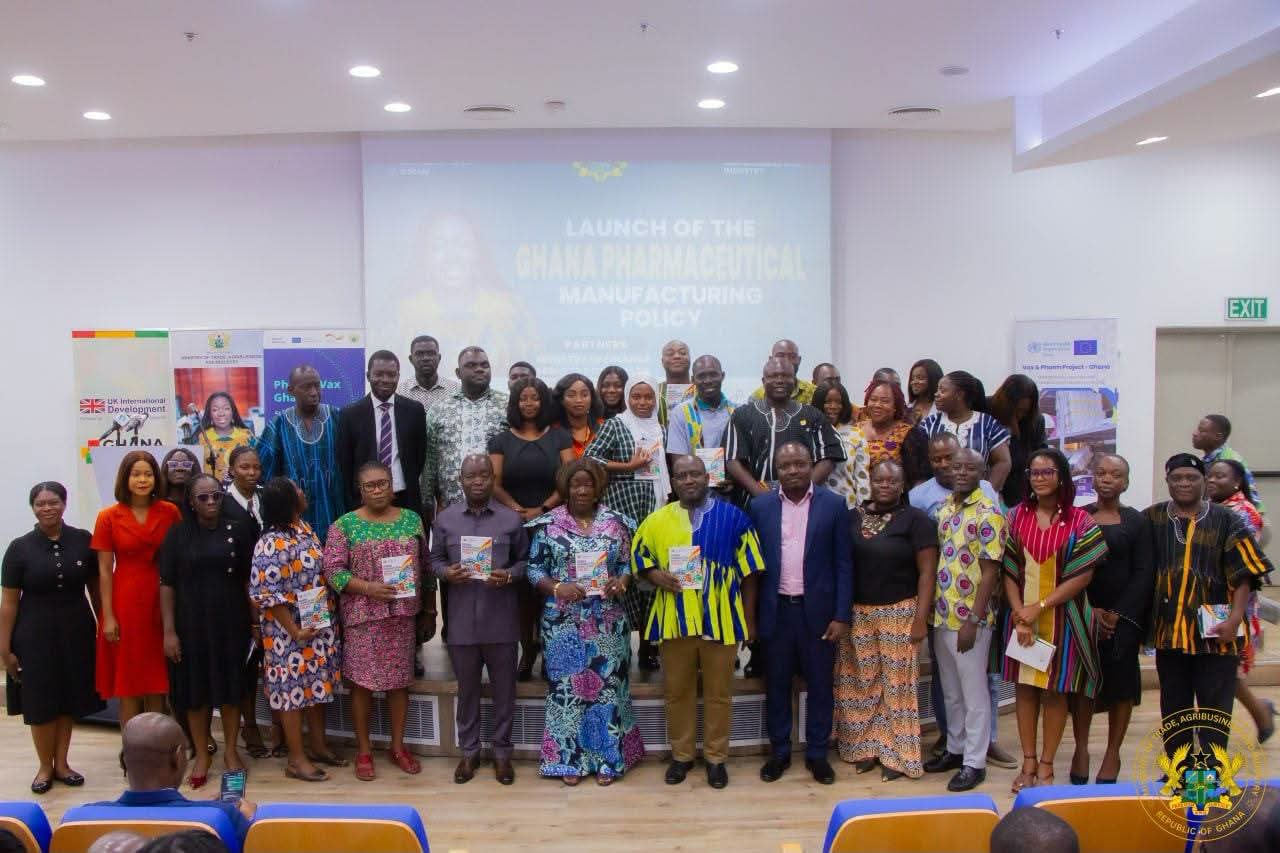
The Ministry of Trade, Agribusiness and Industry has unveiled a comprehensive, Cabinet-approved Ghana Pharmaceutical Manufacturing Policy aimed at overhauling the nation’s health sector and strengthening domestic production.
The strategy seeks to transform Ghana into a West African pharmaceutical powerhouse by doubling local medicine production, expanding skilled employment, and significantly reducing the country’s heavy reliance on foreign pharmaceutical products.
Speaking at the official launch in Accra on Wednesday, October 28, 2026, the Minister for Trade, Agribusiness and Industry, Hon. Elizabeth Ofosu-Adjare, stressed the urgent need to overhaul a system that currently sees 70 per cent of essential medicines imported from overseas.
She explained that the blueprint sets a target to raise local production from the current 30 per cent market share to 60 per cent, serving as a critical stepping stone toward President John Dramani Mahama’s broader vision of achieving 70 per cent self-sufficiency in medicine supply.
Reflecting on the strategic necessity of the move, Hon. Ofosu-Adjare underscored that access to health supplies remains tied to economic stability and national sovereignty. She noted that relying on foreign markets for life-saving items leaves the country exposed to external supply shocks and global price fluctuations.
According to the Minister, the unified framework integrates regional trade initiatives, public procurement systems, specialized training programmes, regulatory frameworks, and targeted financing to support Ghanaian manufacturers.
The policy targets core growth areas, including upgrading local facilities to meet World Health Organisation Good Manufacturing Practice standards, leveraging state procurement through the National Health Insurance Scheme to secure demand for domestic products, and offering long-term financing through institutions like Development Bank Ghana and Ghana EXIM Bank.
Additionally, the strategy aims to transition local industries beyond simple packaging into the synthesis of active pharmaceutical ingredients and vaccines, while encouraging academic-industry research and utilizing opportunities under the African Continental Free Trade Area to boost exports across West Africa.
The high-level launch gathered key stakeholders, including representatives from the Ministry of Health, Ministry of Finance, the Food and Drugs Authority, National Vaccine Institute, GIZ, the World Health Organisation, and the European Union.
By: Rainbowradioonline.com/Ghana