
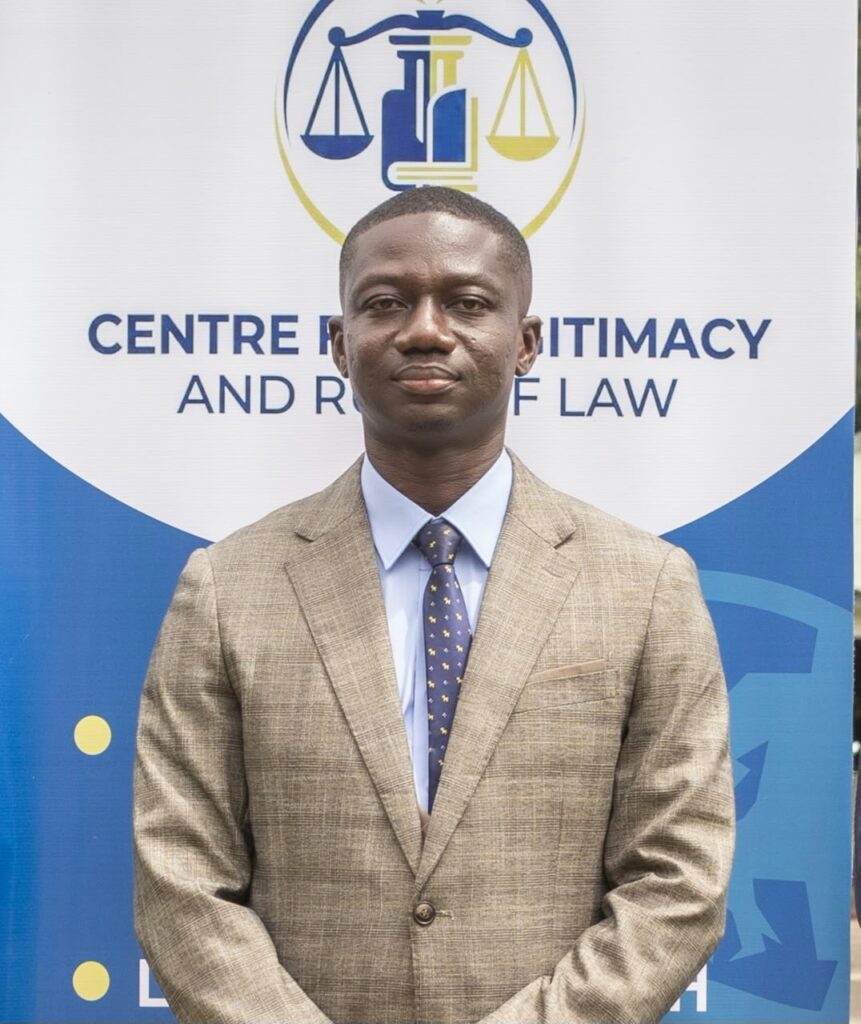
Richard Nii Amarh, Head of Legal for the Centre for Legitimacy and Rule of Law, has stated that the Ghana Police Service is incompetent when it comes to investigating and tackling fraud orchestrated through digital means.
He made the remarks following news that two Ghanaian nationals have pleaded guilty in a United States federal court for their roles in a massive international fraud network.
The illicit operation is said to have defrauded victims of over $100 million through sophisticated romance scams and business email compromise schemes.
Isaac Oduro Boateng, 37, also known as “Kofi Boat,” and Inusah Ahmed, 41, popularly known as “Pascal,” admitted to conspiracy to commit wire fraud before U.S. District Judge Arun Subramanian in the Southern District of New York.
Court filings revealed that both men acted as leaders within the Ghana-based syndicate, which targeted vulnerable individuals and corporate entities across the United States.
Commenting on the matter on Rainbow Radio 87.5FM’s news show, Nyankonton Mu Nsem, Richard Nii Amarh stated that it is a disgrace that local Ghanaian law enforcement systems failed to track down and apprehend these individuals, leaving the U.S. Federal Bureau of Investigation (FBI) to step in and effect the arrests in Ghana.
“This is embarrassing and a disgrace to Ghana that we could not detect the fraudulent activities of our nationals who engaged in these criminal acts. It had to take the FBI to come to Ghana to arrest them and send them to the U.S. to face prosecution,” he lamented.
He explained that it was time for security agencies in the country to up their game to deal with such cases, which are gradually giving Ghana a bad image abroad.
“It is unfortunate that we have allowed these young men to use our internet infrastructure to engage in fraud. I told a friend recently that when you examine how the Ghana Police Service operates, they are incompetent when it comes to handling cybersecurity crimes. Why do I say so? Imagine someone defrauds another through the internet and you file a report; they will ask you to provide money so they can print documents to take your statement because they lack basic supplies,” he remarked.
He added: “They will delay until the suspect absconds. Even when a suspect is arrested and their mobile phones are seized, it becomes difficult for the police to retrieve relevant information. A case can drag on for a year with the police unable to extract digital evidence. Meanwhile, in the U.S., they can retrieve evidence within 62 hours. This is a disgraceful situation we must address. Whether through retraining officers, providing necessary equipment, or implementing other solutions, we must fix this.”
During court proceedings, it emerged that the perpetrators created fake online personas to lure elderly victims into romantic relationships before tricking them into transferring funds or laundering illicit proceeds.
The criminal enterprise also manipulated businesses into executing fraudulent wire transfers, subsequently routing the stolen funds to West Africa.
Boateng pleaded guilty on Friday and agreed to pay $12,529,213.98 in restitution and forfeiture for his role in the scheme. Ahmed, who admitted guilt on October 27, agreed to restitution and forfeiture totaling $28,574,002. Both men face a maximum potential sentence of 20 years in prison.
Commenting on the sentences, Nii Amarh opined that because the two pleaded guilty and agreed to forfeit portions of the money involved, they would likely avoid maximum sentences.
The pair were extradited to the United States on August 7, 2025, following a joint operation involving the FBI and several Ghanaian security and intelligence agencies, including the Economic and Organised Crime Office, the Ghana Police Service, the Cyber Security Authority, and the Financial Intelligence Centre.
By: Rainbowradioonline.com/Ghana