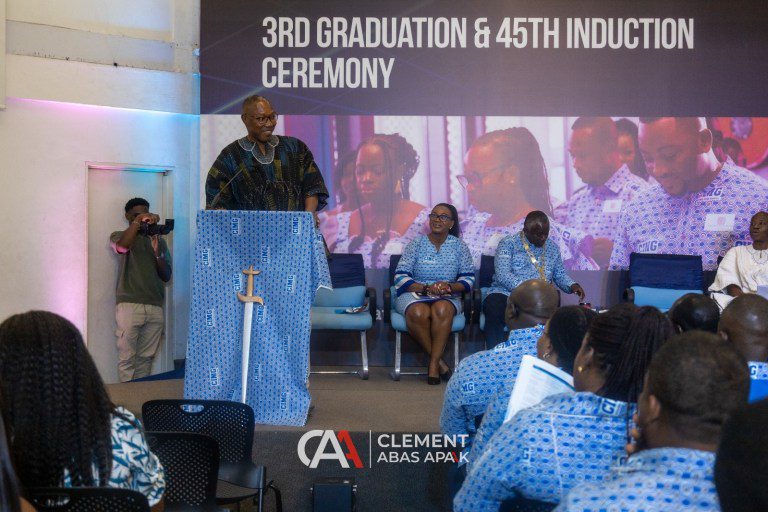
The Deputy Minister for Education, Dr Clement Abas Apaak, has advocated for a shift in Ghana’s educational framework, emphasizing that schooling must equip students to build businesses rather than merely seek employment.
Speaking at the third graduation and 45th induction ceremony of the Chartered Institute of Marketing, Ghana (CIMG) on Saturday, 31st October 2026, Dr Apaak called for a structured collaboration between the Ministry of Education and the institute to boost practical business skills and entrepreneurship nationwide.
According to him, marrying technical and academic training with essential marketing know-how will allow learners to spot commercial opportunities, build strong brands, and attract customers for their products.
“I therefore wish to use this occasion to formally invite the Chartered Institute of Marketing, Ghana, to engage the Ministry of Education in exploring a structured partnership to advance marketing education and enterprise development,” he stated.
Dr Apaak highlighted how CIMG’s involvement could transform technical and vocational education and training (TVET) by helping to design practical modules that teach students to commercialise their work. He noted that similar collaborations at the tertiary level could encompass curriculum enrichment, mentorship programmes, industry lectures, applied research, and internships.
Focusing on the practical application of skill sets across sectors, the Deputy Minister pointed out that technical expertise alone is no longer enough to succeed in the modern economy.
“A young person trained in agriculture must understand how to identify markets for agricultural produce. A student trained in fashion design, catering, manufacturing or information technology must appreciate how to build a brand, attract customers and turn technical expertise into a viable business,” he said.
He stressed that the nation must instil the capacity to generate economic value from raw skills, adding, “In other words, we must teach our young people not only how to produce, but also how to position, promote and successfully market what they produce.”
Addressing the government’s ongoing educational agenda, Dr Apaak explained that recent reforms—such as TVET enhancements, basic level AI literacy, coding, the STEM Box initiative, and the Secondary Education Transformation for Access, Relevance and Results for Jobs (STARR-J) programme—are designed to build a creative and adaptable workforce.
“These reforms are informed by a fundamental conviction: education must equip our young people not only to seek employment but also to identify opportunities, create enterprises and contribute meaningfully to national development,” he remarked.
In his concluding remarks, the Deputy Minister encouraged CIMG executives to begin formal discussions with the Ministry to establish a practical framework, noting that specific implementation details will be finalized following proper consultations and state approvals.
By: Rainbowradioonline.com/Ghana