
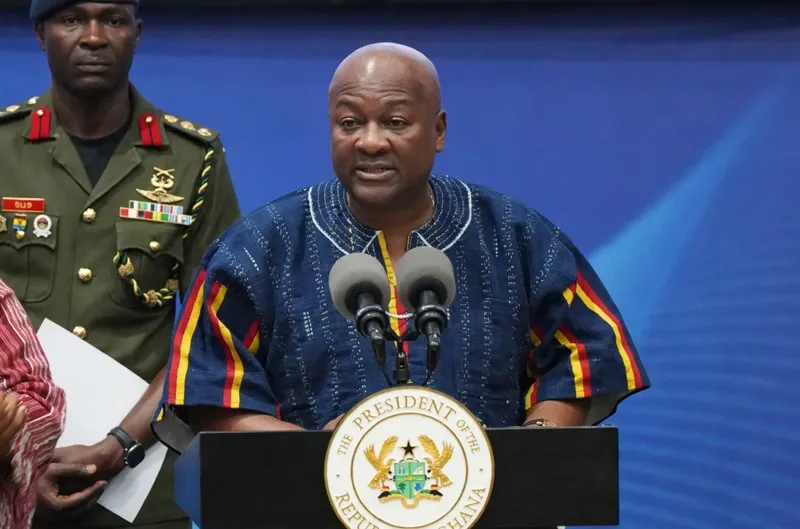
Ghana has ended its reliance on foreign facilities for forensic DNA analysis following the commissioning of a national human identification laboratory at the University of Ghana’s Noguchi Memorial Institute for Medical Research (NMIMR).
President John Dramani Mahama inaugurated the facility on Wednesday, November 18, 2026, alongside new mRNA and protein laboratories dedicated to local vaccine research. Established jointly by the National Vaccine Institute and Noguchi, the laboratories will serve as national assets accessible to Ghanaian scientists across all institutions.
Speaking at the ceremony, President Mahama revealed that the push for a local DNA testing facility was triggered by the tragic military helicopter crash on 6 August 2025. At the time, Ghana lacked the capacity to identify the victims, forcing authorities to fly tissue samples to South Africa while bereaved relatives endured “several nerve-wracking days” awaiting confirmation.
“It actually was a day of shame for Ghana that we couldn’t carry out our DNA analysis in country,” Mahama said. “That will be a thing of the past.”
Beyond disaster victim identification, the President noted that the new DNA laboratory will boost the Ghana Police Service’s forensic capabilities in solving complex crimes such as murder and rape. He added that the facility will help resolve paternity and inheritance disputes, as well as verify the biological relationships of children travelling abroad with adults to curb child trafficking.
Urging user agencies to handle cases with urgency and empathy, the President stated: “Behind every request for identification is a family that is waiting anxiously for news.”
On vaccine sovereignty, President Mahama announced that two indigenous pharmaceutical firms—Atlantic Life Sciences and DEK Laboratories—have been selected to lead local vaccine production. This follows a recent summit of African leaders in Accra focused on achieving continental vaccine self-sufficiency.
With the opening of the mRNA facility, Ghana joins an elite group of only five African nations utilising mRNA technology for vaccine research and development. President Mahama commended the Africa Centres for Disease Control and Prevention (Africa CDC) for its technical support, disclosing that the National Vaccine Institute is currently engaging a European partner to explore using the new mRNA platform for cancer vaccine research.
To ensure local expertise, five Ghanaian scientists drawn from Noguchi, the West African Centre for Cell Biology of Infectious Pathogens (WACCBIP), the Kumasi Centre for Collaborative Research (KCCR), and the University of Health and Allied Sciences (UHAS) underwent specialised training in Brussels and Accra. They are expected to train other local researchers to operate the facility.
Addressing public scepticism surrounding medical research, the President urged citizens to embrace clinical trials. He referenced a past incident where a planned Ebola vaccine trial in the Volta Region—led by researchers including the late Professor Fred Binka—was relocated outside Ghana due to public panic and misinformation.
“Nobody would do the clinical trials for us to develop vaccines in our country,” he stressed.
President Mahama further disclosed that his administration has earmarked $1 billion under the seventh pillar of its new economic blueprint to develop pharmaceutical and bio-manufacturing hubs across the country.
He also revealed that the government will spend $46 million this year on procuring vaccines for routine childhood immunisation, noting that the investment is critical as Ghana prepares to transition out of Gavi, the Vaccine Alliance support by January 2030.
By: Rainbowradioonline.com/Ghana