
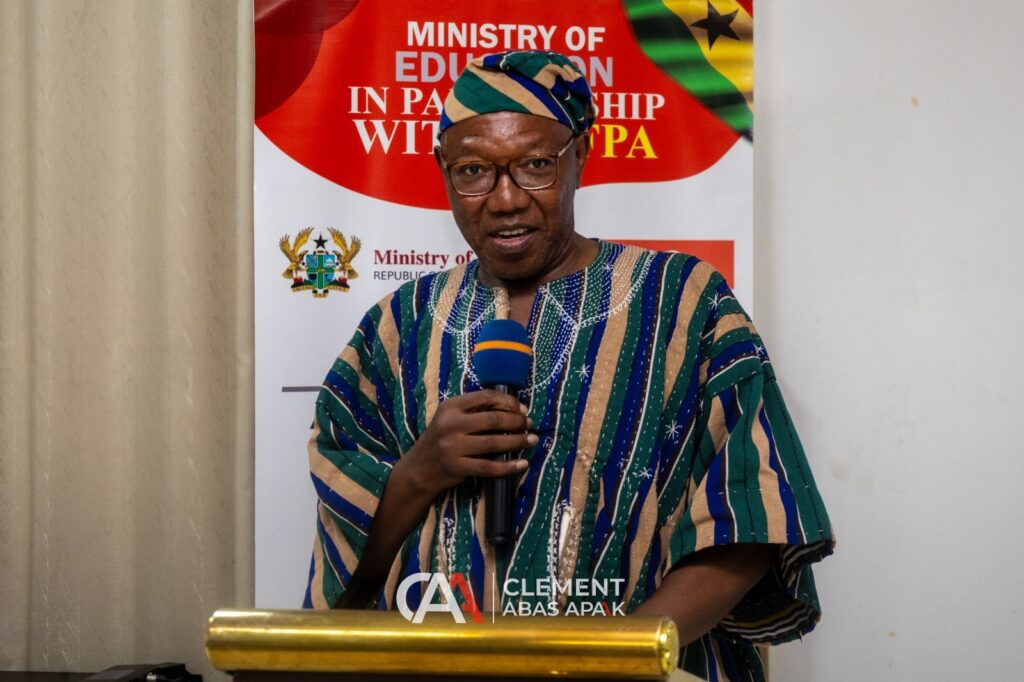
The Government has earmarked GH¢292 million in the 2027 Budget to sustain the free distribution of sanitary pads to schoolgirls nationwide, the Deputy Minister for Education, Hon. Dr. Clement Abas Apaak, has announced.
Speaking at the launch of the National Menstrual Hygiene Taskforce in Accra on Wednesday, November 25, 2026, Dr. Apaak revealed that the allocation forms part of an aggressive state intervention to ensure no female student drops out of school or misses lessons because she cannot afford basic menstrual products.
Providing a breakdown of recent procurement milestones, the Deputy Minister disclosed that while government procured over 13 million sanitary pads for distribution in 2025, an order for more than 17 million pads has already been placed for the 2026 academic year.
“This increase reflects our determination that no girl misses school, or is denied her educational opportunities, because she lacks basic menstrual hygiene products,” Dr. Apaak told stakeholders at the event. “It also reflects our belief that investment in girls is investment in Ghana’s future.”
He explained that limited access to sanitary wear, coupled with poor water and sanitation infrastructure in some basic and second-cycle schools, often results in reduced classroom participation and high absenteeism among adolescent girls.
“Every girl deserves to attend school consistently, learn comfortably and take part fully in academic and social life, without fear, embarrassment or disadvantage because of her menstrual cycle,” the Builsa South legislator emphasised.
While hailing the budgetary commitment as a major boost for educational inclusion, Dr. Apaak maintained that tackling period poverty requires a holistic approach. He tasked the newly inaugurated National Menstrual Hygiene Taskforce to ensure that investments in sanitary products are matched with improved school sanitation facilities and sustained advocacy against menstrual stigma.
“Together, we must work towards a Ghana where no girl misses school because of menstruation, where menstrual health is discussed openly without stigma, and where schools provide safe and supportive environments,” he added.
By:Rainbowradioonline.com/Ghana