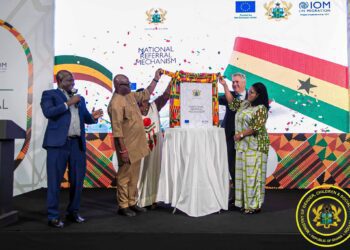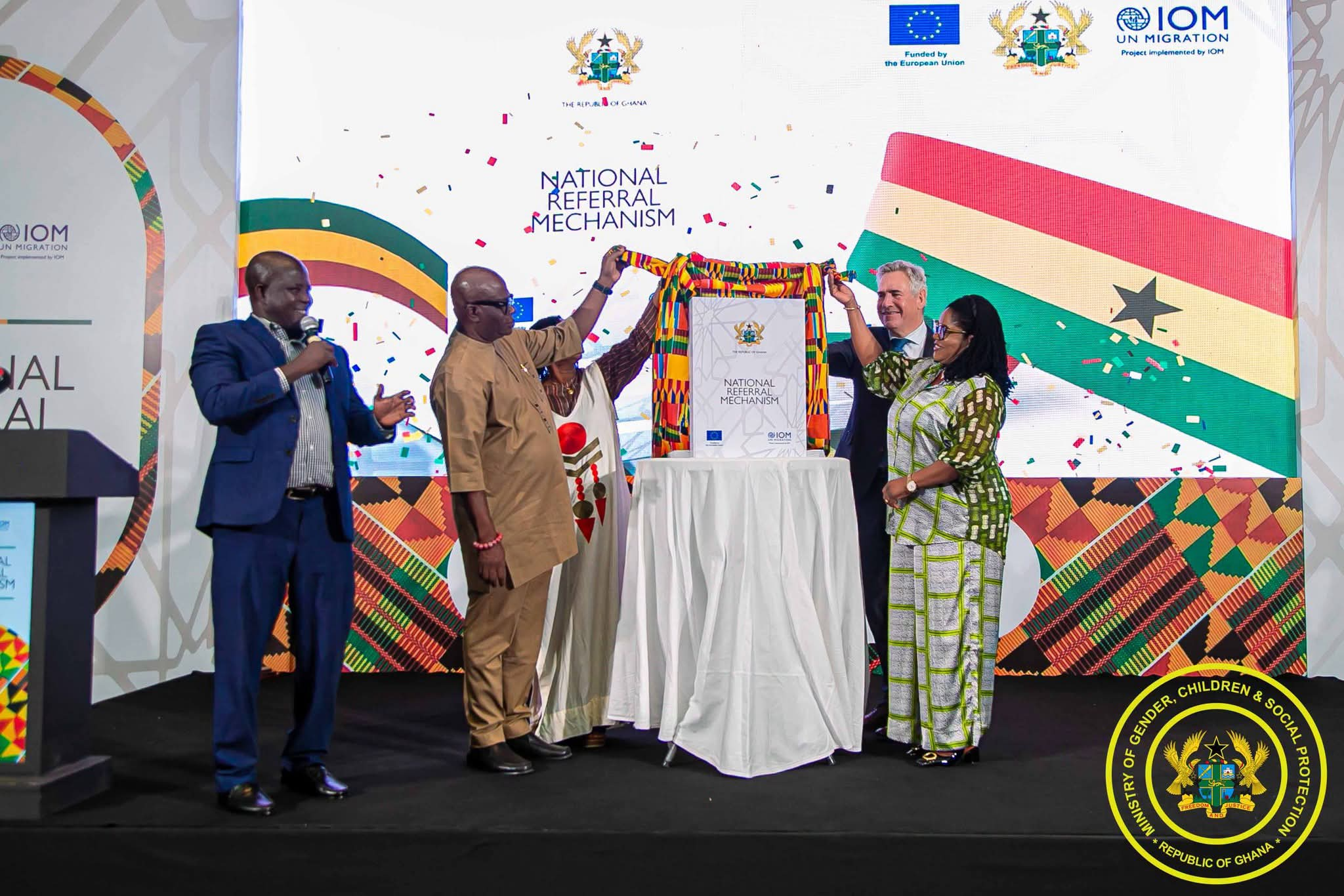
Ghana has officially launched a National Referral Mechanism (NRM) aimed at safeguarding, ensuring the safe return, and supporting the sustainable reintegration of migrants facing vulnerable conditions.
The initiative is a joint effort between the International Organization for Migration (IOM), the Ministry of Gender, Children and Social Protection, the Ministry of the Interior, and key partners, backed by funding and support from the European Union.
By establishing a unified framework, the mechanism seeks to streamline coordination among state institutions tasked with migration management. It will enable authorities to properly identify at-risk migrants, evaluate their specific needs, and connect them to essential support services.
Addressing the launch event, the Minister for Gender, Children and Social Protection, Dr. Agnes Naa Momo Lartey, hailed the rollout as a vital milestone in fortifying Ghana’s national protection systems and delivering timely aid to distressed migrants.
Dr. Lartey observed that while migration often brings economic prospects to individuals and households, many travellers fall victim to human trafficking, exploitation, abuse, and violence. She stressed that affected persons urgently require access to shelter, healthcare, psychosocial counselling, legal aid, child protection, and viable livelihood programmes.
She maintained that no single state agency can tackle these complex challenges alone, calling instead for a unified, rights-based, and multi-sectoral approach.
According to the Minister, the NRM establishes a locally owned structure complete with clear referral pathways linking government bodies, civil society groups, and international development partners.
It clearly defines institutional roles to boost accountability and guarantee continuous care, keeping the dignity and welfare of migrants at the heart of all interventions.
She added that the framework is firmly rooted in Ghana’s existing legal and constitutional architecture, drawing directly from the 1992 Constitution, the Human Trafficking Act of 2005 (as amended in 2020), the Children’s Act of 1998, and the Domestic Violence Act of 2007.
Furthermore, the mechanism aligns with the National Migration Policy, the National Plan of Action for the Elimination of Human Trafficking, the Diaspora Engagement Policy, and Ghana’s National Implementation Plan for the Global Compact for Safe, Orderly and Regular Migration.
Dr. Lartey announced that the Ministry of Gender, Children and Social Protection will house the NRM Secretariat and drive its execution, fitting squarely within its core mandate to champion social protection and safeguard vulnerable groups.
Through a dedicated case management model, the NRM will unite state institutions, non-governmental organisations, and international bodies to deliver holistic assistance. This comprehensive package covers access to justice, safe accommodation, medical care, education and vocational training, economic empowerment, personal wellbeing, and family tracing and reunification.
Officials at the event also unveiled a clear roadmap to bring the mechanism into full operation. Key steps include mapping relevant stakeholders, auditing existing systems, drafting standard operating procedures, setting up monitoring and evaluation tools, and forming an oversight coordinating committee.
Implemented by the IOM alongside state agencies with European Union backing, the initiative reinforces Ghana’s commitment to a coordinated national response that protects vulnerable migrants and helps them rebuild their lives sustainably.
By: Rainbowradioonline.com/Ghana