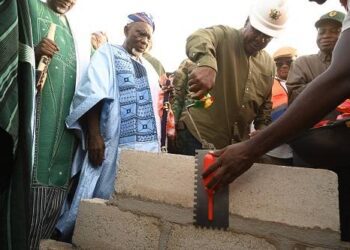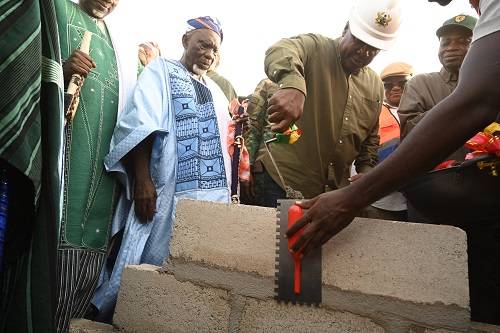
The Minister for Local Government, Chieftaincy and Religious Affairs, Hon. Ahmed Ibrahim, has announced government plans to construct 261 24-hour markets nationwide, ensuring every district receives one.
Appearing before Parliament’s Government Assurance Committee, Hon. Ibrahim explained that the project aims to modernise trading infrastructure and boost local economies.
“We intend to build two hundred and sixty-one market, one in every district. We have two hundred and sixty-one districts and we intend to build two hundred and sixty-one, one in every district,” he stated.
Although the official contract allows 36 months for construction, the government has instructed contractors to fast-track the project for completion within 18 to 24 months, aiming to commission the markets before the end of its current term.
“The construction period is supposed to be thirty-six months. But we ask the contractors that at least government does not have thirty-six months to be in office. So the completion period should be at least… we want you to be able to build it within eighteen to twenty-four months,” Hon. Ibrahim explained.
He added that he is personally committed to ensuring his own district benefits from the rollout, which is expected to generate employment, ease congestion in existing trading hubs, and improve working conditions for thousands of traders.
Hon. Ibrahim stated that state intervention is crucial because the collapse of indigenous banks has left Ghanaian traders unable to compete with foreign enterprises, which are increasingly dominating key commercial sectors.
“Unibank is no more. Sovereign Bank is no more. First Capital Bank is no more. The indigenous bank that used to give you and I, our sisters and our constituents money to go and do business are no more,” he stated.
The Minister noted that rising unemployment and a lack of capital prevent local traders from renting spaces in foreign-dominated shopping centres.
“When you go to Spintex Road you see China Mall. You go to other shopping malls, South Africa, Shoprite, Stanbic Bank. But the market women cannot go into them. They don’t have the high capital to go and pay the rent,” he told the Committee.
To counter this, he argued that the state must provide modern, suitable facilities.
“If the President wants to construct twenty-four hour market you can’t go and construct shelves that they should work twenty-four hours,” he said.
He further observed that international competitors succeed because they receive state-backed financial support.
“The China Mall and the market that you see are state-partnered businesses. The China government give them money. They go to China Bank for loan,” Hon. Ibrahim noted.
Without equivalent state backing, he warned, Ghanaian traders will continue to be priced out of major commercial hubs.
By: Rainbowradioonline.com/Ghana