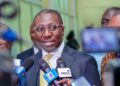
The Minority Leader in Parliament, Alexander Afenyo-Markin, has called for an urgent, non-partisan national conversation to address what he describes as a deepening crisis across Ghana’s secondary education sector.
Expressing deep concern over the latest examination outcomes and placement challenges, the lawmaker warned that the country risks leaving behind more than 200,000 young citizens without immediate intervention.
The call follows recent West African Examinations Council results, which revealed that 183,233 secondary school graduates failed to secure a credit pass in Core Mathematics, whilst English Language pass rates dropped to 62.40 per cent—marking the lowest level recorded in four years.
Simultaneously, nearly 55,000 Basic Education Certificate Examination candidates faced initial placement hurdles, with reports emerging of wrong assignments and space shortages despite official statistics indicating available vacancies nationwide.
Afenyo-Markin stressed that the current administration must move away from reactive measures and confront the systemic issues weakening the educational framework. He insisted that the government should provide complete transparency regarding placement criteria, properly resource remedial teaching programmes, and strengthen technical and vocational pathways for affected students.
“The latest WAEC results must concern every Ghanaian. They show that the future of our children is under serious threat,” the Minority Leader stated. He noted that the ongoing placement issues have placed immense psychological strain on families across the country, adding, “Mr President, parents are worried, children are anxious and teachers are under pressure. A self-placement portal is not a school place; every child needs an actual seat in a functioning classroom.”
Highlighting the policy foundation established by the New Patriotic Party through the expansion of Free SHS and Free TVET initiatives, Afenyo-Markin maintained that educational access must be matched with sustained quality, infrastructure, and adequate supervision. He called on the administration to treat the situation as a national emergency that requires comprehensive, lasting solutions rather than partisan rhetoric.
“Ghana urgently needs an honest national conversation about educational funding, teaching quality, contact hours, teacher motivation, learning materials, infrastructure and supervision,” Afenyo-Markin emphasised. “This must rise above partisan excuses because the future of an entire generation is at stake. When our children’s education is in crisis, Ghana’s future is in danger. The time to act is now.”
Read his full opinion below
WE NEED A CRITICAL NATIONAL CONVERSATION ON EDUCATION
The latest WAEC results must concern every Ghanaian. They show that the future of our children are under serious threat.
Some 183,233 young people completed secondary school without a credit in Core Mathematics, while the credit pass rate in English Language fell to 62.40%, its lowest level in four years. Performance in both subjects remains below the levels recorded in 2024.
At the same time, nearly 55,000 BECE candidates were initially denied automatic placement. We are hearing reports of children wrongly placed in special schools and others arriving at their assigned schools only to find no space. Yet government’s own figures show 859,828 vacancies for 623,072 candidates, while 85 private schools participating in Free SHS also have capacity. A self-placement portal is not a school place; every child needs an actual seat in a functioning classroom.
More than 200,000 young Ghanaians are therefore at risk of being left behind at both ends of the secondary-school system.
Government must stop reacting only when problems become public. It must publish the final placement outcomes, explain the rules and pass marks applied, properly fund teaching and remedial programmes, and provide clear pathways into TVET, apprenticeships and skills training for those who did not obtain the required WASSCE credits.
Mahama government is expected to treat this as a major national crisis requiring immediate action and lasting solutions.
Ghana urgently needs an honest national conversation about educational funding, teaching quality, contact hours, teacher motivation, learning materials, infrastructure and supervision. This must rise above partisan excuses because the future of an entire generation is at stake.
The NPP expanded access through Free SHS and created Free TVET, apprenticeship and skills-development opportunities because we believe no Ghanaian child should be denied a future by poverty or one set of examination results.
The 54,985 BECE candidates need real school places; the 183,233 WASSCE graduates need a second chance.
Mr President, parents are worried, children are anxious and teachers are under pressure.
When our children’s education is in crisis, Ghana’s future is in danger. The time to act is now.
By: Rainbowradioonline.com/Ghana