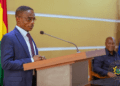
The minority leader, Alexander Afenyo-Markin, has opposed calls for reparatory justice over the Trans-Atlantic Slave Trade.
The Efuttu Member of Parliament opined that the historical narrative must fully reflect the role played by local actors.
He argued that slave trade was not driven solely by external forces but also involved the participation of some Ghanaians who subjected their own people to inhumane treatment.
He was responding to a statement on the floor of Parliament on Friday, March 27, 2026.
‘When somebody berths a vessel at Cape Coast, and you decide to go to the North, Bono area, get to the Ashanti area, and to the Assin area, and you are chasing your strongest among your own people, then after 100 years, you say, “I should be compensated.”‘
“Who should compensate whom? We maltreated our own and told the whiteman that he should also maltreat our own. The story must be told and must be put in its proper context.
“It is also a fact that the inhumane treatment, the unfortunate humiliation, the marginalisation, the injustice and the abuse of our ancestors who became victims of this slave trade must be condemned,” he said.
On his part, the majority leader, Mahama Ayariga, defended calls for compensation.
“Many of those countries that have wealth can trace their wealth to slavery. Many of the capitalist countries that have become rich started from plantations that were worked on by slaves. It is the labour of these slaves that helped them to build capital. As a result, there is the need to share that wealth in recognition of those who have been the foundation of the creation of that wealth,” he added.
By: Rainbowradioonline.com/Ghana