In the quiet savannah community of Gambaga, life begins early.
Before sunrise, smoke rises from clay pots as elderly women prepare porridge over firewood. Others sit silently in front of their mud huts, their faces marked by time, loss, and stories too heavy to tell at once.
These are not just women.
They are mothers, grandmothers, sisters, daughters.
But here, they are known by a different name: “witches.”
A Journey Into Ghana’s Hidden Reality
From Accra to northern Ghana is a journey of nearly 20 hours by road, a transition not just in distance, but in lived realities.
As temperatures climb beyond 40°C, and the dry harmattan wind sweeps across the land, communities like Gambaga remain largely invisible in national conversations.
Yet for decades, this settlement has served as a refuge for women accused of witchcraft, many of whom arrive here after facing threats, violence, and rejection from their own families.
How Women End Up in the Camps
In northern Ghana, accusations of witchcraft often emerge from fear, misunderstanding, or unresolved misfortune.
A woman may be accused if:
- A family member dies suddenly
- A child falls ill
- A marriage breaks down
- Or even through a dream or suspicion
For many, especially widows, the accusations come at their most vulnerable moments.
With no formal investigation or legal process, these accusations can quickly escalate into violence.
Some women are beaten. Others are chased out of their homes. A few barely escape with their lives.
For them, camps like Gambaga become the only place to run to.
Life Inside the Camp
Gambaga is one of at least six known “witch camps” in Ghana, alongside Kukuo, Gnani, Nabuli, Kpatinga, and Leli Dabari.
In Gambaga alone, about 86 women currently live under the authority of a traditional priest, who is believed to determine their innocence or guilt through spiritual rituals.
Life here is difficult, limited access to food and clean water, inadequate healthcare, poor shelter conditions and heavy dependence on firewood for survival
Yet, despite these conditions, the women have formed a fragile community of support.
They farm small plots, cook together, and share the little they have.
“They Said I Was the Cause”
Each woman carries her own story.
Fati recalls being accused after her husband’s death.
Mma Abiriwa says her son’s mental illness was blamed on her.

Adiza was accused after her daughter-in-law suffered multiple miscarriages.
Ama Salifu says her refusal to agree to a child marriage turned her into a target.
Then there is Dinwaak.
Blind, after surviving a brutal attack, she now sings instead of speaking.
“It doesn’t matter whether I am a witch or not,” she says quietly.
“Living here already makes people believe I am.”
Moments like these reveal a painful truth, accusation alone is enough to change a life forever.
A Broader Social and Health Concern
Beyond the human rights implications, the existence of these camps raises serious concerns about public health and social protection.
Many of the women suffer from:
- Untreated medical conditions
- Trauma and mental health challenges
- Malnutrition and poverty
Experts say the situation is worsened by:
- Low levels of education
- Deep-rooted cultural beliefs
- Limited access to social services in rural areas
Children are also affected.
Some are brought to the camps with their mothers, while others are abandoned.
In extreme cases, children with conditions such as epilepsy or developmental disorders are labelled “spirit children” and face neglect or harm.
Government and NGO Efforts
Successive governments and civil society organisations have acknowledged the need to address the issue.
Organisations like ActionAid Ghana, Savana Signatures and other NGOs have worked to reintegrate accused women back into their communities, provide livelihood support, raise awareness to reduce stigma.
Between 2014 and 2022, over 80 women were successfully reintegrated, while more recent interventions have seen dozens more return home.
However, reintegration remains slow and challenging.
Many communities are unwilling to accept the women back, fearing spiritual consequences.
To Close or Not to Close the Camps
While there have been calls to close down the camps, experts warn that doing so without proper reintegration plans could put lives at risk.
For many of the women, the camps, despite their harsh conditions, remain a place of safety.
Closing them abruptly could expose them to renewed violence or even death.

A Thin Line Between Belief and Reality
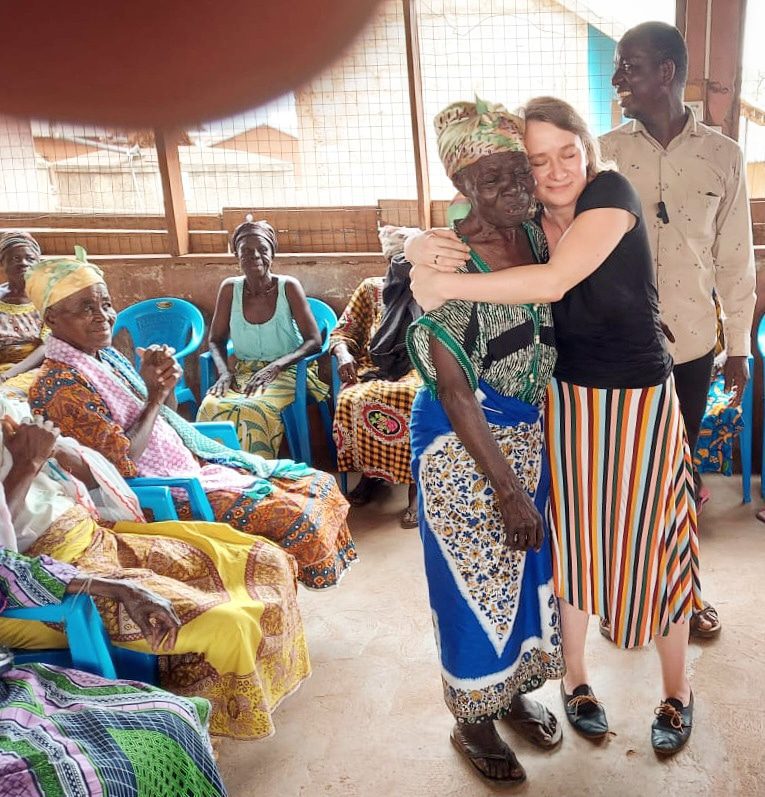
Walking through the camp, it becomes clear that these women are not defined by the accusations against them.
They laugh. They share food. They welcome strangers warmly.
In many ways, they continue to rebuild a sense of dignity in a place born out of rejection.
Their stories raise difficult but necessary questions about justice, belief systems, and the protection of vulnerable people in society.
Because in the end, the difference between being accepted and being cast out may be nothing more than suspicion.
A Story Ghana Cannot Ignore
As Ghana continues to position itself as a leader in democracy and human rights, the existence of these camps presents a stark contradiction.
For the women in Gambaga and beyond, the hope is simple:
Not just to survive, but to be seen, heard, and accepted again.
By Anna Alboth, in collaboration with Prince Kwame Tamakloe