The Minister for Communication, Digital Technology and Innovations, Hon. Samuel Nartey George, has announced plans to seek Cabinet approval this week for the implementation of a ‘dig once’ policy aimed at permanently resolving recurring network fibre cuts across the country.
Speaking at the Government Accountability Series, the Minister outlined the major causes of data disruptions on mobile networks, identifying ongoing road construction and excavation works as the single largest contributor.
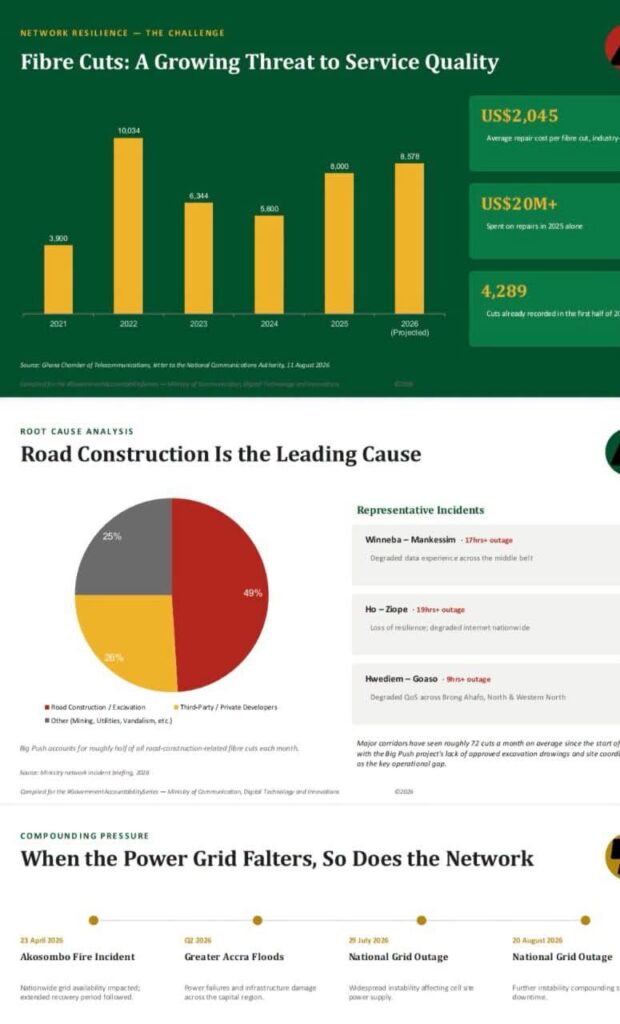
According to data presented by the sector Minister, road construction accounts for 49 per cent of all fibre line cuts. Third-party and private developers follow as the second major driver at 26 per cent, while other activities—including mining, utility works, and vandalism—make up the remaining 25 per cent.
The Minister revealed that the situation has severely impacted network quality, with major road corridors experiencing an average of roughly 72 cuts per month.
The problem is heavily driven by the lack of approved excavation drawings and proper site coordination during road construction under government infrastructure initiatives like the Big Push project.
Representative incidents highlighted during the presentation showed severe local service disruptions, including a 17-hour outage along the Winneba-Mankessim stretch, a 19-hour outage affecting the Ho-Ziope corridor, and an 11-hour outage on the Hwediem-Goaso line.
Addressing the financial impact on the telecommunications industry, Hon. Sam George disclosed that the average repair cost stands at $2,045 per fibre cut, bringing the total expenditure on repairs alone to over $20 million in 2025.
Data from the Ghana Chamber of Telecommunications shows that 4,289 cuts were recorded in the first half of 2026 alone, with full-year projections expected to reach 8,578 incidents—up from 8,000 cuts in 2025 and 5,600 in 2024.
The sector Minister further explained that the problem is compounded by instability in the national power grid, which directly impairs cell site power supply and delays network recovery periods during prolonged blackouts.
He expressed optimism that the proposed ‘dig once’ policy, when approved by Cabinet, will mandate synchronized utility installations along major transit routes, eliminating uncoordinated excavations and protecting telecommunications infrastructure.
By: Rainbowradioonline.com/Ghana