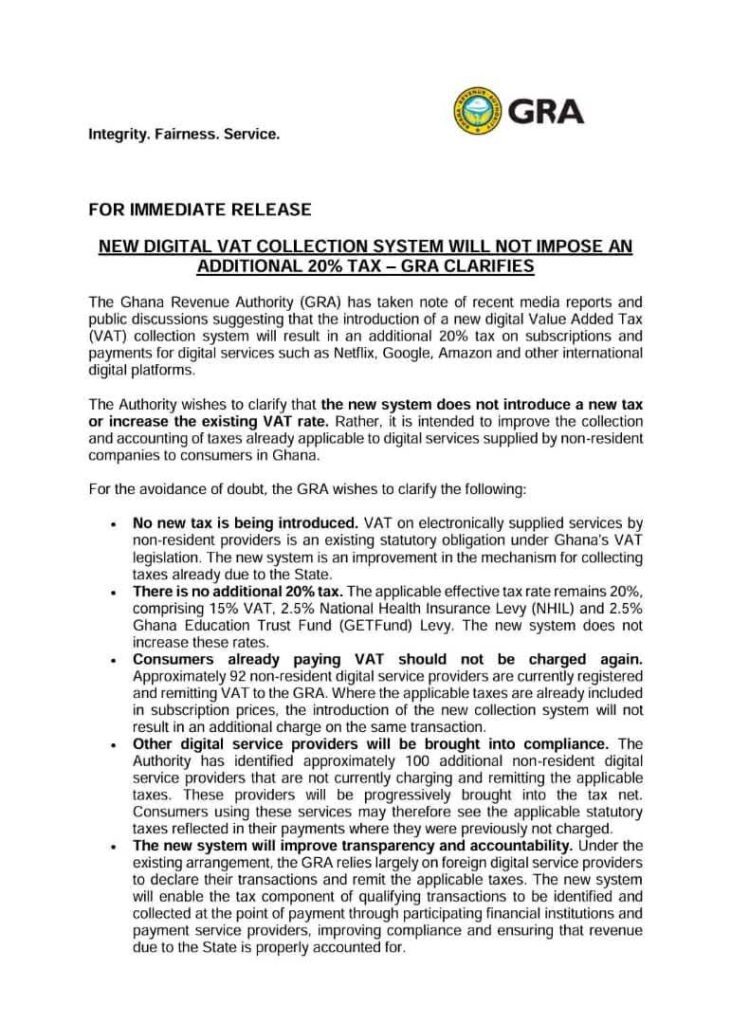
The Ghana Revenue Authority (GRA) has addressed growing public concerns and media reports regarding the implementation of its new digital Value Added Tax (VAT) collection system, clarifying that the policy does not introduce any new taxes or increase existing rates.
In an official statement released on Wednesday, 14th October 2026, the tax authority clarified that the mechanism is purely designed to streamline revenue collection from foreign digital service providers, rather than impose an additional 20% burden on consumers.
Addressing rumors surrounding subscription fees for international platforms such as Netflix, Google, and Amazon, the Authority emphasized that the applicable statutory charges remain unchanged.
“The Authority wishes to clarify that the new system does not introduce a new tax or increase the existing VAT rate,” the GRA stated. “Rather, it is intended to improve the collection and accounting of taxes already applicable to digital services supplied by non-resident companies to consumers in Ghana.”
Setting out the specifics of the taxation structure, the GRA explained that the effective tax rate on digital services stands at 20%, comprising 15% VAT, 2.5% National Health Insurance Levy (NHIL), and 2.5% Ghana Education Trust Fund (GETFund) Levy. The revenue body noted that these obligations already exist under Ghana’s current tax legislation.
The statement further reassured consumers who are already paying VAT on their digital subscriptions that they will not face double taxation. According to the Authority, approximately 92 non-resident digital service providers are already registered and remitting taxes. Where taxes are already built into subscription pricing, the new system will not trigger any extra fees on the same transaction.
However, the GRA disclosed that roughly 100 additional non-resident digital service providers have been identified for onboarding. Consumers using services from these hitherto uncompliant platforms may notice the statutory taxes reflected in their billing as those companies are progressively brought into the tax net.
Explaining the operational shift, the Authority stated that the new system will track and collect the tax component of qualifying transactions directly at the point of payment through participating financial institutions and payment service providers. This replaces the previous arrangement where the GRA relied largely on foreign entities to self-declare and remit taxes.
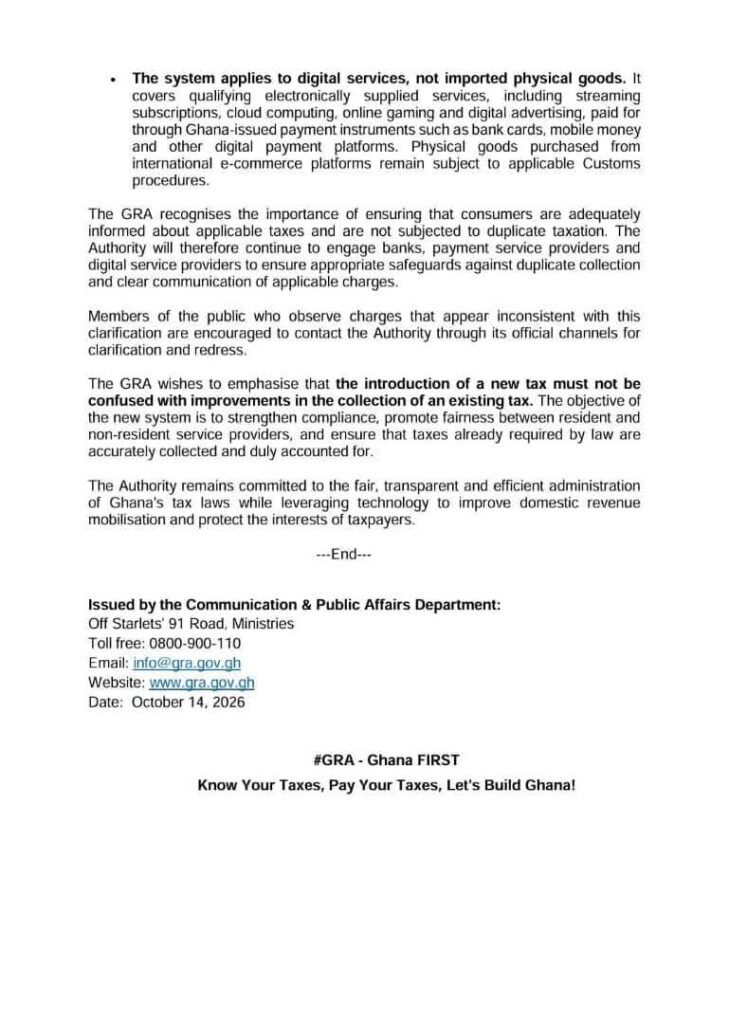
The GRA added that the mechanism applies strictly to electronically supplied services—such as streaming subscriptions, online gaming, cloud computing, and digital advertising—paid for via Ghana-issued payment cards, mobile money, or digital platforms. Physical goods bought from international e-commerce sites will continue to be processed under standard Customs procedures.
Reaffirming its commitment to fair administration, the GRA urged members of the public who observe inconsistent or duplicate charges to reach out through official channels for clarification and redress.
By: Rainbowradioonline.com/Ghana