
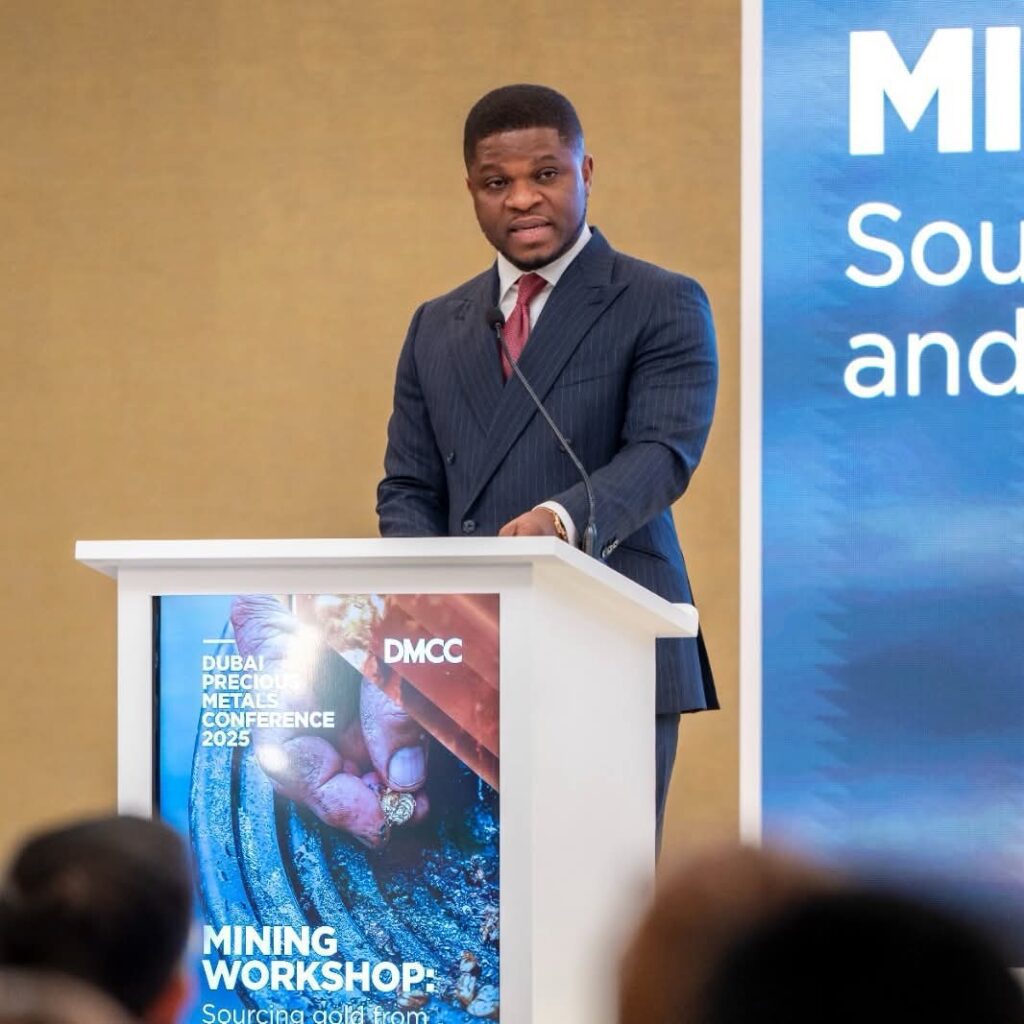
The Ghana Gold Board (GoldBod) has outlined an ambitious policy trajectory aimed at completely eliminating the export of raw gold from the country by the end of 2030, positioning value addition and domestic refining as central pillars of national economic transformation.
Delivering the keynote address at the African Minerals Policy Forum in Kumasi, Chief Executive Officer of the GoldBod, Sammy Gyamfi Esq., revealed that strategic partnerships with domestic refineries have already triggered significant gains in local processing. According to him, the GoldBod is aggressively shifting the historic paradigm of total raw material exports toward total incountry refining and value retention.
“Under the visionary leadership of H.E. President John Mahama, the GoldBod is fast-changing Ghana’s tragic story of 100% raw mineral export as at the end of 2024, to zero raw mineral export by the end of 2030. This is because the goal behind the establishment of the GoldBod is not merely to trade gold but to ensure that every ounce of gold produced in Ghana creates greater value for Ghanaians,” Mr. Gyamfi stated.
The Chief Executive noted that structural reforms within the small-scale gold sector have yielded immediate dividends for the national economy. Through targeted regulatory interventions, including the exclusion of foreign nationals from direct local gold trading and the implementation of a strict four-tier licensing regime, official gold exports from the artisanal and small-scale mining (ASM) sector surged significantly.
Highlighting the recent performance data, Mr. Gyamfi disclosed that between January 1 and October 20, 2026, the GoldBod aggregated and exported 85.4 tonnes of ASM gold valued at US11.6 billion, surpassing large-scale mining exports of 76 tonnes valued at US11.1 billion over the same duration. He added that local refining capacity has experienced exponential growth within the period, with over 94 percent of ASM gold purchased in October 2026 processed domestically through agreements with local refineries.
Addressing the broader macroeconomic impact, the GoldBod Chief explained that official aggregation and foreign exchange repatriation from the small-scale mining sector played a decisive role in strengthening national reserves and supporting foreign exchange market stability. He emphasized that the regulatory framework achieved a critical recovery of gold previously lost to illicit channels and cross-border smuggling.
“The Ghana Gold Board did not create gold that did not exist or was not already being produced; through reforms it achieved what I call a production claw back – recovering into the official economy, gold that was already being produced but was previously lost to smuggling and the illegal gold trade,” he explained.
To further safeguard supply chain integrity and adhere to international standards, the GoldBod is currently undertaking a competitive procurement process for a blockchain-based track-and-trace system expected to be finalized before the end of the year. The system will track gold from its point of origin through the aggregation network to ensure responsible sourcing in alignment with international guidelines.
Mr. Gyamfi called for enhanced continental collaboration to ensure African nations retain maximum value from their mineral wealth, stressing that mineral resource endowment must directly translate into job creation and sustainable economic opportunities for the continent’s population.
“Mineral wealth does not automatically become national wealth. Geology creates potential. Policy decides who should benefit. Institutions decide whether value is retained or lost. And leadership decides whether a mineral boom becomes a passing statistic or the foundation of lasting transformation,” he added.
By: Rainbowradioonline.com/Ghana