The Minerals Commission has warned Northern Ashanti Mines Limited to cease waging a public media campaign over the revocation of its operational authorisations and instead fight its legal battles in court.
The state regulator simultaneously confirmed plans to aggressively pursue the mining firm to recover US$8.38 million in unremitted statutory fees owed to the state.
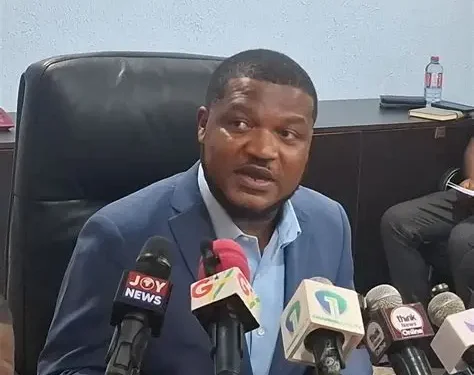
Addressing journalists at a media briefing on Thursday, October 29, the Chief Executive Officer of the Minerals Commission, Isaac Tandoh, condemned the mining entity for pursuing legal redress while simultaneously attempting to sway public opinion through the press.
“The company duly acknowledged receipt of the termination notice and yet it has chosen the courts. So we advise that they should pursue the courts and not the court of public opinion,” he said.
Mr Tandoh dismissed claims that the firm was pursuing an amicable resolution, arguing that simultaneous litigation and media posturing undermined judicial integrity.
“We state plainly, a company that sues the Honourable Minister, the Minerals Commission and the Attorney General is not a company that is seeking dialogue. It is a company seeking to litigate in court and in the media simultaneously. This is improper, and it is contemptuous of the judicial process,” he said.
The confrontation follows a joint enforcement operation on Thursday, October 22, when Commission officials, supported by military personnel, entered the company’s concession to enforce the cancellation of its operational leases.
The regulatory sanctions were triggered by the company’s failure to conduct active mining operations for over two years and its persistent default on statutory payments. According to the regulator, Northern Ashanti Mines accumulated US8.33 million in unpaid Annual Mineral Right (AMR) fees for its mining leases between 2010 and 2025, alongside US49,928 in prospecting licence arrears spanning 2019 to 2025.
Mr Tandoh emphasized that the regulatory actions strictly adhered to the Minerals and Mining Act, 2006 (Act 703), the Minerals and Mining (Licensing) Regulations, 2012 (L.I. 2176), and contractually binding lease terms.
“The Minerals Commission acted lawfully and followed due process at every stage. The company was given several opportunities to regularise its position, but they chose not to do so,” he said.
Reaffirming the state’s resolve to claw back all outstanding debts and safeguard reclaimed concessions against illegal encroachment, Mr Tandoh stressed that the revocation of rights does not erase pre-existing debt liabilities.
“The Minerals Commission reserves the right and shall pursue the company to pay the full sums it owes to the state,” he insisted.
“Once the annual mineral rights were terminated, they reverted to the state as a lawful owner without prejudice to all the liabilities assumed by the company prior to termination, including the substantial indebtedness,” he said.
He concluded by reiterating that national mineral resources belong to the Ghanaian public, and the Commission will not be swayed by external public relations efforts from holding titleholders to their legal responsibilities.
By: Rainbowradioonline.com/Ghana