
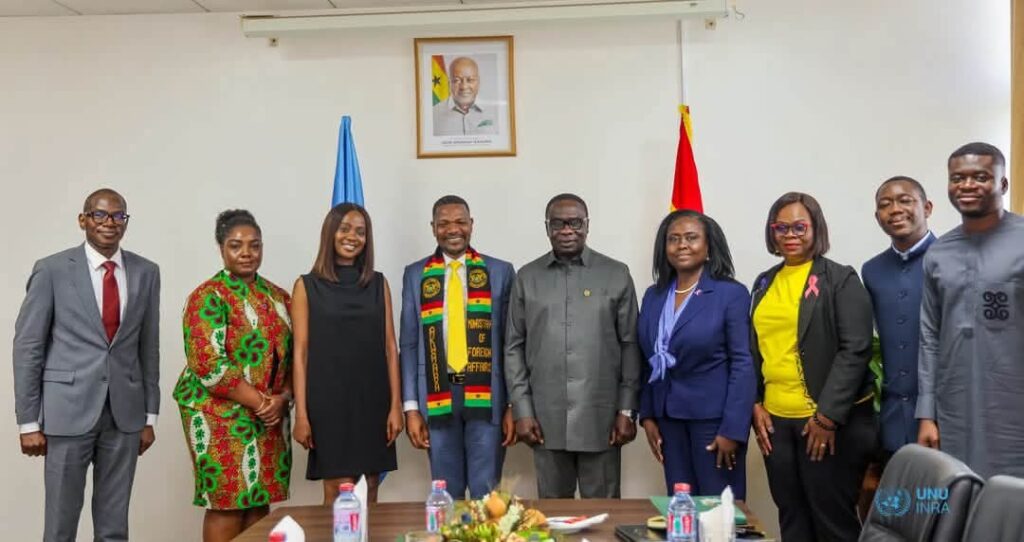
Ghana has reaffirmed its commitment to supporting institutions dedicated to advancing the continent’s socio-economic development, with a call for African nations to take stronger financial ownership of institutions established to resolve local challenges.
Deputy Minister for Foreign Affairs, James Gyakye Quayson, made the call in Accra when he received Open Letters from the newly appointed Director of the United Nations University Institute for Natural Resources in Africa (UNU-INRA), Dr Richard Munang.
The meeting focused on strengthening UNU-INRA’s mandate as an African-led research institution capable of generating evidence-based policy solutions to environmental and development hurdles facing Ghana and the wider continent.
Receiving the letters, Mr Gyakye Quayson expressed concern over Africa’s continued reliance on external donors to fund institutions designed to tackle local problems, urging African governments to step up financial commitments to drive sustainable growth.
He described proposals to reposition UNU-INRA as a fully self-reliant African institution as laudable, assuring that the outcome of the discussions would be brought to the attention of the Sector Minister and the Presidency.
The Deputy Minister observed that pressing challenges such as persistent flooding, environmental degradation, and water pollution cross national borders, making enhanced regional cooperation essential.
He assured Dr Munang of the Foreign Ministry’s firm backing and urged the institute to deepen ties with local academic and state institutions to ensure research findings translate into practical policies.
Outlining his vision, Dr Munang revealed that UNU-INRA is currently partnering with relevant state bodies in Ghana to develop an advanced early-warning system for flood management. The mechanism aims to establish critical environmental thresholds that enable state agencies to trigger preventive actions before vulnerable communities suffer damage.
Dr Munang also drew attention to ongoing interventions targeting sustainable mining and the protection of water bodies, stressing the need for robust monitoring mechanisms to curb the devastating impact of illegal mining activities on aquatic ecosystems.
He argued that African countries must take complete ownership of their data, research, and natural wealth to guarantee that solutions are tailored specifically to the continent’s unique requirements.
Dr Munang expressed gratitude to the Ghanaian government for its warm reception and reiterated his determination to work alongside Ghana and other African nations to position UNU-INRA as a cornerstone for climate resilience, natural resource management, and sustainable development.
By” Rainbowradioonline.com/Ghana