
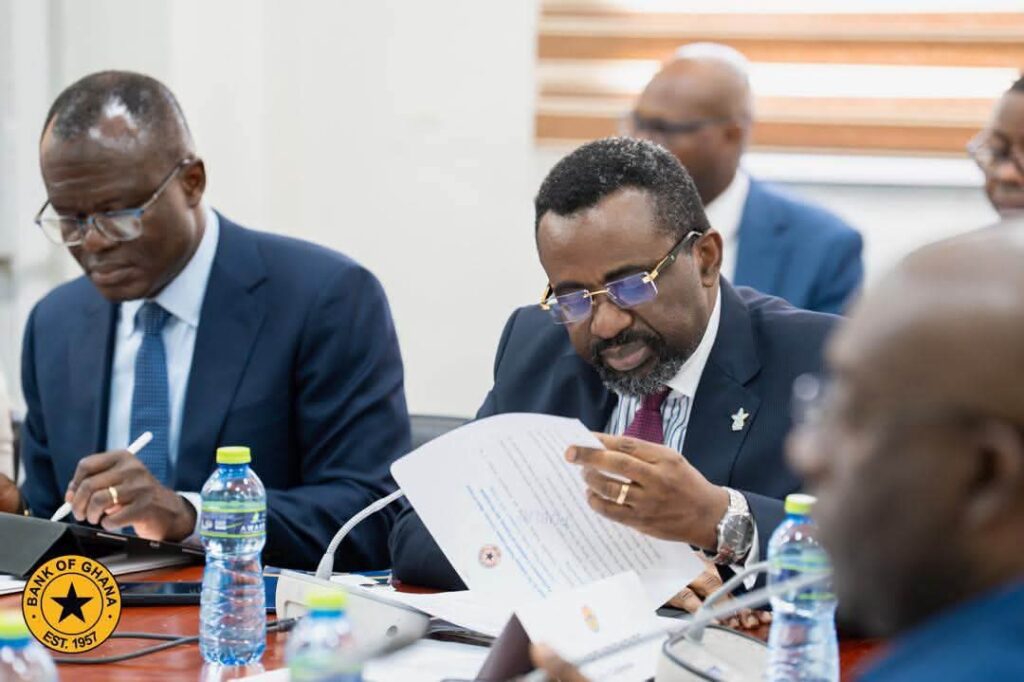
The Governor of the Bank of Ghana, Johnson Pandit Asiama, appeared before the Parliamentary Committee on Economy and Development to deliver a comprehensive update on monetary policy and macroeconomic developments for the first half of 2026.
Addressing lawmakers in Parliament, Dr Asiama highlighted the central bank’s strategic monetary policy decisions aimed at maintaining domestic economic stability.
He explained that after lowering the Monetary Policy Rate from 18.0 per cent to 14.0 per cent across January and March, the Bank opted to hold the rate steady at 14.0 per cent during its May, July, and September meetings.
The hold was necessary to cushion the economy against rising global oil prices and persistent domestic price pressures.
Dr Asiama reported robust expansion in real gross domestic product, which grew by 6.4 per cent in the first quarter of the year. Headline inflation showed significant moderation, dropping to 3.2 per cent in March before inching up to 5.3 per cent in June. Despite the mid-year uptick, inflation remained comfortably below the central bank’s target band of 6 to 10 per cent.
The Governor pointed to notable ease in domestic credit conditions, noting that average commercial bank lending rates plunged from 27.0 per cent down to 15.6 per cent.
This sharp reduction in borrowing costs spurred commercial activity, driving credit growth to the private sector up by 41.2 per cent over the period.
On the external front, Ghana’s trade balance remained firmly in positive territory, generating a trade surplus of US8.81 billion alongside a current account surplus of US5.1 billion.
The country’s international gross reserves stood at US$12.94 billion, providing roughly 5 months of import cover.
Ghana’s banking sector also registered solid performance metrics.
Total balance sheet assets expanded by 30.7 per cent to hit GH¢502.4 billion, while the industry’s Capital Adequacy Ratio remained strong at 20.4 per cent. Asset quality showed marked improvement, with the ratio of non-performing loans falling from 23.1 per cent to 16.1 per cent.
Outlining key structural reforms, the Governor detailed the implementation of a uniform Cash Reserve Ratio of 20 per cent and the adoption of a transparent, rules-based foreign exchange intervention framework.
He further introduced the Ghana Accelerated National Reserve Accumulation Programme (GANRAP), an ambitious strategy designed to boost the nation’s reserve buffer to 15 months of import cover by 2028.
Closing his presentation, Governor Asiama reaffirmed the central bank’s unwavering commitment to maintaining price stability, enhancing operational transparency, and ensuring strict accountability to Parliament and the wider Ghanaian public.
By: Rainbowradioonline.com/Ghana