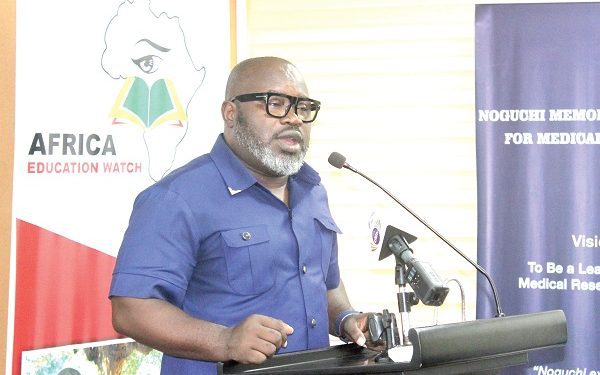
The Ghanaian government is demonstrating a “clearer purposive intentionality” toward inclusive education through a series of unprecedented financial reforms, according to a leading education policy advocate.
Kofi Asare, the Executive Director of Africa Education Watch (Eduwatch), stated that recent policy shifts over the past 18 months signal a deliberate reorientation toward supporting learners with disabilities.
Among the central interventions is a crucial legislative reform ensuring reliable funding.
“I am seeing clearer purposive intentionality in the government’s approach to inclusive education,” Mr Asare said, highlighting the amendment of the Ghana Education Trust Fund (GETFund) Act to ring-fence annual funding specifically for the education of Persons with Disabilities (PWDs). This includes a targeted allocation of GH¢100 million (£5.3m) for 2026, a move he described as “unprecedented.”
The policy shift also targets higher education, introducing free tertiary education for PWDs that covers both full tuition and residential support.
The initiative aims to eliminate systemic financial barriers that have historically locked disabled students out of advanced academia.
According to Mr Asare, the intervention is already yielding measurable results, with approximately 1,540 learners benefitting from the scheme so far.
Additionally, the government has addressed immediate welfare needs in basic education by implementing an 87.5% increase in the daily feeding grant for special schools, raising it from GH¢8 to GH¢15 per learner.
The adjustment is designed to directly improve nutrition and overall student welfare in state-supported special institutions.
While the civil society group welcomed the multi-tiered financial injection, he warned that policy design must be matched by structural efficiency to achieve long-term success.
Ghana’s educational sector has frequently been plagued by administrative bottlenecks and delayed budget releases.
“Taken together, these measures within the past one and half years reflect a deliberate reorientation toward a more inclusive education financing and support architecture for learners with disabilities,” Mr Asare noted.
However, he cautioned that the true test of the reforms lies in their execution. “While these steps are welcome, sustained results will depend on consistency, efficiency, and timely disbursement of funds.”
Below is the full Facebook
I am seeing clearer purposive intentionality in the government’s approach to inclusive education:
- Amendment of the GETFund Act to ring-fence annual funding for PWDs education, including GH¢100 million in 2026. (Unprecedented)
- Free tertiary education for Persons with Disabilities, covering full tuition and residential support to remove financial barriers and promote equitable access. So far, about 1,540 learners have benefitted. (Unprecedented)
- An increase in the daily feeding grant for special schools from GH¢8 to GH¢15 per learner (an 87.5% increase), aimed at improving nutrition and learner welfare.
Taken together, these measures within the past one and half years reflect a deliberate reorientation toward a more inclusive education financing and support architecture for learners with disabilities.
While these steps are welcome, sustained results will depend on consistency, efficiency, and timely disbursement of funds.
‘When the community adjusts its road, no traveler is left behind.’-Larteh Proverb!
By: Rainbowradioonline.com/Ghana