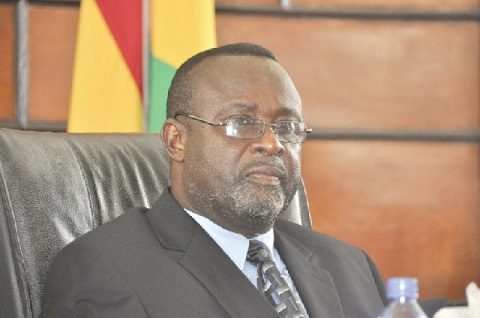
Chief Justice Paul Baffoe-Bonnie has firmly rejected claims that lawyers have the right to refuse appearing in court simply because proceedings are scheduled during the annual legal vacation.
According to him, a judge who is sitting and prepared to hear a matter cannot be hindered merely because counsel has made personal plans during the vacation window.
Addressing the 2nd Quadrennial Delegates Congress of the Senior Staff Association of the Judicial Service of Ghana in Sunyani, Bono Region, the Chief Justice clarified that lawyers are only entitled to take time off if their clients explicitly grant them leave to do so.
“You cannot say that there is legal vacation, so a judge who is actually sitting and ready to do your case cannot do it. No, that’s not it,” he declared.
Justice Baffoe-Bonnie took issue with the practice where lawyers notify the Chief Justice that a case should not proceed on account of their pre-scheduled personal arrangements.
“To write to the Chief Justice to say that the cases should not be adjourned to the vacation, so I am not coming, I have already made arrangements outside, so I am not coming.
“You are a lawyer, you have your clients. If your clients decide to give you leave, well, go on leave, but you cannot say that there is a legal vacation and the judge who is actually sitting cannot do your case. No, that is not it,” he stated.
Furthermore, the Chief Justice emphasised that decisions regarding court adjournments fall strictly under the judicial discretion of the presiding judge rather than the administrative remit of the Chief Justice.
“No, adjournments are not at the instance of the Chief Justice. Adjournment is a judicial act. This is something that is so basic,” he noted.
His remarks follow a formal petition sent by the Ghana Bar Association (GBA) expressing strong concerns over lawyers being required to appear before courts during the vacation period.
In its letter dated August 10, 2026, the GBA contended that legal practitioners who have communicated their unavailability during this period should not be forced to attend court sessions.
The GBA highlighted that its petition was prompted by grievances from law firms including Zoe, Akyea & Co, Dame & Partners, and Sam Okudzeto & Associates regarding notices compelling counsel to appear before designated judges handling part-heard criminal cases during the break.
Citing Order 79, Rule 4 of the High Court (Civil Procedure) Rules, 2004 (CI 47), the Bar Association pointed out that the High Court observes three distinct vacations annually, with the main break running from August 1 to September 30.
This period, the GBA noted, is designed to afford judges, legal practitioners, and court personnel a much-needed respite following the intense second term of the legal year.
While acknowledging that designated Vacation Courts and Virtual Courts remain open to hear urgent matters such as interlocutory applications, the GBA maintained that full trials are typically not held during the recess.
The Association further argued that a lawyer’s willingness and availability must be a key factor in deciding whether a court matter goes forward.
“Once Counsel in a matter indicates their unavailability to attend Court during the vacation, even though the Court may have listed their case, it cannot proceed with the case in any way,” the GBA stated.
Additionally, the GBA insisted that litigants in both civil and criminal matters should not be forced to represent themselves in the absence of their legal counsel during the legal vacation.
The standoff has sparked an intense legal debate over the boundaries of court proceedings during the official vacation period.
Weighing in on the matter, Deputy Attorney-General and Minister for Justice, Dr Justice Srem-Sai, supported the view that the authority to determine whether court proceedings continue rests squarely with the bench, not counsel.
By: Rainbowradioonline.com/Ghana