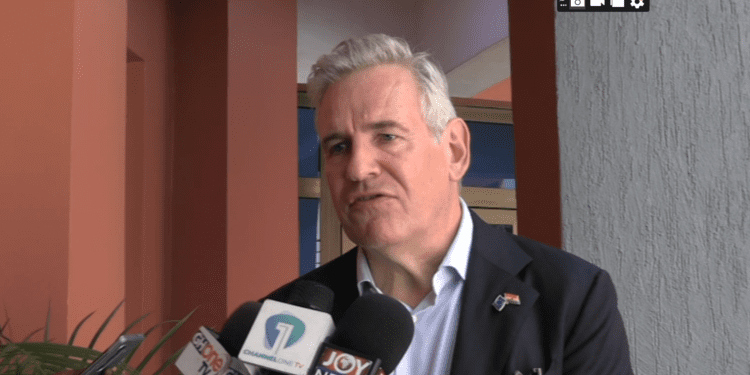
The European Union (EU) Ambassador to Ghana, Rune Skinnebach, has admonished the nation to preserve its economic and political stability to secure further European investment.
Speaking at a Career Service Centre programme at the Kwame Nkrumah University of Science and Technology (KNUST) on Thursday, 14 May 2026, the Ambassador noted that such stability is essential for Ghana to maintain its status as a premier investment hub within the region.
Ambassador Skinnebach observed that while Ghana’s current stability is promising, sustaining investor confidence necessitates a steadfast commitment to economic reform and robust governance, particularly during electoral cycles.
He also warned that instability within the Sahel and adjacent territories could potentially jeopardise Ghana’s peace and security.
He reaffirmed the EU’s dedication to assisting Ghana in safeguarding its democratic foundations and developmental milestones.
The Ambassador emphasised that Ghana’s democratic freedoms should serve as a tool for citizens to demand greater accountability from political leaders and public bodies.
Furthermore, he encouraged the country to utilise the European Union’s Global Gateway Investment Package for Africa to enhance development financing and draw in strategic capital.
“Since 2022, the EU has established what we call the Global Gateway Investment Package for Africa, 150 billion euros. This is a huge amount, of course. It’s a merger of traditional development financing, international financial institutions’ financing, and private sector investments,” he said.
While acknowledging that the European Union remains Ghana’s primary investor, export market, and development partner, the Ambassador stressed that future capital inflows are contingent upon the maintenance of an appealing business environment.
“Today, the biggest investor in Ghana is the EU. And the EU is the biggest export market for Ghana also. We’re also the biggest development partner,” he stated.
He concluded that Ghana must prioritise the reinforcement of its macroeconomic stability, infrastructure, legal frameworks, and overall business climate to ensure it remains competitive against regional rivals.
“It has to make sure that it has the required political and macroeconomic stability, that they have the business-friendly climate, that they have the functioning infrastructures, that make the legal frameworks, that makes itself attractive for European investors,” he said.
“If that is in place, then the European investors will come. If it’s in place, but not as good as in neighbouring countries, then the European investors will go to neighbouring countries,” he added.
By: Rainbowradioonline.com/Ghana