A fierce budgetary dispute has erupted between two of Ghana’s key state institutions, as the Ministry of Food and Agriculture (MOFA) publicly accused the Ministry of Finance of fabricating financial data and using “infantile propaganda” to mislead the public about agricultural funding.
The conflict stems from a recent claim by the Ministry of Finance asserting it had released GH¢1.6 billion to MOFA, a figure it claimed represents 85 percent of the agriculture ministry’s total budget allocation for 2026.
In a sharply worded response released by Samuel Huntor, the Media Liaison Officer for the Office of the Minister for Food and Agriculture, MOFA stated that the finance ministry’s public narrative directly contradicts its own official budget execution documents.
According to MOFA, the treasury has actually starved critical food security programs of necessary funding while artificially inflating figures in the media.
“Public financial management is governed by official allotments, cash releases, and actual budget availability—not by public relations narratives or propaganda,” Huntor stated.
“The Ghanaian people deserve transparency, accuracy, and honesty in the management of public finances, particularly in a sector as critical as agriculture and food security.”
According to the official timeline provided by agricultural officials, the Ministry of Finance issued a Commitment Authorization to MOFA on February 15, 2026.
However, just four days later, the treasury issued a First and Second Quarter Budget Allotment Letter that effectively nullified the previous authorization.
This second document explicitly capped MOFA’s total expenditure for the entire first half of 2026 at GH¢910 million.
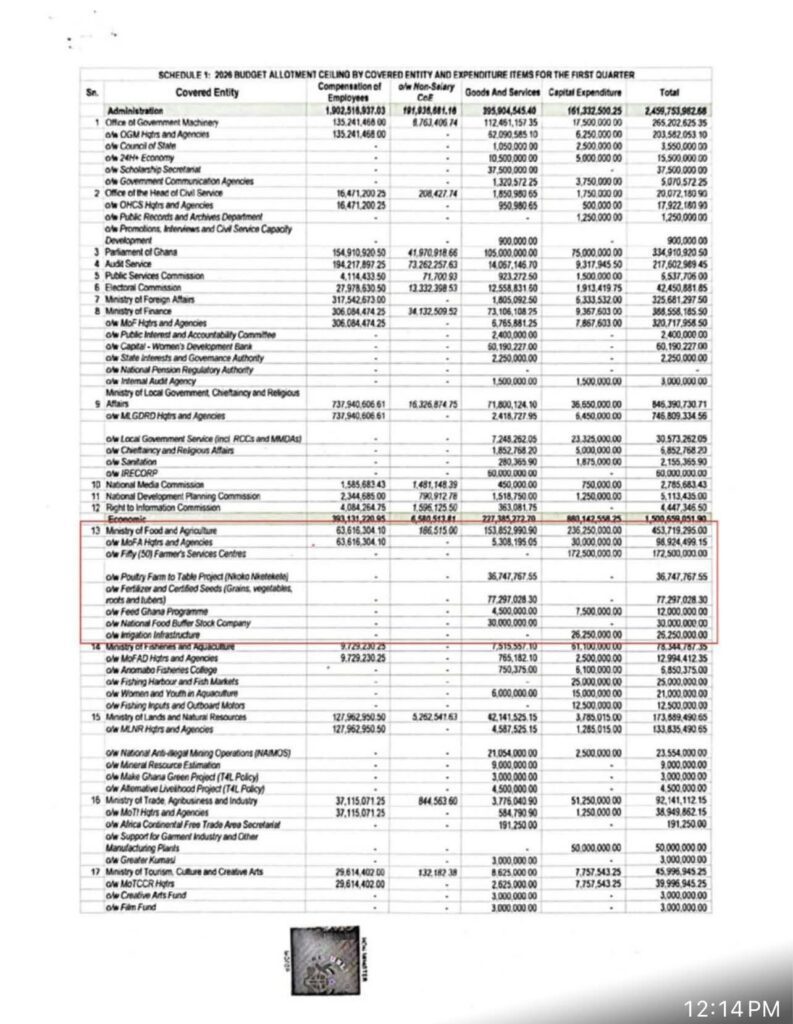
Furthermore, internal allotment schedules reveal that actual spending allowed between January and June was restricted even further, down to approximately GH¢453 million.
This limited sum was forced to cover all ministerial operations, including staff compensation, existing contract commitments, and national agricultural interventions.
The strict caps have left vital national farming initiatives operating on fractions of their expected budgets. Official records show that out of the alleged billions, the Farmer Service Centres received only GH¢172.5 million, while the Fertiliser and Certified Seeds initiative was allocated just GH¢77.2 million. Other critical programs suffered even harsher constraints, with the National Food Buffer Stock Company receiving GH¢30 million, the Irrigation Infrastructure project getting GH¢26.2 million, and the Feed Ghana Programme left with a meager GH¢4.5 million.
The Nkokonkitinkiti Programme was allocated roughly GH¢36.7 million.
MOFA insists that it has received no subsequent communications or authorizations from the finance ministry to validate the claims of a GH¢1.6 billion injection.
Officials have now challenged the treasury to explain the massive discrepancy between its public declarations and its restrictive legal directives.
“The question, therefore, remains straightforward,” Huntor noted in the briefing.
“If the Ministry of Finance officially capped MOFA’s spending through its allotment system and has not issued any subsequent authorisation, where exactly is this GH¢1.6 billion figure coming from?”
To back its pushback, the agriculture ministry has taken the unusual step of attaching the treasury’s own confidential allotment letters and internal schedules to its public statement, daring the finance ministry to dispute its own paperwork. “The facts speak for themselves,” the ministry concluded.



By: Rainbowradioonline.com/Ghana