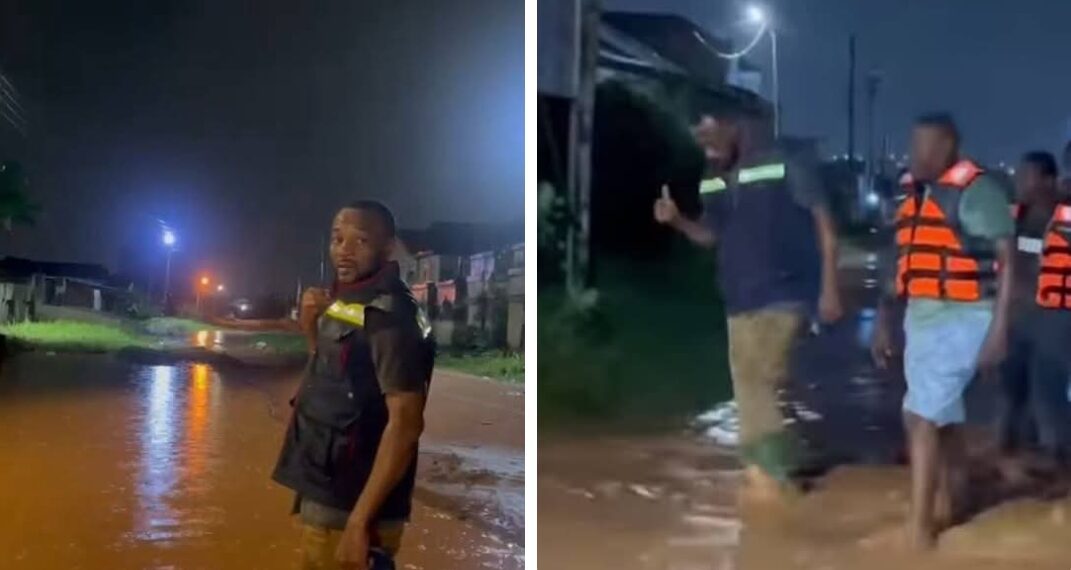
Weija-Gbawe Member of Parliament and Second Deputy Minority Whip Jerry Ahmed Shaib has called on Parliament to establish a comprehensive Greater Accra Flood Resilience Plan to end the country’s continuous cycle of disaster, relief, and reconstruction.
Weija-Gbawe Member of Parliament and Second Deputy Minority Whip Jerry Ahmed Shaib has called on Parliament to establish a comprehensive Greater Accra Flood Resilience Plan to end the country’s continuous cycle of disaster, relief, and reconstruction.
He emphasised that the nation needs to move past the repetitive pattern of catastrophe followed by temporary aid and rebuilding, suggesting instead a fundamental shift in how the country manages its water resources.
The lawmaker stressed that relying on temporary, seasonal crisis management is insufficient.
“I therefore call for the development of a comprehensive Greater Accra flood resilience plan. A long term strategy that moves us beyond seasonal emergency responses and addresses flooding at its roots.”
To achieve this, he proposed an integrated approach combining the expertise of engineers, climate experts, city planners, municipal bodies, local chiefs, and citizens.
Hon. Shaib detailed a five-pronged approach to tackle the crisis. This framework involves technical engineering alongside crisis readiness, which encompasses updating drainage infrastructure, routine clearing of waterways, and refining weather prediction and emergency reaction mechanisms.
He also championed ecological tactics like safeguarding and reviving wetlands, conserving floodplains, and establishing green spaces to retain water naturally.
Furthermore, he highlighted the need for intelligent city growth through climate-conscious construction laws, hydrological assessments, rainwater collection mechanisms, and restrictions on widespread concrete paving.
Community involvement and a shift in public habits form another cornerstone of his proposal.
“Flood resilience is not only an engineering challenge. It is a shared responsibility. It requires stronger public education, responsible waste disposal, respect for natural drainage pathways and active community leadership.”
He pointed to specific cultural habits that exacerbate the issue, noting that:
“Plastic waste and indiscriminate dumping continue to block our drains Mister Speaker and worsen flooding.”
He called for robust oversight and institutional accountability, demanding transparent organizational roles, dependable financing, quantifiable objectives, and periodic updates to Parliament to keep flood mitigation at the forefront of national policy.
The representative focused heavily on the tragic human consequences of political passivity, noting that investing in preventative measures is far more economical than repairing destroyed property and public systems.
“But while buildings can be reconstructed and roads can be repaired, the lives lost can never be recovered. This is the true cost of our inaction.”
According to Hon. Shaib, the challenges faced by Weija-Gbawe and the broader capital region demand more than just widening concrete gutters.
“The lesson is that we need a new relationship with water. Mr Speaker, the emphasis is that we need a new relationship with water.”
He criticized the historical approach of viewing water as an adversary to be diverted.
He observed that global cities successfully managing this issue have learned to accommodate water, align with ecological processes, and architect neighborhoods capable of enduring shifting climate realities.
“Let this parliament not be remembered merely for how many times it’s debated floods after they occurred. Let it be remembered as the parliament that changed Ghana’s approach to flood management from a cycle of disaster, relief, and reconstruction to a future built on prevention, resilience, and responsible development.”
He wrapped up his address by stating that the citizens of his constituency, the capital, and the entire nation are entitled to effective leadership and secure, flood-free homes.
By: Rainbowradioonline.com/Ghana