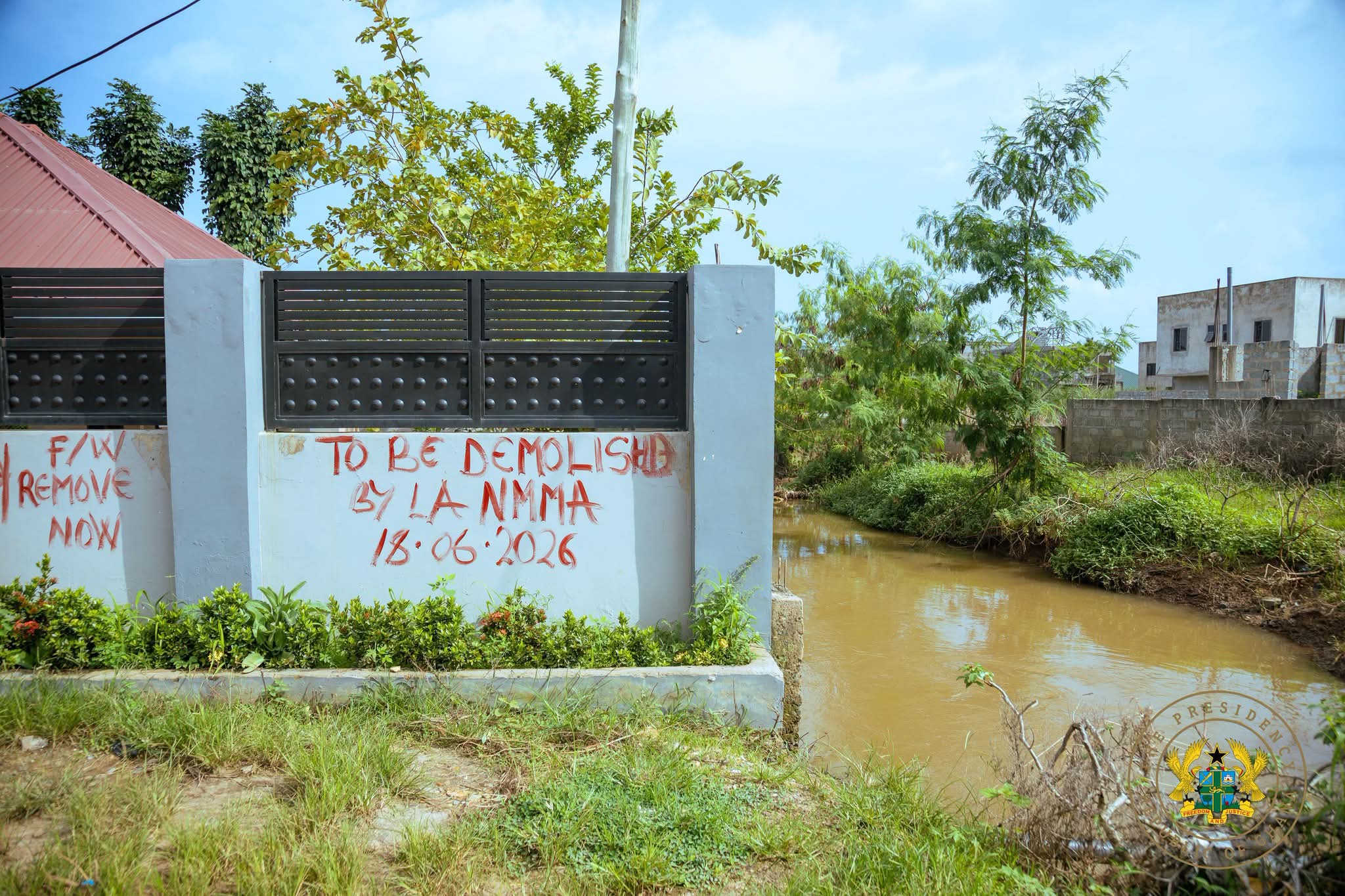
The Ghana Institute of Planning (GIP) has forcefully renewed calls for a structural overhaul in how the country tackles its perennial flooding crisis, insisting that the scale of destruction witnessed across the country is primarily a man-made failure of law enforcement rather than an inevitable natural disaster.
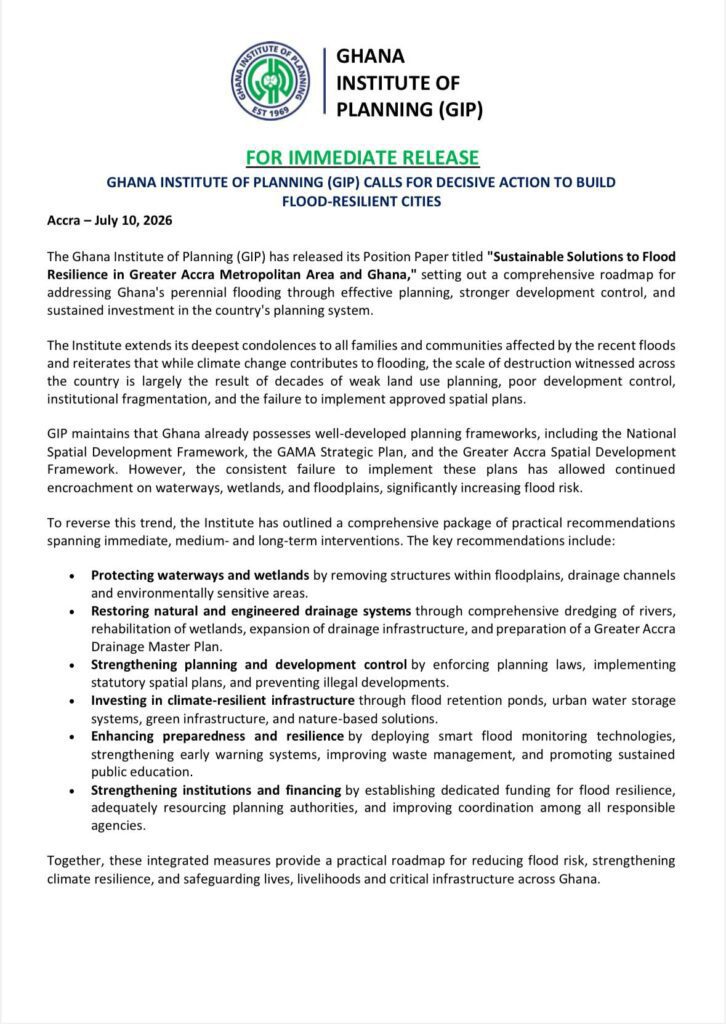
In a sharply worded position paper titled “Sustainable Solutions to Flood Resilience in Greater Accra Metropolitan Area and Ghana,” the Institute argued that while climate change plays a role, decades of institutional failure have left major cities highly vulnerable.
“The scale of destruction witnessed across the country is largely the result of decades of weak land use planning, poor development control, institutional fragmentation, and the failure to implement approved spatial plans,” the GIP stated.
According to the Institute, Ghana is not short on technical blueprints to solve the drainage crisis.
The country already possesses robust frameworks, including the National Spatial Development Framework, the GAMA Strategic Plan, and the Greater Accra Spatial Development Framework. However, these documents have largely gathered dust while political will falters.
The GIP observed that “the consistent failure to implement these plans has allowed continued encroachment on waterways, wetlands, and floodplains, significantly increasing flood risk”.
To arrest the situation, the GIP has outlined a comprehensive package of immediate and long-term interventions. Top on the agenda is the aggressive protection of waterways and wetlands through the demolition and removal of illegal structures standing within floodplains and drainage channels.
The planners are also demanding the restoration of both natural and engineered drainage systems. This includes the comprehensive dredging of rivers, rehabilitation of depleted wetlands, expansion of existing drainage infrastructure, and the immediate drafting of a Greater Accra Drainage Master Plan.
Beyond physical infrastructure, the GIP is advocating for a technological shift, urging authorities to deploy smart flood monitoring technologies and strengthen early warning systems to safeguard lives.
The Institute maintains that the current approach of reactionary governance must end if the country is to make any real progress.
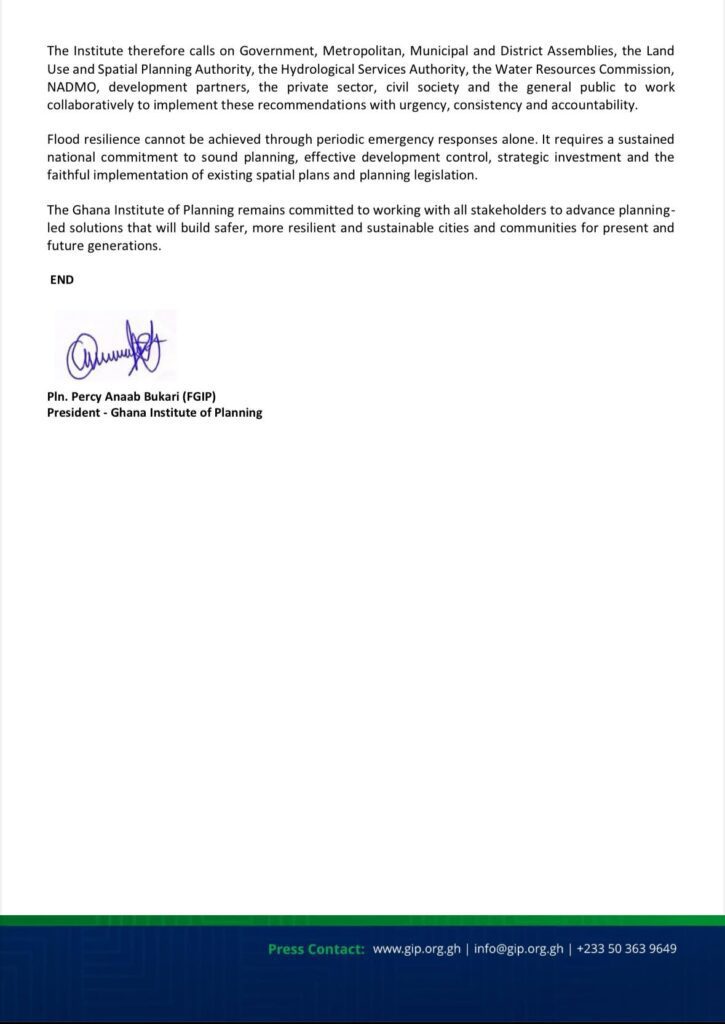
“Flood resilience cannot be achieved through periodic emergency responses alone,” the GIP cautioned. “It requires a sustained national commitment to sound planning, effective development control, strategic investment and the faithful implementation of existing spatial plans and planning legislation”.
The GIP, signed by its President, Pln. Percy Anaab Bukari (FGIP), called on the central government, Metropolitan, Municipal, and District Assemblies (MMDAs), the Land Use and Spatial Planning Authority (LUSPA), the Hydrological Services Authority, and the National Disaster Management Organisation (NADMO) to immediately coordinate their efforts.
The planners warned that without urgency, consistency, and strict accountability from all state actors, major urban centers will remain locked in a cycle of avoidable devastation.
By: Rainbowradioonline.com/Ghana